Architecture firms used to draft. They had tables, parallel rules, lead holders, mylar, and a system for stacking 2D drawings until the building was completely described. The drafting era ended quietly over the last twenty years. What replaced it is something fundamentally different · a coordinated 3D model from which all drawings are extracted, with every wall, window, door, and finish carrying enough data to schedule the building rather than just draw it. That replacement is what the industry calls architectural BIM services.
For most architecture firms today, the choice is no longer between drafting and BIM. It is between staffing architectural BIM services in-house at full cost, or partnering with an external BIM team that does the modeling work while the architect’s design team focuses on design intent, client relationships, and stamped deliverables. That second model · outsourced architectural BIM modeling supporting the firm’s design team · is increasingly the default for small and mid-size firms that win larger projects than their staff can model from scratch. The economics of architectural BIM services tilt toward partnership rather than in-house build-out for any firm running fewer than 8 to 10 concurrent BIM projects.
This article is the complete guide to architectural BIM services in 2026. What they are. How they differ from traditional 2D drafting. What gets included in the architectural BIM modeling scope. The SD-DD-CD-CA workflow phase by phase. The software stack (Revit, ArchiCAD, AutoCAD). The typical deliverables architects expect. The Revit family content libraries that make a firm’s BIM operation scalable. When architecture firms outsource the work. And how Eagle BIM supports architecture firms across Texas and the United States.
Two related Eagle BIM articles set context for what follows: BIM Level of Development (LOD) explains the LOD 100 through LOD 400 progression that anchors every architectural BIM services engagement, and What Is BIM Coordination explains how the architectural model coordinates with structural and MEP teams during CD.
What Are Architectural BIM Services
| Architectural BIM services are the modeling, documentation, and coordination work an architect performs (or outsources) using Building Information Modeling software like Autodesk Revit or Graphisoft ArchiCAD. They cover everything from concept massing through stamped construction documents and construction-administration support · all generated from a single coordinated 3D model rather than drawn separately as 2D sheets. Architectural BIM modeling replaces traditional drafting with parametric, data-rich elements that produce plans, sections, elevations, schedules, and renderings simultaneously from one source. |
Architectural BIM services are a category of professional services, not a single deliverable. The category includes modeling (creating the building in 3D), documenting (generating contract drawings from the model), coordinating (resolving conflicts with structural and MEP), managing content (Revit families, types, and standards), and supporting construction administration after the documents are issued. A firm offering complete architectural BIM services touches all five of these activities. A firm contracting for architectural BIM services might engage an external partner for one, several, or all of them depending on capacity and project complexity.
The fundamental shift architectural BIM services represent is not 3D versus 2D · it is parametric data versus drawn lines. In a 2D drafted plan, a wall is a pair of parallel lines with a number written nearby saying the assembly is 8 inches thick. In a BIM model, the same wall is an actual database object with a wall type (Generic Interior 5⅛-inch), an assembly (one layer of GWB, metal stud framing, another layer of GWB), a fire rating (1 hour per UL U419), an acoustic rating (STC 50), a height (10 feet), and so on. Every drawing the wall appears in · plan, section, elevation, 3D view, schedule · references the same object. Edit the wall once and every drawing updates.
Architectural Revit modeling is the most common implementation of architectural BIM services in North America. Autodesk Revit dominates the US architectural BIM market with deep parametric capability and tight integration with structural and MEP Revit. ArchiCAD by Graphisoft holds a significant share in Europe and parts of Asia and is gaining traction with US firms working on international projects. AutoCAD persists in some firms for 2D drafting tasks, civil work, and small-scale projects, but it is no longer the primary tool for delivering full architectural BIM services on building projects of any meaningful scale.
The legal framework around architectural BIM services in the United States is anchored by the AIA’s Digital Practice Documents. AIA Document E201-2022 (BIM Exhibit for Sharing Models with Project Participants, Where Model Versions May be Enumerated as a Contract Document) is the current exhibit that sets the parties’ expectations for use of BIM on a project. It works with AIA G203-2022, the BIM Execution Plan, which captures the granular protocols for model sharing, versioning, and Level of Development. Internationally, the RIBA Plan of Work 2020 provides an equivalent staged framework that maps reasonably well to the AIA SD-DD-CD-CA phases.
Architectural BIM vs Traditional 2D Drafting
| Traditional 2D drafting produces drawings only · separate plan, section, and elevation sheets that have to be manually kept consistent. Architectural BIM produces a 3D model with metadata that generates all drawings automatically from one source. The model carries quantities, material properties, fire ratings, and cost data that 2D drafting cannot store. Architectural BIM services replace per-sheet drafting with model-driven documentation. |
The difference between traditional 2D drafting and architectural BIM services is not just a software change · it is a workflow change. In drafting, every sheet is an independent artifact. The plan is one drawing, the section is another drawing, the elevation is a third drawing. If the designer changes a window position, every sheet that shows that window has to be edited individually. In BIM, the window is one parametric object placed in the model once; the plan, section, elevation, and schedule all reference the same object and update simultaneously when it moves.
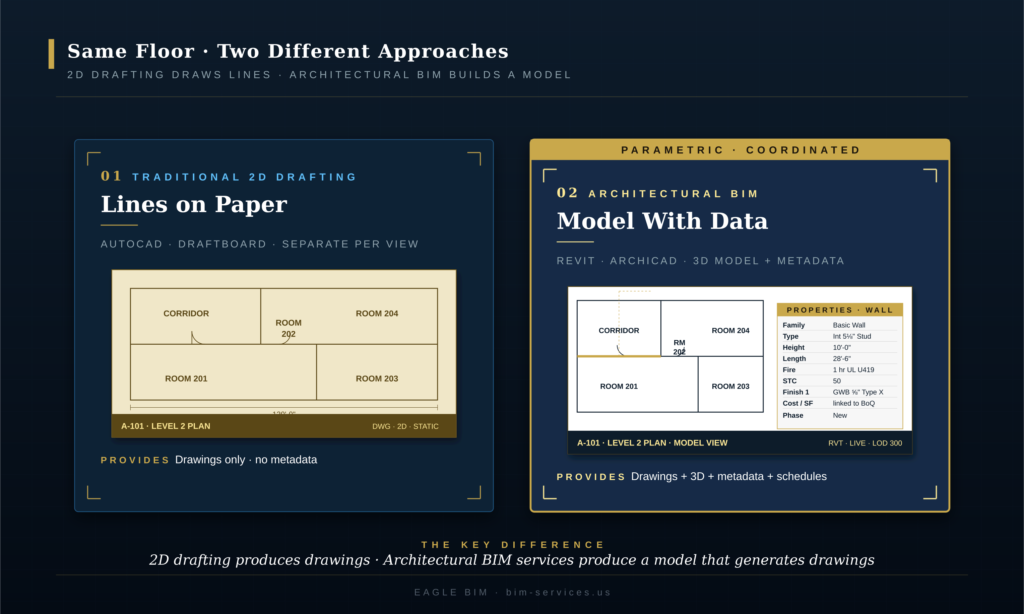
2D drafting workflow. The architect draws each sheet in AutoCAD or equivalent. Plans are separate from sections, sections are separate from elevations, schedules are typed manually. Coordination between sheets is the architect’s responsibility · there is no automatic enforcement that the plan and section show the same wall thickness or the same door swing. Quantity takeoffs are manual reads off the drawings. When a design change happens, the architect updates each affected sheet individually. The advantage is simplicity (one tool, low learning curve) and the disadvantage is that consistency depends entirely on the architect’s discipline.
Architectural BIM workflow. The architect models the building once in Revit or ArchiCAD. Plans, sections, elevations, schedules, and 3D views are all generated automatically as views into that model. Coordination is enforced by the model · the wall in the plan and the wall in the section are the same wall, not two drawings that have to match. Quantity takeoffs run as schedules that update whenever the model updates. Design changes propagate automatically. The advantage is consistency, speed, and downstream data; the disadvantage is the higher initial investment in software, training, and content libraries.
The economics also differ. A 2D-only firm scales linearly · more sheets means more drafting hours. A BIM-equipped firm scales sub-linearly on documentation · once the model is set up, additional views (more plan levels, more sections) take incremental time rather than starting-from-zero time. This is one of the main reasons larger projects (multifamily towers, healthcare facilities, mixed-use developments) almost always run on architectural BIM services today · the documentation efficiency over the project lifecycle outweighs the upfront model investment. Most firms that retain pure 2D drafting today do so on small renovation projects · for new construction of any meaningful scale, architectural BIM services are now the default delivery method rather than the exception.
Architectural drafting services remain relevant for small projects, renovations of existing CAD-documented buildings, and survey or as-built drawings that do not need full architectural BIM modeling. Eagle BIM offers both depending on the project’s needs · 2D drafting where it makes sense, full architectural BIM services where the project scale or coordination demand warrants it.
What Is Included in Architectural BIM Services
| Architectural BIM services typically include: site and building modeling, walls and floors and roofs, doors and windows and openings, stairs and elevators and ramps, interior partitions and finishes, RCPs and ceilings, schedules (rooms, doors, windows, finishes), areas and zoning, sheet setup and view configuration, code analysis annotations, coordination with structural and MEP, and 3D views for client presentation. Scope is usually defined per AIA G203-2022 BIM Execution Plan. |
Architectural BIM services scope is defined in the engagement contract, not assumed by the contractor. Two firms can both say they do architectural BIM services and mean very different things · one might mean basic Revit floor plans, the other might mean full modeling including all furniture, fixtures, and equipment plus rendering. The scope conversation always references AIA G203-2022 or an equivalent BIM Execution Plan that captures what’s modeled, at what LOD, and who is responsible for which model elements.
Building shell. Site modeling (toposurface, site components, hardscape), foundation walls and slabs (or coordination with structural), exterior walls with full assembly, roof systems including drainage and parapets, floors with full assembly stack-ups, structural columns and beams (architectural representation, real geometry handled by structural BIM), exterior windows and storefronts with sill / head detailing, exterior doors with hardware groups, exterior finishes and material breaks. These shell elements form the foundational scope of every architectural BIM services engagement regardless of project type or complexity.
Interior modeling. Interior partitions by wall type, doors with hardware schedules, interior glazing, interior finishes (paint, GWB, wall covering, acoustic panels), reflected ceiling plans with grid layouts and integration of MEP elements, casework and millwork (often LOD 300, sometimes LOD 350 for fabrication), furniture if scope requires (FF&E modeling).
Circulation and code. Stairs (egress and convenience), elevators with shaft modeling, ramps and accessible routes, code-required clearances and door swings, occupant load calculations (often via room/space modeling), travel-distance graphics, fire-rated wall and floor assemblies clearly tagged.
Documentation setup. Sheet layouts and title blocks, view configuration (plan views, section markers, elevation markers, callout placement), annotation and tagging strategy, schedule design (rooms, doors, windows, finishes, fixtures), keynotes / sheet notes, dimensioning standards. The model is only as useful as the documentation it produces, and documentation setup is a substantial portion of architectural Revit modeling work. Across Eagle BIM’s architectural BIM services engagements, documentation setup typically runs 20 to 25 percent of total project hours · invisible to the client but critical to delivery quality.
Coordination. With structural BIM (column lines, shear walls, beam depths, slab edges), MEP BIM (penetrations, equipment rooms, ceiling-zone congestion, shaft locations), civil (grading, site utilities), and landscape (planting, hardscape, lighting). The design documentation BIM scope includes the architect’s responsibility to receive and incorporate the other disciplines’ model updates and resolve any conflicts that affect architectural elements. Coordination quality is what separates competent architectural BIM services from average ones · the model has to talk to structural and MEP without breaking the architectural design intent.
Visualization. Construction-quality 3D views for the architect’s documentation, plus optional photorealistic renderings via Enscape, Twinmotion, or V-Ray. Visualization scope varies hugely by project · some firms only do diagrammatic axons for sheets, others deliver full marketing renderings as part of architectural BIM services for client presentations and approvals. Photorealistic visualization is one of the most differentiating components of comprehensive architectural BIM services offerings · firms with strong rendering capability close more design-build pursuits than firms without it.
Architectural BIM Workflow by Project Phase
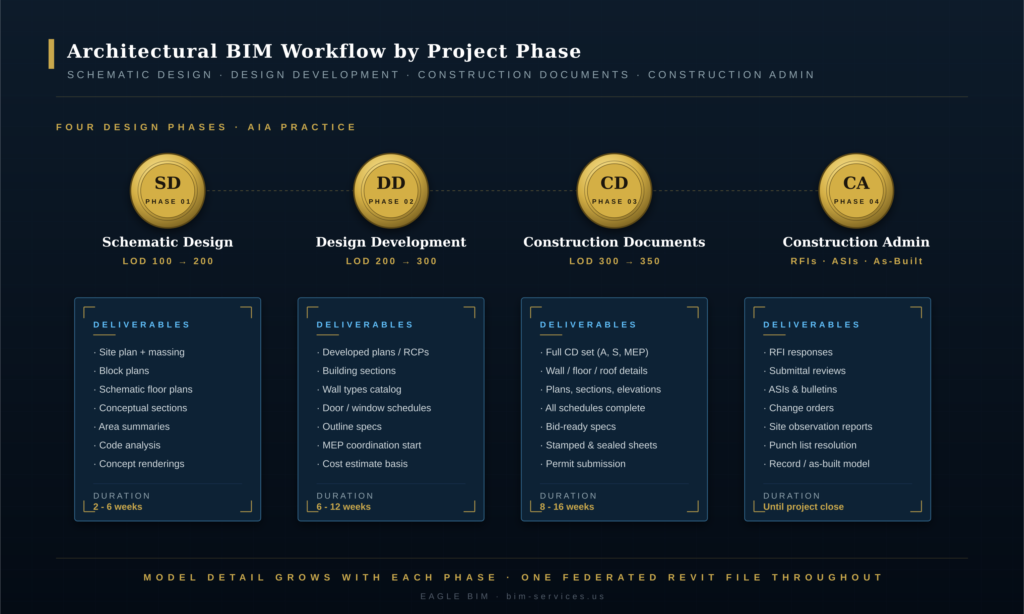
| Architectural BIM services follow the AIA SD-DD-CD-CA phase model. Schematic Design (SD) starts at LOD 100-200 with massing and block planning. Design Development (DD) progresses to LOD 200-300 with developed plans, sections, and outline specs. Construction Documents (CD) reaches LOD 300-350 with full sheet set, schedules, and stamped drawings. Construction Administration (CA) supports the project through RFIs, ASIs, and as-built model production. AIA G203-2022 defines responsibility per phase. |
The four-phase AIA workflow · Schematic Design, Design Development, Construction Documents, Construction Administration · is the framework every US architecture firm uses, and every architectural BIM services engagement maps to it. The model starts simple in SD and grows in detail through each phase until it carries enough information at CD to be the basis for permit and bid.
Schematic Design (SD)
Schematic Design is the conceptual phase. The architect translates the program brief into a building proposal · site plan, building massing, block plans showing room adjacencies, schematic floor plans showing major spaces, conceptual sections and elevations showing the building character. Model LOD is typically 100 to 200 · elements are approximate, geometry is generic, materials are conceptual. The deliverable is enough information for the client to validate the design direction and for the engineer to start mass/load studies.
Architectural BIM modeling at SD is often lighter than people expect · most firms use BIM in SD primarily for area calculations, code compliance studies, and quick view generation. The model is intentionally low-detail so design changes can happen fast. Phase duration is typically 2 to 6 weeks depending on building complexity. Eagle BIM commonly takes over SD modeling for architecture firms whose internal team is concentrating on design exploration in Rhino or SketchUp, and we translate concept work into a Revit model that can carry forward into DD and CD. This SD-phase delivery is one of the most common architectural BIM services engagements we run for architecture firms across Texas and the broader US market.
Design Development (DD)
Design Development is where the model gains real maturity. Walls take real types and assemblies, doors and windows take real schedules, the structural system gets defined in coordination with the structural engineer, MEP system zones get defined in coordination with the MEP engineer. The model moves from LOD 200 to LOD 300 over the phase. Deliverables include developed plans with full dimensions, RCPs showing ceiling and lighting layouts, building sections at key locations, wall types catalog with assembly drawings, outline specifications, and a cost-estimate basis from the model’s quantity takeoffs.
DD is the most coordination-heavy phase for architectural BIM services. The architectural model has to incorporate structural and MEP model inputs without breaking the design intent · which means substantial back-and-forth meetings and model updates. Phase duration is typically 6 to 12 weeks. AIA G203-2022 BIM Execution Plan typically calls for clash detection rounds at the end of DD to catch coordination issues before they propagate into CD. Strong DD-phase architectural BIM services make or break the downstream CD phase · issues left unresolved in DD compound rapidly through documentation, and Eagle BIM dedicates roughly twice the modeling effort to DD coordination as to SD or early CD work.
Construction Documents (CD)
Construction Documents is the phase that produces the contractually binding drawings. The model reaches LOD 300 to LOD 350 in the elements that matter for construction · walls, floors, roofs, structural connections, MEP rough-in penetrations, hardware locations. Deliverables are the full CD sheet set (architectural, structural, MEP), wall sections and details, complete schedules (rooms, doors, windows, finishes, fixtures), bid-ready specifications, stamped and sealed drawings, and the permit submission package.
CD is where the architectural BIM services workflow shows its biggest payoff. Because every sheet pulls from the same model, dimensional consistency is automatic. Schedule entries match the actual model elements. Sheet revisions propagate model updates. A firm that hand-drafts CDs spends weeks on consistency checks; a firm that runs CDs from a coordinated Revit model has those weeks back for design refinement. Phase duration runs 8 to 16 weeks for a typical commercial or multifamily project, longer for healthcare and complex institutional work. CD is also the phase where architectural BIM services ROI becomes most visible · the model that took DD to develop pays back through automated schedules, dimension consistency, and rapid revision turns.
Construction Administration (CA)
Construction Administration starts when the construction contract is signed and runs through project completion. The architect’s role shifts from authoring documents to supporting the contractor’s interpretation of them · responding to RFIs, reviewing submittals, issuing ASIs (Architect’s Supplemental Instructions) and bulletins when changes are needed, processing change orders, performing site observation visits, resolving the punch list, and ultimately delivering the record model or as-built drawings.
In a BIM-driven workflow, CA support is more efficient because the model can be queried for any condition the contractor asks about · a fast trip into the Revit model often answers what would have been a written RFI in a 2D workflow. Many firms also maintain the model as a living document through CA, updating it with approved field changes so the final as-built model represents what was actually built. Eagle BIM supports architecture firms through CA on projects where we authored or maintained the production model, including as-built model updates for facility management handover. CA-phase architectural BIM services also include FF&E coordination updates, owner-requested modifications absorbed into the model before turnover, and warranty-period model maintenance for facility management handover.
| Need architectural BIM services that scale with your project pipeline?
Eagle BIM provides architectural BIM modeling support to architecture firms across Texas and the broader USA · from SD massing through CD documentation and CA support. We work as an extension of your design team, not a replacement for it. |
Architectural BIM Software · Revit, ArchiCAD, AutoCAD
| Autodesk Revit dominates US architectural BIM services with roughly 70 to 80 percent market share. Graphisoft ArchiCAD holds a strong international position especially in Europe and Asia. AutoCAD remains relevant for 2D drafting, civil work, and as-built documentation but is no longer the primary BIM authoring tool. Most US architecture firms run architectural Revit modeling as their core tool with AutoCAD as a supplementary 2D tool. |
Software selection sets the foundation for any architectural BIM services engagement · the firm’s tool choice constrains what kinds of partners and consultants can work alongside it. The architectural BIM software stack has consolidated significantly over the past decade. Where firms once made meaningful choices between multiple BIM authoring tools, the practical reality in the US market is that Revit is the default and other tools are exceptions. International firms and some boutique practices use ArchiCAD; the rest run Revit. This matters for outsourced architectural BIM services because the contracting firm needs to match the architecture firm’s software · trying to deliver architectural Revit modeling to a firm running ArchiCAD doesn’t work without a model translation that loses parametric fidelity.
Autodesk Revit. The dominant US architectural BIM services platform. Revit’s strengths are deep parametric modeling, tight integration with Revit Structure and Revit MEP, mature family content ecosystem, robust scheduling, and worksharing for multi-user team collaboration on large projects. Weaknesses are perceived steep learning curve, expensive subscription licensing, and constrained file size that becomes a real problem on very large projects without careful model splitting. Versions current in 2026 are Revit 2025 and Revit 2026. For US-based architectural BIM services providers including Eagle BIM, Revit is the primary production tool roughly 9 out of 10 engagements.
Graphisoft ArchiCAD. Strong international market share, especially in Europe and parts of Asia. Strengths are excellent design-stage flexibility, intuitive interface for design-focused architects, native macOS support (Revit does not run native on Mac), and powerful rendering integration. Weaknesses for US work include smaller ecosystem of US-based content, fewer US firms running it (which constrains partner options for outsourced architectural BIM services), and less integration with US-dominant structural and MEP tools.
AutoCAD. Still in every architect’s tool belt for civil drawings, site plans, simple renovations, as-built drawings from PDF source, and any task that genuinely needs only 2D. AutoCAD’s role has shrunk dramatically as a primary BIM authoring tool but it remains essential for the supporting 2D work that surrounds full architectural BIM services. Most firms maintain both Revit and AutoCAD licenses indefinitely.
Supplementary tools. Rhino with Grasshopper for complex geometry and parametric design exploration (often early-stage SD), SketchUp for fast 3D concept modeling, Enscape and Twinmotion for real-time rendering integrated with Revit, V-Ray and Lumion for higher-fidelity rendering, Navisworks for federated coordination across disciplines, BIM 360 / Autodesk Construction Cloud for common data environment. The full architectural BIM services stack typically uses 4 to 8 tools depending on project type and firm preferences. The supplementary tool selection often distinguishes mature architectural BIM services teams from less-experienced ones · tool choice signals where a firm has invested its production capability.
Typical Deliverables From Architectural BIM Services
| Architectural BIM services produce six deliverable categories: floor plans (A-100 series), elevations (A-200), sections (A-300), schedules (auto-generated from the model), 3D views (A-900), and 3D renderings. All are generated from one coordinated Revit or ArchiCAD model · dimensions and schedules update automatically when the model changes. 3D rendering services are typically delivered via Enscape, Twinmotion, or V-Ray for photorealistic visualization. |
Every architectural BIM services engagement produces a recognizable set of deliverables that map to a standard CSI / AIA sheet number convention. Architects and consultants who have worked together for years can predict what an A-100 sheet contains versus an A-300 sheet without ever opening the file. The architectural BIM services workflow honors that convention · the deliverables look like the deliverables architects have always expected, but they come out of a model rather than being hand-drafted.
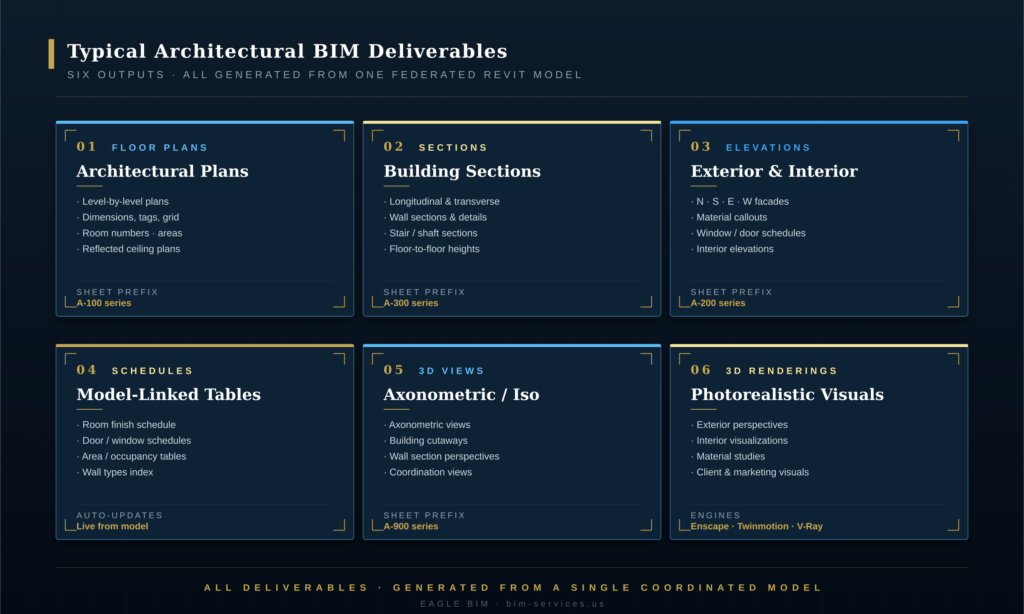
Floor plans (A-100 series). Level-by-level plans showing walls, doors, windows, openings, room labels, room numbers, room areas, dimensions, grid lines, and key annotation. Reflected ceiling plans (RCPs) showing ceiling grids, lighting layouts, sprinkler heads, diffusers, and any ceiling-zone elements. Floor plans are the workhorse deliverable of architectural BIM services and typically run 8 to 30+ sheets depending on building size.
Building sections (A-300 series). Longitudinal and transverse sections cut through the building showing floor-to-floor heights, structural depths, ceiling zones, mechanical chases, and the overall vertical organization. Wall sections at key conditions (typical exterior wall, foundation, parapet, atrium) with full assembly callouts. Stair and elevator shaft sections showing critical clearances and code compliance.
Elevations (A-200 series). Exterior elevations from north, south, east, and west with material callouts, fenestration patterns, sill and head heights, building height limits, and key code dimensions. Interior elevations at key locations (millwork walls, signage walls, restroom layouts) showing wall finishes, casework, and accessories.
Schedules. Room finish schedule (floor, base, wall, ceiling per room), door schedule with hardware groups, window schedule with sill heights and operations, plumbing fixture schedule, light fixture schedule, equipment schedule. All schedules in architectural BIM modeling are auto-generated from model elements · a door added to the model automatically appears on the door schedule with its size, type, hardware group, and fire rating populated from the door family’s parameters. Schedule automation is one of the most measurable productivity gains architectural BIM services deliver over traditional 2D drafting.
3D views (A-900 series). Construction-quality 3D views for documentation · axonometric views, building cutaways, wall section perspectives, and coordination views that help the contractor understand complex three-dimensional conditions. These are not marketing renderings · they are technical 3D documentation generated directly from the Revit model with no post-processing. A-900 series sheets are an underused capability in many architectural BIM services engagements · they communicate complex conditions faster than detailed 2D sections and reduce RFIs during construction.
3D renderings. Photorealistic visualization for client presentations, marketing, and approvals. 3D rendering services are often delivered via Enscape (real-time, Revit-integrated), Twinmotion (Unreal Engine-based, very fast iteration), or V-Ray (highest fidelity, longest render times). Rendering scope ranges from a handful of exterior views for marketing through full interior walkthroughs and animations for high-end residential or hospitality projects. Rendering quality is increasingly a deciding factor in architectural BIM services partner selection · architecture firms that win design competitions invest more in rendering than firms that compete on price.
Architectural Revit Families and Content Libraries
| Revit families are the parametric content blocks of architectural Revit modeling · doors, windows, casework, plumbing fixtures, light fixtures, furniture, and every other component placed in a model. A well-built content library makes a firm’s architectural BIM services faster and more consistent. Custom families and content management are typically 10 to 20 percent of a firm’s BIM operational cost and the highest-leverage investment for scaling architectural production. |
Revit family content is the foundation of every architecture firm’s BIM operation. A firm with a mature, well-organized content library can model a building roughly twice as fast as a firm assembling content ad-hoc from manufacturer downloads and internet sources. The library is also the firm’s quality control mechanism · standardized families enforce dimensional consistency, schedule data completeness, and presentation consistency across every project the firm produces.
Loadable families. The most common type of Revit family content · doors, windows, casework, plumbing fixtures, light fixtures, furniture, signage, accessories. Loadable families are created in Revit’s Family Editor, saved as .rfa files, and loaded into projects as needed. A well-built loadable family parameter-controls its geometry (so one family covers many sizes), carries scheduling data (manufacturer, model number, cost, weight), and supports the firm’s annotation style. Loadable family quality is one of the silent quality indicators of a firm’s architectural BIM services output.
System families. Built into Revit and configured per project · wall types, floor types, roof types, ceiling types, stair types. System families are usually managed via project templates rather than as separate .rfa files. A firm’s project template carries its standard system family library (typical exterior walls, typical interior partitions, typical floor assemblies) so every new project starts with the firm’s tested types pre-loaded.
In-place families. Project-specific one-off geometry created inside a project rather than as a reusable library family. In-place families are useful for genuinely unique geometry (an unusual canopy, a sculpted feature wall) but are generally discouraged for anything repeated · they don’t schedule cleanly and they can’t be reused across projects.
For architecture firms building or scaling their family library, Eagle BIM’s Revit Family Creation services supports family development from manufacturer specifications, model conversion from CAD-only sources, parametric flex programming, and family library audit and standardization.
Content library management. Beyond creating individual families, the bigger operational challenge is maintaining a library of hundreds or thousands of families with consistent naming, parameter sets, and presentation. Firms that take this seriously assign a BIM manager or content manager whose responsibility includes library curation, family audit and update cycles, training new staff on the library standards, and integration of manufacturer-provided BIM content into the firm’s standard format. This work is invisible from outside the firm but it directly determines how fast and how well the firm’s architectural BIM services run. An auditing pass through the family library at the start of a new architectural BIM services engagement is one of the highest-leverage activities Eagle BIM performs · the cleanup typically pays for itself within the first project cycle.
When Architects Outsource BIM Modeling
| Architecture firms outsource architectural BIM modeling in four common scenarios: when a project is too large for current in-house staff, when the firm wants to keep senior designers on design work rather than production, when CD-phase documentation has tight deadlines that exceed staff capacity, and when the firm doesn’t have deep enough BIM expertise on a specific building type (healthcare, lab, semiconductor). Outsourced architectural BIM services typically scale from individual project support through long-term partnered modeling teams. |
The decision to outsource architectural BIM modeling is rarely an absolute · most architecture firms keep a portion of BIM work in-house and selectively engage external partners for capacity, expertise, or schedule reasons. The economics are usually straightforward · a one-person increase in in-house BIM headcount commits the firm to a year of salary, benefits, software seats, and overhead before any project work starts; an external BIM partner scales up and down per project without that fixed commitment.
Project-too-large. The most common outsourcing trigger. A firm with a 4-person Revit team that has historically handled mid-sized commercial projects wins a 200-unit multifamily project that genuinely needs 8 to 10 modelers for CD phase. Hiring 4 more staff for one project doesn’t make economic sense · engaging an external architectural BIM services partner for the CD push, while keeping the principal-in-charge and senior designers in-house, fits the project cleanly. Project-too-large scenarios are where architectural BIM services from a partner pay for themselves within a single project.
Senior-time-protection. Senior architects whose value is design exploration, client relationships, and code interpretation are often pulled into production drafting on tight projects when they shouldn’t be. Outsourcing the production modeling lets the firm’s senior staff stay on the work only they can do, while production work runs in parallel with an external BIM team. This pattern is especially common in boutique design firms whose competitive advantage is design quality rather than production volume · architectural BIM services from an external partner protect the firm’s most valuable hours.
Schedule pressure. CD phases often arrive at firms with insufficient internal capacity to hit the contracted deadline. Adding short-term outsourced architectural BIM services capacity through CD lets the firm hit the schedule without breaking staff or compromising quality. Eagle BIM regularly scales up architectural BIM teams to 6 or 8 modelers for 2 to 4 month CD pushes and scales back down to 1 or 2 for the post-CD CA support.
Specialty expertise. Healthcare, semiconductor fabs, data centers, life science labs, and other technically demanding building types require BIM modeling expertise that most general architecture firms don’t carry in-house. When a firm wins one of these projects, partnering with a BIM team that has done similar work before saves the firm from a steep, expensive learning curve. Eagle BIM has delivered architectural BIM services on healthcare expansions, semiconductor fabs, and data centers across Texas for exactly this reason. Across all four outsourcing scenarios above, the common thread is that architectural BIM services from an external partner are a capacity and expertise multiplier · they do not replace the firm’s in-house design judgment, they extend the firm’s production reach so design judgment can stay where it belongs.
For the Texas multifamily context where Eagle BIM has deepest architectural BIM services experience, see BIM for Texas Multifamily · multifamily projects in Austin, DFW, Houston, and San Antonio are the largest single share of our architectural BIM workload.
How Eagle BIM Delivers Architectural BIM Services
| Eagle BIM, in association with BIMPRO LLC, delivers architectural BIM services to architecture firms as an extension of their design team. We support SD through CA across the AIA workflow, run architectural Revit modeling on the firm’s project template and standards, coordinate with the firm’s structural and MEP consultants, and deliver stamped-ready documentation. Geographic focus is Texas (Houston, Dallas-Fort Worth, Austin, San Antonio) and the broader USA. Most engagements run as named project teams that scale up and down through the project lifecycle. |
Eagle BIM, in association with BIMPRO LLC, delivers architectural BIM services to architecture firms across Texas and the United States. We work as an extension of the architect’s design team · the firm’s principals and senior designers stay on design intent, client interface, and stamped responsibility while our BIM modelers handle the production work in Revit (or ArchiCAD where required). We adopt the firm’s project template, standards, and content library so the output looks like the firm’s output, not like a third-party deliverable. Most Eagle BIM architectural BIM services engagements run for 4 to 12 months on a named-project basis with scaling team size by phase.
Typical Eagle BIM architectural BIM services engagement structure: a named project lead at our end paired with the architect’s project architect, a team of 3 to 8 modelers scaling per phase, daily or weekly check-in cadence depending on project tempo, and integrated use of the firm’s BIM 360 or Autodesk Construction Cloud workspace so our work product lives in the architect’s environment rather than ours. We use the firm’s title blocks, the firm’s annotation families, the firm’s standard schedules · the deliverable is indistinguishable from in-house work. This embedded-team approach is what differentiates Eagle BIM’s architectural BIM services from typical offshore production · we work to the firm’s standards from day one rather than asking the firm to adapt to ours.
Eagle BIM’s strongest project experience for architectural BIM services is in Texas multifamily, where we have supported architectural BIM through CD on a number of 200-plus-unit projects across Austin and Dallas-Fort Worth · the recent 8-story multifamily project in Austin is a representative example where our team handled architectural BIM from DD through CD release while the firm’s senior designers continued to refine unit layouts and facade design. We also work on healthcare, semiconductor fabs, data centers, and commercial projects where architectural BIM services have to coordinate tightly with complex MEP scope.
Software stack: Autodesk Revit (versions 2023 through 2026 depending on the firm’s standard), Navisworks for federated coordination with structural and MEP, Enscape and Twinmotion for real-time rendering integrated with Revit, AutoCAD for supplementary 2D work, and BIM 360 / Autodesk Construction Cloud for common data environment. Where firms run ArchiCAD we work in ArchiCAD with the same workflow approach · we adapt to the firm’s stack rather than forcing ours. Software flexibility is a baseline expectation for serious architectural BIM services providers in 2026 · firms that insist on a single tool are not viable long-term partners for diverse architecture practices.
| Considering outsourcing your firm’s architectural BIM production?
Send Eagle BIM a sample sheet set or model, your firm’s standards documentation, and a target deliverable date. We will scope an architectural BIM services engagement against your project schedule and provide a named project team that integrates with your design team. |
Choosing the Right Architectural BIM Services Partner
| Architecture firms evaluating architectural BIM services partners should weigh five criteria: software match (Revit, ArchiCAD), portfolio depth in the firm’s project types, team scaling flexibility, integration into the firm’s standards rather than imposed standards, and time-zone overlap for daily coordination. Eagle BIM scores on all five for US-based architecture firms · Texas time zone, deep Revit experience, multifamily and commercial portfolios, and embedded-team engagement structure. |
Selecting an architectural BIM services partner is not the same as hiring a vendor for a one-time deliverable. The partner has to operate as part of the architect’s production capability across multiple projects, often across multiple years. Five criteria separate good architectural BIM services partners from average ones · and most of them are not visible until the first project is well underway.
Software match. The partner needs to fluently run the architect’s tool of choice · usually Revit, sometimes ArchiCAD. A partner that primarily runs ArchiCAD will struggle to deliver high-quality architectural BIM services on a Revit project no matter how skilled the modelers are, because tool-specific muscle memory matters more than people expect.
Portfolio depth. Architecture firms specialize · multifamily, healthcare, institutional, commercial, hospitality, life science. A partner with deep architectural BIM services experience in the architect’s project types will start projects faster and need less ramp-up. A partner with only general experience will treat every project as a new learning curve.
Team scaling. Architectural projects flex dramatically in team size from SD (often 1 to 2 modelers) through CD (often 6 to 10 modelers) and back down through CA (1 to 2). A partner that cannot flex this gracefully ends up either understaffing CD (which delays delivery) or over-staffing SD/CA (which inflates cost). Mature architectural BIM services providers handle this scaling routinely; less-experienced ones often don’t.
Standards integration. The partner needs to work to the architect’s standards · title blocks, schedule formats, annotation styles, naming conventions, file structure · rather than imposing the partner’s standards on the architect. Eagle BIM treats architectural BIM services as embedded-team work, not vendor work, and that distinction shows up in deliverable quality from week one.
Time-zone overlap. Daily or near-daily coordination is required during DD and CD. A partner in a time zone with no business-hours overlap forces async-only communication that slows iteration. Texas-based architectural BIM services providers like Eagle BIM offer full business-hours overlap with US architecture firms from coast to coast · a meaningful advantage over offshore-only providers when projects move fast.
Frequently Asked Questions
These are the questions Eagle BIM hears most often from architecture firms evaluating architectural BIM services partners for the first time. Answers are short and direct, optimized for both firm decision-making and AI search engine citation.
What are architectural BIM services?
Architectural BIM services are the modeling, documentation, and coordination work an architect performs or outsources using Building Information Modeling software like Autodesk Revit or Graphisoft ArchiCAD. They cover everything from concept massing through stamped construction documents and construction-administration support · all generated from a single coordinated 3D model rather than drawn separately as 2D sheets. Architectural BIM services replace traditional drafting with parametric, data-rich elements that produce plans, sections, elevations, schedules, and renderings simultaneously.
How is architectural BIM different from 2D drafting?
Traditional 2D drafting produces drawings only · separate plan, section, and elevation sheets that have to be manually kept consistent. Architectural BIM services produce a 3D model with metadata that generates all drawings automatically from one source. The model carries quantities, material properties, fire ratings, and cost data that 2D drafting cannot store. When a wall moves in the BIM model, every plan, section, elevation, schedule, and 3D view updates automatically. In 2D drafting, each affected sheet has to be edited individually.
What software is used for architectural BIM?
Autodesk Revit dominates US architectural BIM services with roughly 70 to 80 percent market share. Graphisoft ArchiCAD holds a strong international position, especially in Europe and parts of Asia. AutoCAD remains relevant for 2D drafting, civil work, and as-built documentation but is no longer the primary BIM authoring tool. Most US architecture firms run architectural Revit modeling as their core tool with AutoCAD as a supplementary 2D tool, plus rendering tools like Enscape, Twinmotion, or V-Ray for visualization.
What’s included in architectural BIM services?
Typical architectural BIM services include site and building modeling, exterior shell (walls, roofs, floors, windows, doors), interior partitions and finishes, RCPs and ceilings, stairs and elevators, schedules (rooms, doors, windows, finishes), code analysis, coordination with structural and MEP consultants, sheet setup, annotation, and 3D views. Optional scope often includes photorealistic renderings, marketing visualizations, and as-built model production. Scope is usually defined per AIA G203-2022 BIM Execution Plan.
How long does each project phase take?
Schematic Design (SD) typically runs 2 to 6 weeks. Design Development (DD) runs 6 to 12 weeks. Construction Documents (CD) runs 8 to 16 weeks for typical commercial or multifamily projects (longer for healthcare and complex institutional work). Construction Administration (CA) runs from construction contract signing through project completion. Phase durations depend heavily on building complexity, team size, and how mature the architect’s content library and project template are when the project starts.
When should architecture firms outsource BIM modeling?
Architecture firms outsource architectural BIM modeling in four common scenarios: when a project is too large for current in-house staff, when the firm wants senior designers focused on design work rather than production drafting, when CD-phase documentation has tight deadlines that exceed staff capacity, and when the firm lacks deep BIM expertise on a specific building type like healthcare or semiconductor. Outsourced architectural BIM services scale up and down per project without the fixed cost of additional in-house headcount.
What are typical architectural BIM deliverables?
Architectural BIM services produce six deliverable categories: floor plans (A-100 series with dimensions, tags, RCPs), building sections (A-300 series), elevations (A-200 series), schedules (rooms, doors, windows, finishes · auto-generated from the model), 3D views (A-900 series), and 3D rendering services via Enscape, Twinmotion, or V-Ray. All deliverables are generated from one coordinated Revit or ArchiCAD model · dimensions and schedules update automatically when the model changes.
What standards govern architectural BIM in the United States?
The current US standard for architectural BIM services contractual terms is AIA Document E201-2022 (BIM Exhibit for Sharing Models with Project Participants, Where Model Versions May be Enumerated as a Contract Document). It works with AIA G203-2022, the BIM Execution Plan, which captures granular protocols for model sharing, versioning, and Level of Development. The BIMForum USA LOD Specification defines LOD 100 through LOD 400. For international projects, the RIBA Plan of Work 2020 provides an equivalent staged framework.