
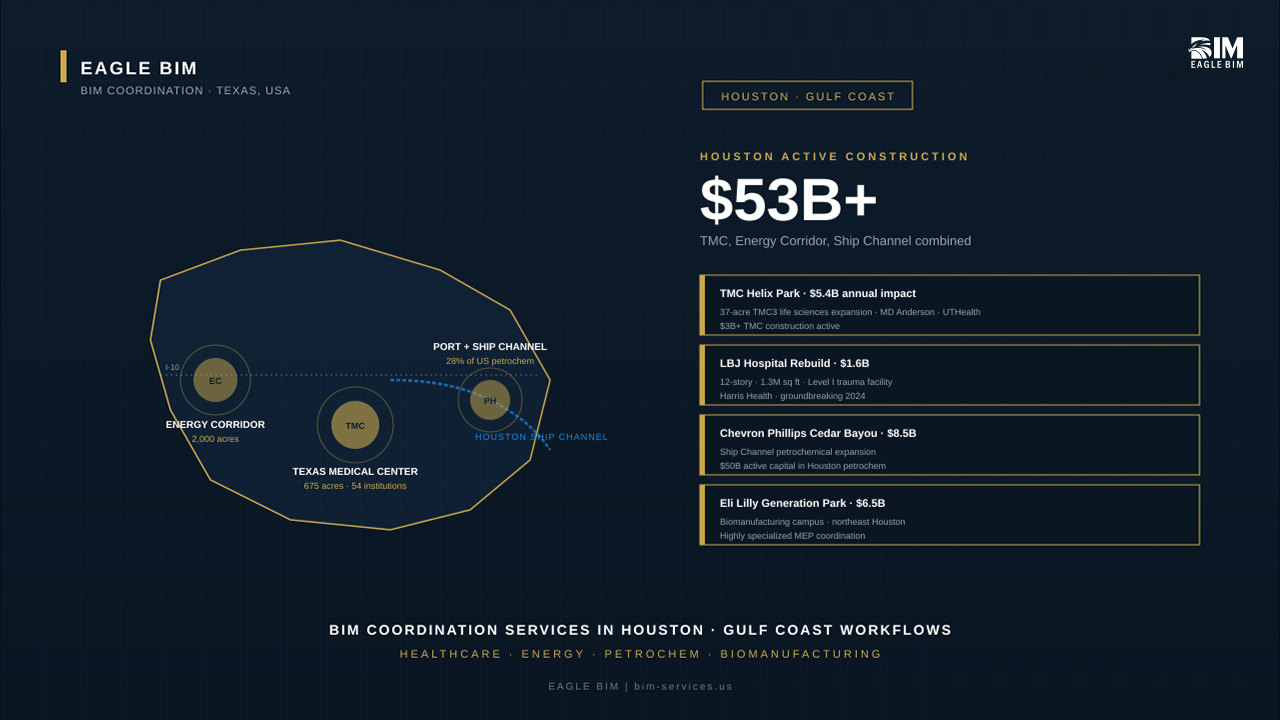
Houston is not Dallas. It is not Austin. It is not anywhere else in Texas. Walk a Houston project and you can feel it. The Texas Medical Center sits on 675 acres with 54 institutions, more than $3 billion in active construction, and roughly 10 million patient encounters a year. The Energy Corridor stretches across 2,000 acres west of downtown, home to most of the country’s major energy company headquarters. The Ship Channel runs from Baytown through Pasadena down to Texas City, hosting 28 percent of all US petrochemical employment and roughly $50 billion in active capital projects. None of these markets behave like the rest of Texas commercial construction, and BIM coordination services Houston teams have to know all three to be useful here.
This blog is for contractors, MEP subs, owner’s reps, and developers working in the Houston metro who need a BIM partner who actually understands what makes Gulf Coast projects different. We walk through what’s driving demand right now (real projects, real budgets, real timelines), what makes hospital coordination at the TMC different from anywhere else in the country, why Ship Channel petrochem coordination is its own discipline, and the Houston-specific climate and code realities that show up in every model. By the end you’ll know what to look for when you scope BIM services Houston Texas on your next project. Whether you’re hiring a MEP BIM Houston specialist for a hospital build or a full-stack Houston construction BIM team for an Energy Corridor retrofit, the same principles apply.
Houston work runs at scale most other markets don’t see. The Chevron Phillips Cedar Bayou expansion is an $8.5 billion build. The LBJ Hospital rebuild is a $1.6 billion, 12-story, 1.3 million-square-foot Level I trauma facility. Eli Lilly’s Generation Park biomanufacturing campus is $6.5 billion. The TMC3 Helix Park life sciences expansion is targeting $5.4 billion in annual economic impact when complete. These are not generic commercial projects, and they don’t coordinate like generic commercial projects. The Texas Medical Center BIM standard, the Houston Energy Corridor BIM workflow, and the Ship Channel petrochem coordination model all have to live in the same firm’s capability set.
Houston’s Construction Pipeline Is Different From the Rest of Texas
Most of Texas’s 2026 construction story is about new construction in greenfield sites. Samsung’s Taylor fab is greenfield. Most DFW data centers are greenfield. Multifamily across Austin and San Antonio is mostly greenfield. Houston is different. Most of what’s getting built in Houston in 2026 is either a renovation in an occupied building, an expansion of an existing campus, or a brownfield industrial scope on a site that has been in operation for decades. That changes everything about how BIM coordination services Houston teams approach the work.
The TMC is the cleanest example. Roughly 70 percent of TMC construction spend is renovation or expansion in occupied buildings. Existing infection control protocols, existing patient flow, existing utility infrastructure, existing structural conditions. Every project starts with a scan-to-BIM capture of what’s already there, then layers the new work into the model around the existing reality. Texas Medical Center BIM work is closer to surgical reconstruction than greenfield building.
Energy Corridor work has a different flavor but the same pattern. The Energy Corridor District has been actively building since the 1980s, and the office, hospital, and retail stock that’s there now is being renovated, retrofitted, or replaced rather than expanded into open land. Boardwalk Pipelines is moving its corporate headquarters to the Energy Corridor in fall 2026. That move is into existing office space that needs significant MEP retrofit to support modern operations. Houston Energy Corridor BIM work tends to involve substantial existing-conditions modeling, plus the careful phasing of renovation around tenants who are still in the building.
Ship Channel petrochem work is different again. The ExxonMobil Baytown olefins expansion ($2 billion) has reached mechanical completion. Chevron Phillips Cedar Bayou ($8.5 billion) continues to absorb thousands of construction workers. These are mostly brownfield expansions on operating refineries and chemical plants, with the new units integrating into existing process piping, existing utilities, and existing safety systems. The BIM model on these projects has to capture the as-built reality of plants that have been running for 50 years and integrate new construction without disrupting operations.
Sectors Driving BIM Demand in Houston
Five sectors are doing most of the heavy lifting in Houston construction in 2026. Each one has its own BIM coordination workflow, its own technical demands, and its own local context that matters.
Texas Medical Center and Healthcare Expansion
The TMC is the gravitational center of Houston construction. The 37-acre TMC3 Helix Park expansion is the most visible piece, with the TMC3 Collaborative Building already open and additional research, clinical, and academic buildings in various stages of construction. MD Anderson is building a 470,000 square foot Sugar Land campus, scheduled to open in 2029. Baylor St. Luke’s has a four-year, $25 million renovation of the TMC campus lobby, cafeteria, and three nursing units underway. Memorial Hermann, Houston Methodist, HCA Houston Healthcare, and Texas Children’s all have multiple active campus expansions.
Outside the TMC proper, the Ben Taub Hospital expansion was approved in April 2026 (controversially, on Hermann Park land taken by eminent domain) with the project expected to take years. The LBJ Hospital rebuild is one of the most significant Harris Health System projects of the decade. HCA Houston Healthcare Pearland announced a $60 million expansion starting late 2026. Skanska’s Harris Health Central Fill Pharmacy on Keene Street is on track for May 2026 completion.
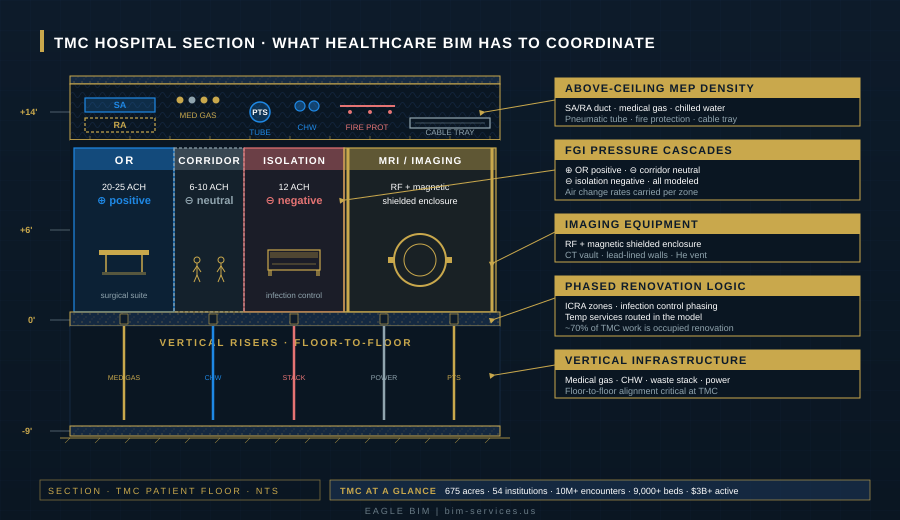
All of this work demands MEP BIM Houston coordination at the highest level. Healthcare BIM is dense: medical gas distribution (oxygen, vacuum, nitrous oxide, medical air, evacuation), above-ceiling MEP density that rivals anything outside a data center, pneumatic tube systems running between pharmacy, lab, and patient floors, FGI-compliant pressure cascades between OR, ICU, and isolation rooms, MRI shielding and CT vault coordination, and phased renovation logic that has to work around occupied wings of the building. Every TMC project gets coordinated to LOD 350 or LOD 400, with documented infection control phasing built into the model. Strong Texas Medical Center BIM work is what separates teams that have done this before from teams that are about to learn the hard way.
Beyond the four big-name healthcare systems, the Texas Medical Center BIM ecosystem includes specialty providers, research institutions, academic medical centers, and a long tail of supporting services. Memorial Hermann operates more than 260 care sites with roughly 4,400 licensed beds across the system. UTHealth Houston is running its Texas Therapeutics Institute out of the TMC3 Collaborative Building. Texas Children’s, Texas A&M Health, and the John S. Dunn Behavioral Sciences Center all have active construction. Each of these projects needs MEP BIM Houston teams who understand the specific clinical, research, or academic requirements they’re building for.
Energy Corridor and Petrochemical
Houston is the country’s energy capital, and that shows up everywhere in the construction market. The Energy Corridor District west of downtown houses major energy company headquarters across 2,000 acres. The Ship Channel and surrounding industrial corridor host the largest integrated petrochemical manufacturing cluster in the Western Hemisphere. Active capital across Houston petrochem now exceeds $50 billion.
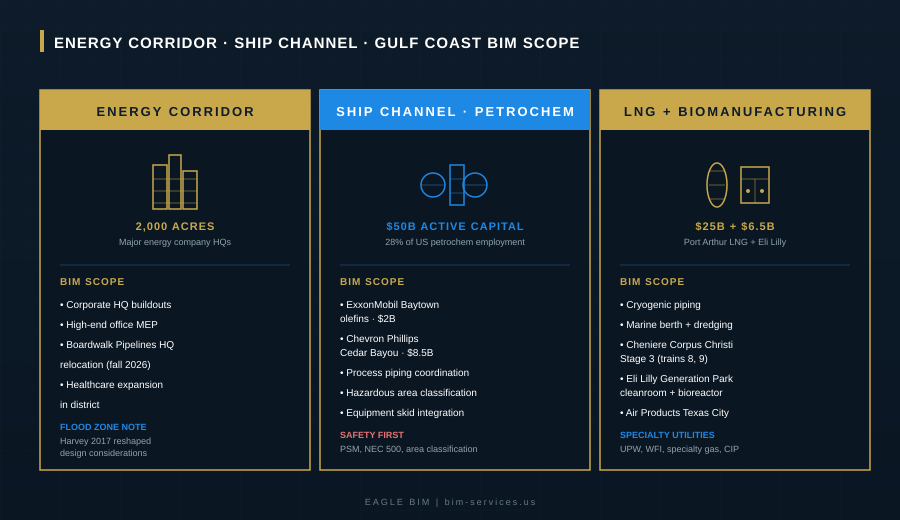
The big projects are visible to anyone in the industry. ExxonMobil Baytown olefins expansion at $2 billion. Chevron Phillips Cedar Bayou at $8.5 billion. The Cheniere Corpus Christi Stage 3 expansion (trains 8 and 9) approved by the DOE earlier this year. The Port Arthur LNG terminal at $25 billion. Add the long tail of supplier facilities, retrofits, debottlenecking projects, emissions controls upgrades, and brownfield expansions, and Houston Energy Corridor BIM work is generating sustained coordination demand across multiple specialized disciplines. Revit modeling Houston teams working in this sector need experience with process piping, equipment skid integration, and hazardous area classification that goes well beyond standard commercial Revit work.
Process piping coordination is the headline scope on most of these projects. Stress analysis, equipment skid integration, hazardous area classification per NEC 500, and PSM (process safety management) documentation all feed into the BIM model. Equipment in petrochem is heavy, hot, and often hazardous, which means clearances, access for maintenance, and emergency egress all have to be modeled correctly. The federated model has to reconcile new construction with as-built piping that may date from the 1970s, captured via scan-to-BIM or recreated from incomplete historical drawings.
Port Houston and Industrial Logistics
Port Houston ranks number one in US foreign waterborne tonnage. That single fact drives a huge volume of industrial logistics construction across the Houston metro: warehouses, distribution centers, intermodal facilities, and freight handling infrastructure. Most of this is straightforward commercial coordination, but the volume is substantial and the schedules are aggressive. Industrial BIM in Houston is typically scoped at LOD 300 to 350, with heavier coordination demands on the MEP side where conveying, dust collection, refrigeration, and process equipment come into play. BIM services Houston Texas teams doing port-adjacent industrial work need volume capacity and the ability to deliver clean models quickly.
Adjacent to the port itself, Houston’s industrial growth in 2026 includes Eli Lilly’s Generation Park biomanufacturing campus ($6.5 billion in northeast Houston), Air Products’ ammonia complex in Texas City, and TMEIC’s power-systems factory in Waller County. These are not generic warehouses. Biomanufacturing requires cleanroom coordination, specialty piping for WFI (water for injection) and CIP (clean-in-place) systems, and bioreactor equipment integration that looks closer to a small-scale semiconductor fab than a typical industrial build. Houston construction BIM teams handling this work need experience that crosses pharma, semiconductor, and traditional industrial coordination. The same BIM services Houston Texas vendors who deliver standard warehouses generally cannot deliver biomanufacturing scope without additional specialty depth.
High-Rise and Mixed-Use
Downtown Houston, the Galleria, the Texas Medical Center area, and the Energy Corridor all continue to add high-rise and mixed-use development. The coordination demands here are familiar to any major US metro: dense stacked MEP risers, podium-over-parking transitions, amenity floor coordination, and curtain wall integration. What makes Houston work different is the climate envelope. Vapor barriers, condensation control, and dehumidification capacity have to be modeled at levels that designers from cooler markets often underestimate.
Why Houston Heat and Humidity Change MEP Coordination
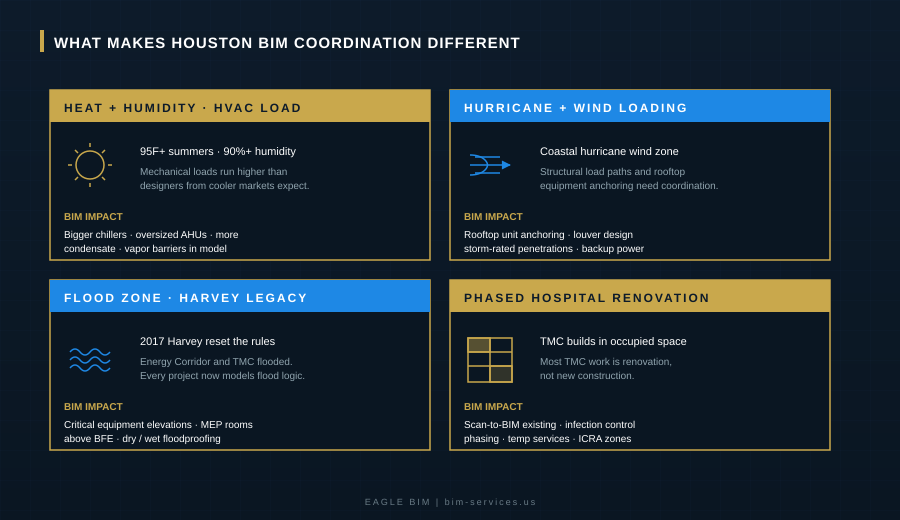
Houston summers are not academic. 95-degree-plus days run from June through September. Humidity routinely sits above 90 percent. The mechanical loads required to keep a building operating to specification are dramatically higher than what designers from cooler markets typically calculate. That has direct implications for BIM coordination services Houston workflows.
Chiller capacity has to be sized for the actual Gulf Coast design conditions. Air handling units run larger because the latent load (humidity removal) competes for capacity with the sensible load (temperature). Condensate drainage has to be modeled aggressively because the cooling system is pulling water out of the air at much higher rates than in cooler climates. Vapor barriers have to be modeled and detailed correctly because the wall and roof assemblies have to keep humid Gulf air out of conditioned space.
On a hospital project at the TMC, all of this stacks with the air change requirements for clinical spaces. ORs need 20-25 air changes per hour. Isolation rooms need negative pressure relative to corridors. Pharmacy compounding rooms need positive pressure with HEPA filtration. Multiply the higher cooling loads by the higher air change requirements and the mechanical room sizes get bigger, the chilled water piping gets bigger, and the ceiling plenum needs more space than designers from Boston or Seattle would have estimated. Texas Medical Center BIM work has to capture all of this in the model from the start, or commissioning becomes a months-long correction effort.
Common Houston BIM Coordination Challenges
Beyond the climate, Houston projects bring a specific set of coordination challenges that don’t show up the same way in other Texas markets.
Phased Hospital Renovations
Most TMC work happens in occupied buildings. Patients are being treated on the floor below. Surgeries are being performed in the wing next door. The BIM model has to support phased construction that maintains infection control compliance (ICRA Class III or IV in many areas), maintains patient access and emergency egress, and provides temporary services (medical gas, power, HVAC) during the transition between phases. Revit modeling Houston teams working on TMC scopes have to deliver as-built capture, phasing diagrams, and temporary service routing as part of the standard coordination package.
The Baylor St. Luke’s renovation of the TMC campus lobby, cafeteria, and three nursing units is a good example. That work runs four years on a campus that doesn’t stop operating. Every phase of the renovation has to be modeled separately, with the federated model carrying the existing conditions, the temporary configuration during construction, and the final state. Coordination meetings happen every week and frequently involve clinical leadership, not just construction teams. The Revit modeling Houston teams running this work need to be fluent in healthcare phasing logic, infection control protocols, and the FGI guidelines that govern hospital construction.
Existing Conditions in Older Energy Corridor Buildings
Most Energy Corridor buildings predate modern BIM workflows. Original drawings exist as 2D PDFs, AutoCAD files of varying quality, or sometimes only as physical documents in a building manager’s filing cabinet. When a major tenant like Boardwalk Pipelines moves into existing space, the BIM coordination work usually starts with a scan-to-BIM capture of the existing building, then builds the new design around verified existing conditions.
This is where Houston construction BIM teams earn their fees. Scanning an occupied office building, processing the point cloud into a Revit model that captures structural, MEP, and architectural conditions accurately, and then coordinating the tenant improvement work against that as-built model is a discipline that gets easier with practice. Teams that have done it ten times deliver faster and more accurate captures than teams doing it for the first time. The same principle applies on Houston Energy Corridor BIM work where existing-conditions accuracy is the foundation everything else builds on.
Hurricane Resilience and Wind Loading
Houston sits in a hurricane wind zone. Every new project, and most major renovations, has to address wind loading in the structural model and storm resilience in the MEP and architectural design. Rooftop equipment has to be anchored to resist design wind speeds. Louver openings have to be storm-rated. Critical building services often need to be relocated above the design flood elevation. Backup power has to be sized and located to support the building during sustained outages.
After Hurricane Harvey in 2017, every Houston design started taking flood resilience more seriously. The Energy Corridor flooded badly when the Addicks and Barker reservoirs overflowed. Parts of the TMC took on water. Major hospitals lost critical equipment. The lesson sunk in, and now BIM coordination services Houston teams routinely model critical electrical rooms, emergency generators, and life-safety equipment above base flood elevations. Dry floodproofing and wet floodproofing strategies get worked into the model from schematic design forward. Houston Energy Corridor BIM teams in particular learned the Harvey lesson firsthand, and the resulting design discipline now extends across Revit modeling Houston workflows on every sector.
| Building in Houston? Eagle BIM Coordinates Across Healthcare, Energy, and Industrial.
We model TMC healthcare expansion, Energy Corridor retrofits, Ship Channel petrochem, and biomanufacturing projects with full understanding of Gulf Coast climate, hurricane resilience, and flood zone realities. Texas-based, contractor-facing, ready for OAC meetings on day one. |
How Eagle BIM Supports Houston Contractors
Eagle BIM is based in Texas, in association with BIMPRO LLC out of Pflugerville. Our Houston work is a regular part of the practice, with team members making frequent trips to the TMC, the Energy Corridor, and Ship Channel sites for OAC meetings and field verification. We deliver BIM coordination services Houston scopes across healthcare, energy, petrochem, biomanufacturing, multifamily, and commercial sectors. Whether the engagement is full Houston construction BIM scope work or a more targeted MEP BIM Houston coordination package on a hospital or industrial build, the workflow scales to the project. You can see the full breakdown of our Houston coverage on our Houston services page.
Our scope on a typical Houston engagement covers federated model coordination across architectural, structural, mechanical, electrical, plumbing, fire protection, and low-voltage. Specialty scopes (medical gas, process piping, specialty utilities, pneumatic tube, cleanroom coordination) get added when the project calls for them. We deliver at LOD 350 by default on commercial work, LOD 400 on mission-critical builds, and we maintain the model through prefab fabrication and field install. Clash detection runs weekly, with formal clash reports going to all trades before each coordination meeting. Coordination decisions get logged in the model with discipline owner and sign-off date.
Houston projects often need scan-to-BIM as part of the standard scope. We deliver that capability directly. According to industry guidance from Building Design + Construction, scan-to-BIM has become a baseline expectation on renovation work in major US healthcare and energy markets, and Houston is the clearest example of why. Our scan-to-BIM workflow integrates with the broader federated coordination model so the existing conditions are not a separate deliverable but a foundation that the rest of the design coordinates against.
Revit modeling Houston teams looking for a partner who can scale up or down depending on project size will find Eagle BIM’s bench depth useful. We can run a multi-discipline coordination effort on a large healthcare or industrial project, or we can fill in as a specialty BIM modeler on a smaller scope that needs specific cleanroom, medical gas, or process piping expertise. The same Texas-based team handles both. Project teams that want to see local capabilities at a glance can start with our Houston BIM services overview.
What Houston Contractors Should Ask Before Hiring a BIM Partner
If you’re hiring a BIM services Houston Texas partner for the first time, or evaluating switching from a current provider, here are the questions that matter most.
Have you delivered scan-to-BIM in occupied hospital space at the TMC? If yes, ask to see the workflow documentation. Most TMC work needs this capability. Have you coordinated medical gas distribution on a project that hit FGI compliance? Medical gas is its own discipline and not every BIM firm handles it well. Texas Medical Center BIM work specifically requires team members who have done healthcare phasing before. Have you worked Ship Channel or Energy Corridor projects? The hazardous area classification, PSM documentation, and process piping coordination on these jobs is different from commercial BIM.
What’s your typical clash detection cadence? On Houston projects, weekly is the standard. Anything less frequent than that and clashes accumulate faster than the team can resolve them. How do you handle flood elevation requirements in the model? Houston design teams expect this to show up, and any BIM partner who hasn’t worked Gulf Coast projects before will need to learn it on your dime. What’s your turnaround on as-built captures? On healthcare and energy work, this is often the critical path item, and slow scan-to-BIM delays everything downstream. MEP BIM Houston teams that have answers to all of these tend to be the same teams that deliver on schedule.
The BIM coordination services Houston teams worth working with will have direct answers to all of these in writing. The ones who give vague answers or try to learn on the project are the ones to avoid. BIM services Houston Texas has matured enough that the firms with real local depth and the firms without it are easy to tell apart, if you ask the right questions.
The Bottom Line on Houston BIM Coordination
Houston is the most diverse construction market in Texas, and arguably in the country. Hospitals, energy company headquarters, petrochemical plants, LNG terminals, biomanufacturing campuses, ports, multifamily, and high-rise mixed-use all run simultaneously across the metro. The BIM coordination services Houston teams that succeed here are the ones who can move comfortably across all of those sectors, with the local context to handle Gulf Coast climate, hurricane resilience, flood elevation realities, and the unique demands of working in occupied buildings at the TMC and Energy Corridor.
If you’re a contractor or owner evaluating BIM partners for a Houston project, look for teams that have done the work, not teams that are willing to learn. Houston projects move fast, the schedules don’t forgive coordination errors, and the buildings you’re putting up serve communities that depend on them. Eagle BIM has built our Houston practice around that reality. Whether the engagement is a Texas Medical Center renovation, an Energy Corridor headquarters retrofit, a Ship Channel brownfield expansion, or a Gulf Coast biomanufacturing buildout, we deliver the coordination depth the work actually requires. MEP BIM Houston work, Texas Medical Center BIM scopes, Houston Energy Corridor BIM engagements, and full-stack BIM services Houston Texas deliverables all run through the same workflow.
Houston construction BIM is its own discipline. We treat it that way, and the contractors we work with see the difference in their schedules, their RFI counts, and their commissioning outcomes. Revit modeling Houston teams who can scale from a small renovation to a multi-billion-dollar campus build, with the local context to handle climate, hurricane, and flood realities, are the partners worth keeping on speed dial. The future of Houston construction BIM belongs to firms that have done the local work, know the sector demands, and can deliver Texas-local service without the friction of out-of-state coordination. Take a look at our Houston service page for a full snapshot of project sectors, capabilities, and recent local work.
| Talk to Eagle BIM About Your Houston Project
Send us your project scope and we’ll come back with a proposal that addresses Gulf Coast climate, hurricane resilience, flood elevation, and the specific sector requirements that matter for your build. TMC, Energy Corridor, Ship Channel, biomanufacturing, multifamily. No generic templates. No “contact us for pricing” runaround. |