Quick Summary
BIM services help project teams understand the building before it is built. They make it easier to review systems, identify clashes, improve coordination, reduce rework, and make better decisions early in the project. The National Institute of Building Sciences defines BIM as a digital representation of the physical and functional characteristics of a facility, used as a shared resource for decision-making across its lifecycle.
In simple terms, BIM Services help construction teams see more clearly, coordinate earlier, and avoid expensive surprises later.
What Are BIM Services and Why They Matter in Construction
BIM Services refer to a set of digital workflows built around intelligent 3D models. These can include architectural modeling, structural modeling, MEP modeling, clash detection, shop drawings, quantity takeoffs, as-built documentation, and facility information support.
What makes these models useful is that they do more than show geometry. They also carry project information that helps teams understand dimensions, system routing, material quantities, clearances, and relationships between different disciplines.
That matters because construction has become more complex. Buildings today involve tighter spaces, denser MEP systems, faster schedules, and more stakeholders. When coordination is weak, even small gaps in information can become costly.
This is why BIM in construction is no longer just a technical upgrade. It is a practical way to reduce uncertainty before it turns into delay, rework, or budget pressure.
If your team is looking for project support across modeling, coordination, and documentation, you can explore our BIM Services to see how we work with architects, engineers, contractors, and project teams across the USA.
Common Construction Challenges
Most construction challenges may look different on the surface, but they usually begin in the same place: teams do not have enough clarity early enough.
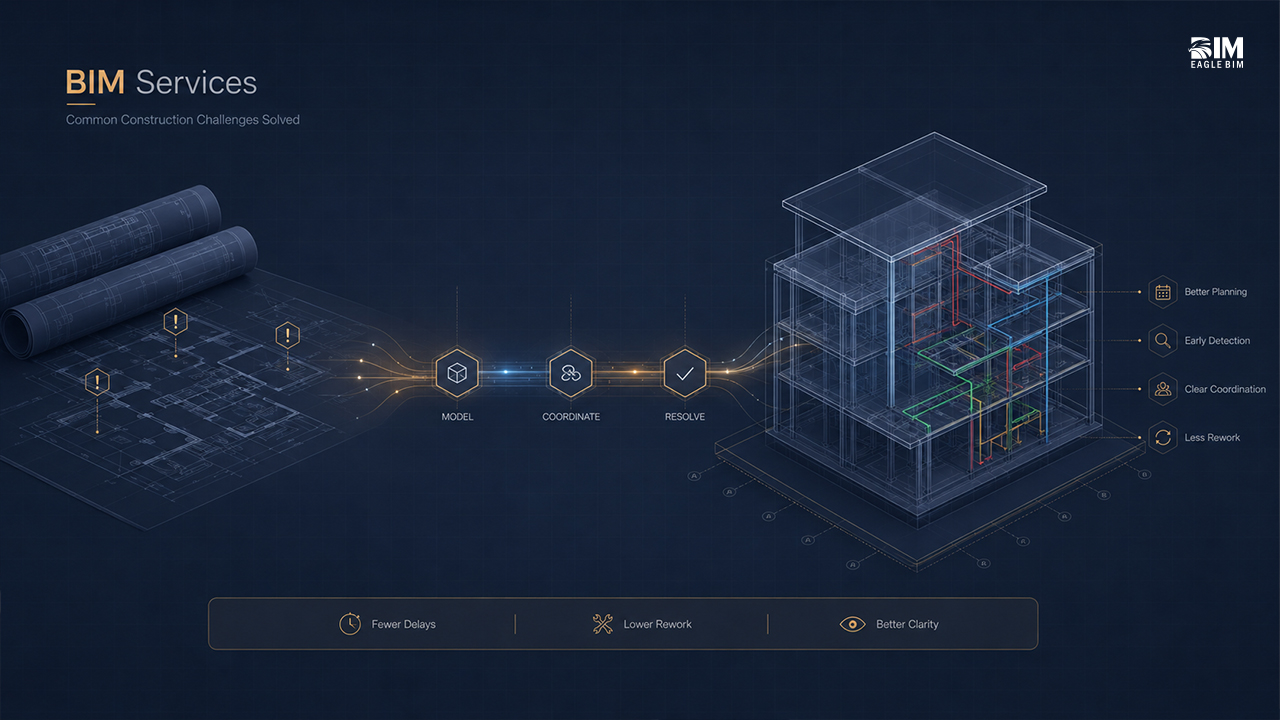
That lack of clarity leads to delays, cost overruns, poor coordination, weak collaboration, and repeated site corrections. Below are some of the most common problems that BIM Services help solve.
1. Project Delays in Construction Projects
Project delays often begin much earlier than anyone notices.
A team may only feel the delay once the site schedule starts slipping, but the actual cause is often hidden in unresolved clashes, incomplete coordination, or design decisions that were never fully reviewed across disciplines.
By the time those issues appear on site, they are no longer simple design questions. They begin affecting procurement, labor planning, approvals, installation sequences, and overall site productivity.
This is where BIM Services help. With coordinated 3D models, teams can review service routes, ceiling congestion, equipment placement, and trade relationships before work begins. Autodesk notes that BIM can identify clashes between different building systems and components before construction begins, helping save time and money.
That early visibility reduces field confusion. Instead of solving problems while crews are already working, teams can address many of them during coordination.
2. Cost Overruns and Budget Issues
Budgets usually do not fail because of one dramatic event.
They get damaged through repeated small issues like rework, site modifications, wasted materials, delayed decisions, change orders, and labor inefficiencies. Poor coordination often sits quietly behind these cost problems.
This is one of the strongest reasons to invest in Building Information Modeling services.
McKinsey has noted that large projects across asset classes typically take 20 percent longer than scheduled and can run up to 80 percent over budget. That does not mean every project will face those numbers, but it does show how vulnerable construction can be when planning and coordination are weak.
When teams work from coordinated models, they can improve quantity confidence, support procurement planning, reduce clashes, and avoid many of the corrections that typically happen later in the project. Better information early often leads to fewer expensive fixes later.
That is the real value of BIM Services. They are not just useful for design teams. They help protect time, effort, and cost across the project lifecycle.
3. Poor Project Visualization Before Construction
A lot of project confusion comes from the fact that different stakeholders interpret the same drawings in different ways.
The architect may understand the design intent. The contractor may focus on constructability. The owner may struggle to visualize the finished result. A trade partner may not notice a routing problem until several systems begin competing for the same space.
This is one of the clearest strengths of BIM Modeling Services.
A coordinated 3D model makes the project easier to review, discuss, and understand. Teams can study service layouts, access zones, equipment locations, and spatial relationships before construction begins.
In simple terms, BIM in construction helps people move from assumption to clarity.
For companies looking to improve preconstruction review and coordination workflows, our Building Information Modeling services support teams with practical BIM solutions built for real construction conditions.
4. Design Conflicts and Coordination Issues
This is one of the biggest reasons project teams rely on BIM Services.
Modern buildings are full of layered systems. Architecture, structure, HVAC, piping, electrical, and fire protection all need room to fit, function, and remain maintainable. Each discipline may complete its own work correctly, but once those packages come together, conflicts begin to show up.
A duct crosses a beam. A cable tray blocks service access. Pipes crowd the ceiling zone. Equipment clearances are ignored. A shaft becomes too tight. Shop drawings still need interpretation because the coordination was never fully resolved.
This is exactly where BIM Services create value. Instead of discovering these issues during installation, teams can review and solve them in the model first.
That means better coordination, fewer site problems, and a smoother path from design to execution.
5. Poor Collaboration Between Stakeholders
Construction depends on collaboration, but not every project has a workflow that supports it well.
Architects, consultants, owners, contractors, subcontractors, and fabricators often work with different priorities, different software, and different timelines. When information is fragmented, people start relying on assumptions.
One team believes something is final. Another is still waiting for clarification. Someone is reviewing an outdated file. Someone else assumes the site team will sort it out later.
That is how coordination risk grows.
BIM Services help by creating a shared reference for discussion, issue tracking, and review. Instead of passing disconnected files back and forth, teams can work around a more coordinated project environment.
Good collaboration is not just about sharing information. It is about making sure everyone is seeing the same reality at the same time.
6. Rework and Construction Errors
Rework is one of the most frustrating costs in construction because it usually feels avoidable once the reason becomes clear.
Once something has been installed incorrectly, the issue affects more than just that one area. It affects labor, materials, sequencing, inspections, and confidence in the drawings. Even small conflicts can create larger ripple effects when multiple trades are involved.
This is where BIM Services help in a very practical way.
When teams coordinate early, the path from model to installation becomes clearer. Shop drawings improve. Fabrication planning becomes more reliable. Field teams work with better information.
The model does not replace experience on site. It helps teams use that experience earlier, when it can prevent mistakes instead of only fixing them.
Key Benefits of BIM Services for Construction Projects
The real value of BIM Services is not only that they create a 3D model. It is that they improve the way decisions are made before those decisions begin affecting cost, schedule, and construction quality.
With BIM Modeling Services, teams can:
- Improve coordination across trades
- Review layouts with more clarity
- Detect clashes before installation
- Reduce rework and waste
- Support better quantity planning
- Improve communication between stakeholders
- Create stronger project documentation
In practical terms, this means fewer surprises, better project flow, and a stronger link between design intent and construction execution.
Industries That Benefit Most from BIM Services
Almost every construction sector can benefit from BIM Services, but the value becomes even more obvious in projects where coordination is dense and risk is high.
Commercial projects benefit because multiple trades need to work within tight spaces and fast timelines. Residential and mixed-use projects benefit from better consistency across repeated units and systems. Healthcare projects benefit because of dense MEP coordination and strict access requirements. Educational, hospitality, industrial, and infrastructure projects also benefit because they involve many stakeholders and need stronger long-term planning.
That is why Building Information Modeling services are now seen as an important part of modern project delivery, not just an optional support service.
How Eagle BIM Services Solves Construction Challenges
Eagle BIM Services helps project teams solve these challenges by focusing on coordination, clarity, and practical project use.
That means BIM is not treated as just a modeling output. It is approached as a construction support process that helps teams reduce blind spots, resolve conflicts early, and improve execution quality.
Whether the need is architectural BIM, structural BIM, MEP coordination, clash detection, shop drawings, scan to BIM, or as-built modeling, the real value comes from making project information more useful for the people who are actually designing, building, and managing the work.
Strong BIM Services do not just make the model look complete. They make the project easier to understand and easier to deliver.
The Future of BIM Services in Construction Industry
The future of BIM Services is moving toward deeper integration across the full building lifecycle.
What started as a better way to model and coordinate is now becoming part of how teams manage scheduling, quantities, handover data, facility information, and long-term building operations.
Conclusion
Most construction problems are not random.
They come from poor visibility, disconnected teams, unresolved coordination, weak communication, and issues being discovered too late. Delays, budget overruns, rework, and design conflicts may look like separate problems, but they usually begin with the same issue: not enough clarity early in the project.
That is why BIM Services matter.
They help teams coordinate better, visualize more clearly, communicate more effectively, and reduce the kind of preventable mistakes that cost time and money on site. From design review to clash detection to project documentation, BIM Modeling Services help turn fragmented information into a more reliable construction workflow.
In simple terms, Building Information Modeling services help project teams make fewer expensive discoveries in the field.
Frequently Asked Questions
Q1. What construction challenges do BIM Services actually solve?
BIM Services solve five recurring construction problems at their root: project delays caused by unresolved clashes, cost overruns from rework and change orders, poor project visualization that leads to misaligned stakeholder expectations, design conflicts between architectural, structural, and MEP disciplines, and weak collaboration across the project team. The common cause behind all five is the same — teams not having enough clarity early enough. BIM in construction addresses that by giving every stakeholder access to a shared, intelligent 3D model where problems surface before they reach the field, not after.
Q2. How do BIM Services prevent project delays in construction?
Project delays usually begin much earlier than they’re felt — the schedule slip only appears on site, but the actual cause is hidden in unresolved clashes, incomplete coordination, or design decisions never fully reviewed across disciplines. BIM Services prevent this by running coordinated reviews of service routes, ceiling congestion, equipment placement, and trade relationships before construction starts. Autodesk notes that BIM clash detection identifies conflicts between systems before construction begins, helping save both time and money. The pattern is consistent: catching a clash in the model takes minutes; catching it on site takes weeks.
Q3. How do BIM Services help control construction cost overruns?
Construction budgets rarely fail because of one dramatic event — they get damaged through repeated small issues: rework, site modifications, wasted materials, delayed decisions, change orders, and labor inefficiencies. McKinsey’s research shows large projects typically run up to 80 percent over budget, with poor coordination sitting quietly behind most of those overruns. BIM Services help by giving teams better quantity confidence, supporting procurement planning, reducing clashes that drive change orders, and avoiding the corrections that usually compound late in a project. Better information early consistently leads to fewer expensive fixes later.
Q4. What design conflicts and coordination issues do BIM Services catch?
Modern buildings layer architecture, structure, HVAC, piping, electrical, and fire protection into the same envelope — and each discipline can complete its work correctly while still producing conflicts when packages combine. Common issues BIM Services catch: a duct crossing a beam, a cable tray blocking service access, pipes crowding the ceiling zone, ignored equipment clearances, shafts too tight for installation, and shop drawings still needing interpretation because coordination was never fully resolved. BIM Modeling Services run automated clash detection across the federated model so these are reviewed and solved virtually — not discovered during installation.
Q5. How do BIM Services improve project visualization and stakeholder understanding?
A lot of project confusion comes from different stakeholders interpreting the same drawings differently. The architect sees design intent. The contractor sees constructability. The owner struggles to picture the finished result. A trade partner may not catch a routing problem until several systems compete for the same space. BIM in construction shifts everyone to the same coordinated 3D model — service layouts, access zones, equipment locations, and spatial relationships become reviewable before construction begins. In simple terms, Building Information Modeling services help people move from assumption to clarity.
Q6. Why should construction teams rely on BIM Services instead of traditional CAD coordination?
Traditional CAD coordination depends on overlaying drawings by eye and trusting that experienced professionals catch most conflicts. That worked when buildings were simpler, but modern construction involves tighter spaces, denser MEP systems, faster schedules, and more stakeholders. BIM Services replace assumption-based coordination with model-based verification — every clash is flagged automatically, every quantity is parametric, every change cascades through the documentation. Teams using BIM Services don’t catch slightly more conflicts; they catch the kinds of conflicts that 2D coordination structurally cannot find. That’s the difference between fewer site corrections and a fundamentally different risk profile.