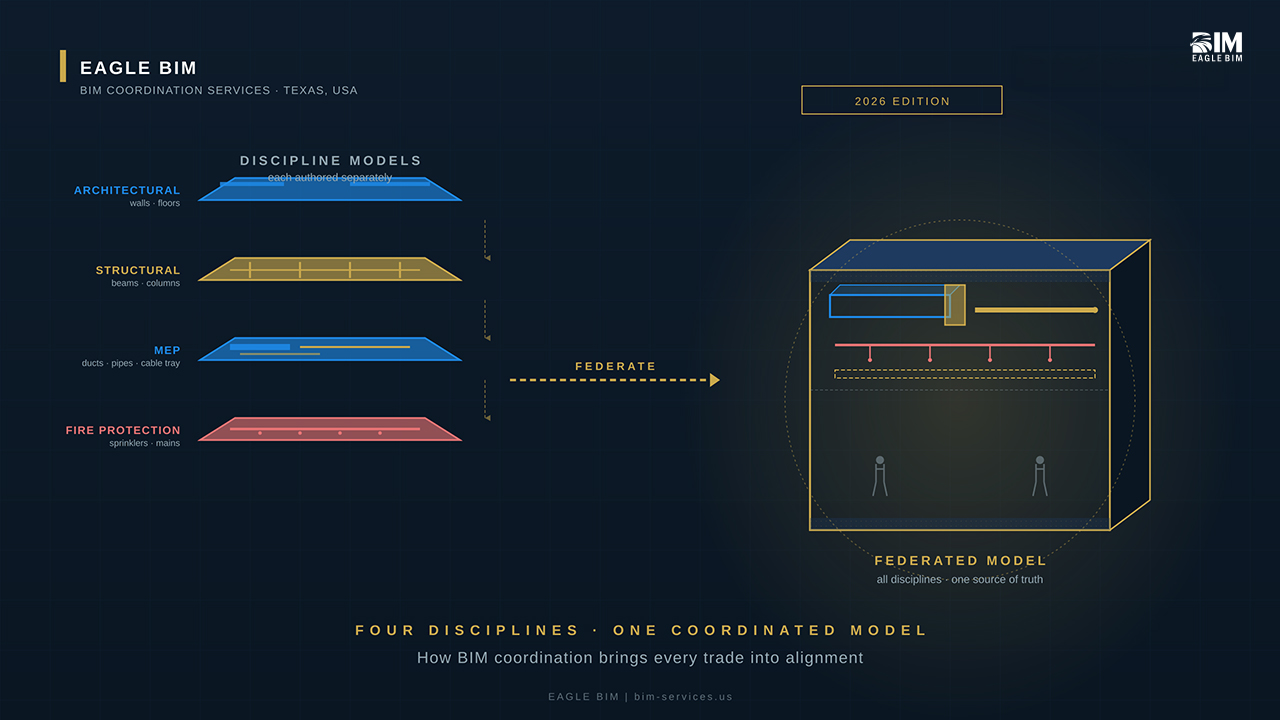
BIM coordination services is the process of combining architectural, structural, MEP, and fire protection models into one federated digital model to find and resolve design conflicts before construction begins. The process uses software like Revit and Navisworks to run automated clash detection, identify hard clashes (physical intersections), soft clashes (clearance violations), and workflow clashes (sequencing conflicts), and then resolve them through structured OAC coordination meetings. The output is a fully coordinated, clash-free, constructable model that delivers shop drawings, fabrication-ready content, and reduced field RFIs.
This guide walks through what BIM coordination services actually involve in 2026, how the BIM coordination process works step by step, what software is used, what deliverables come out, how long it takes, and when to hire an external coordination partner. Written for general contractors, MEP subcontractors, architects, and project owners who need a clear, no-fluff understanding of how good BIM coordination services actually run on commercial construction projects.
What Is BIM Coordination
BIM coordination is the discipline of aligning every building system in a digital model before any contractor breaks ground. Architects, structural engineers, MEP designers, fire protection engineers, and specialty trades each build their own Revit model. BIM coordination links those models into one federated environment, runs automated clash detection between every system, holds regular coordination meetings to resolve conflicts, and produces a final clash-free model ready for fabrication and field install.
The BIM coordination process exists because modern commercial buildings have far more systems than 2D drawings can practically represent. A hospital floor plate has dozens of duct runs, hundreds of pipe segments, thousands of cable tray, conduit, and fire protection elements all routing through the same ceiling plenum. Trying to coordinate that scope in 2D is how field rework happens. BIM coordination services solve the problem by moving the coordination from the field (expensive, late, time-pressured) to the model (cheap, early, methodical).
Every commercial project of meaningful complexity now expects BIM coordination services as a baseline. General contractors require it from MEP subs. Owners require it from GCs. Lenders require it from owners. The MEP BIM coordination scope has matured into a non-negotiable contract requirement on healthcare, data center, semiconductor fab, multifamily, and educational projects.
Why BIM Coordination Matters in Modern Construction
BIM coordination matters because design conflicts are the single most expensive class of construction problem when they’re discovered in the field rather than the model. A ductwork rerouting in a finished mechanical room can cost tens of thousands of dollars per change order. A clash discovered in the model costs almost nothing to resolve. BIM coordination moves the discovery of conflicts from the most expensive phase (construction) to the cheapest phase (design).
Three concrete reasons BIM coordination services pay for themselves on every commercial project that uses them properly. First, RFI reduction. Industry research from Dodge Construction Network shows that projects using disciplined BIM coordination process workflows reduce field RFIs by 40 to 60 percent compared to projects that don’t. Every RFI prevented is real money saved on superintendent time, design team callback, and schedule risk.
Second, prefab readiness. Coordinated models at LOD 400 support off-site fabrication of MEP assemblies. Bathroom pods, plumbing wet walls, MEP racks, and electrical assemblies all benefit from prefab when the underlying model is fully coordinated. Projects that use prefab on multifamily, healthcare, and data center builds shave weeks off the schedule. None of that prefab works without disciplined upstream BIM coordination services.
Third, owner-facing risk reduction. Coordinated models reduce the number of change orders that hit the owner during construction. Change orders are how good projects go bad: every one is a budget hit, a schedule hit, and a relationship hit between the owner, GC, and designers. MEP BIM coordination done properly eliminates most change orders driven by design conflict.
How Does the BIM Coordination Process Work
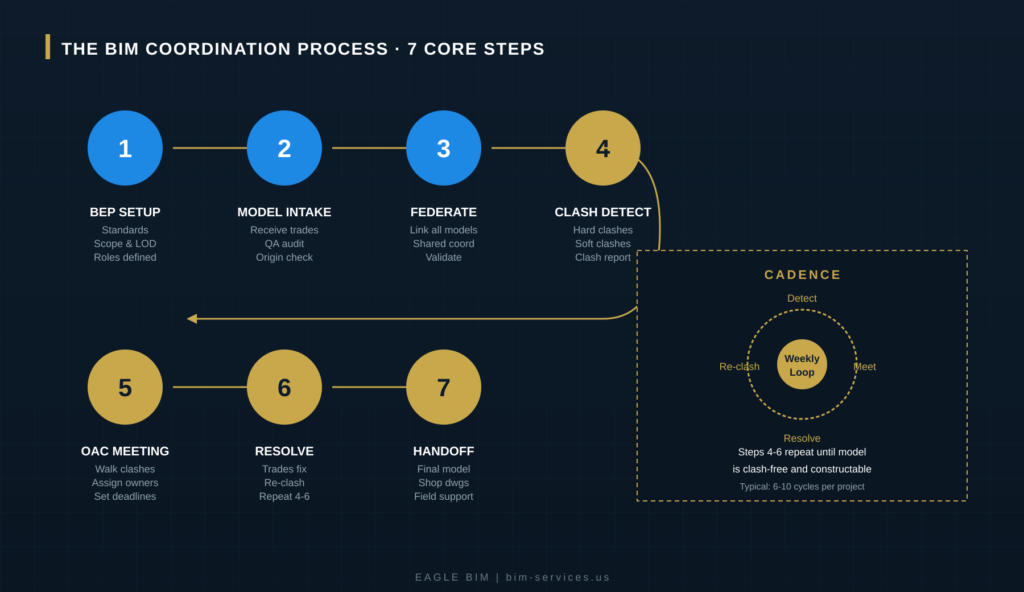
The BIM coordination process works in seven core steps: (1) set up the BIM Execution Plan defining standards and roles, (2) intake each discipline’s model and audit quality, (3) federate all models into one shared coordinate environment, (4) run automated clash detection to find conflicts, (5) hold OAC coordination meetings to assign resolution owners, (6) update models and re-run clash detection until clean, and (7) hand off the final coordinated model with shop drawings and field support. Steps 4 through 6 repeat in weekly cycles until the model is clash-free and constructable.
The BIM coordination workflow is structured because the work is too complex for ad-hoc methods. Trying to coordinate a healthcare floor plate without a systematic workflow produces incomplete clash detection, missed conflicts, and field rework. Every disciplined BIM coordination services engagement follows roughly the same seven-step structure, customized to project type and contract scope. Here’s what each step actually involves.
Step 1: BIM Execution Plan Setup
Every coordination project starts with the BIM Execution Plan (BEP). The BEP is the rulebook: what software versions, what LOD targets, what file naming, what coordinate system, what meeting cadence, what deliverables, what sign-off gates. Without a documented BEP, every trade interprets the scope differently and the BIM coordination workflow falls apart by week three. Eagle BIM’s BEP setup includes coordinate system origin, shared parameters list, level naming, view templates, file naming conventions, and the responsibility matrix for who owns which model elements.
Step 2: Model Intake and Quality Audit
Each discipline submits their authoring model (typically Revit) to the coordination team. The coordination team audits each model for quality: are the model elements at the agreed LOD? Are systems properly named? Are families and types built correctly? Is the origin at the agreed coordinate location? A bad intake audit early prevents wasted clash detection cycles later. Common rejection reasons include incorrect origin, missing systems, wrong LOD, and unresolved warnings in the source file.
Step 3: Federate All Models
With clean discipline models in hand, the coordination team builds the federated BIM model. Federation is the technical act of linking every discipline’s model into a single environment. Revit-to-Revit federation uses linked models with shared coordinates. Navisworks federation aggregates everything into a single NWF or NWD file. Cloud-based federation in BIM 360 or Autodesk Construction Cloud (ACC) keeps the federation live. The federated model becomes the single source of truth for the entire project team.
Step 4: Run Automated Clash Detection
With the federated model in place, the coordination team runs automated clash detection. Software like Navisworks or Revizto compares every element in every discipline against every other element looking for geometric conflicts. The output is a clash report listing every hard clash (physical intersection), soft clash (clearance violation), and optionally workflow clash (4D sequencing conflict). A typical first-run clash report on a commercial project might surface hundreds or thousands of clashes, which is normal and expected.
Step 5: OAC Coordination Meetings
Clash reports get walked in weekly Owner-Architect-Contractor (OAC) coordination meetings. The BIM coordinator (often the role Eagle BIM plays) drives the meeting: walk each clash, assign a resolution owner, set a deadline, capture the decision. Good OAC meetings move through dozens of clashes per session because the prep work was done upfront. Bad OAC meetings devolve into trade arguments because the BEP didn’t define who owns what. The BIM coordination meetings cadence is usually weekly during active coordination phases, scaling to bi-weekly or monthly during slower phases.
Step 6: Resolve and Re-Run Clash Detection
Trades update their models based on the OAC decisions. The coordination team re-federates the models and re-runs clash detection. New clashes always surface. Fixing one duct route often creates a new clash with electrical or plumbing. The cycle repeats: detect, meet, resolve, re-clash. A typical commercial project might run six to ten of these cycles before the model is clean enough for construction. Steps 4 through 6 are where the real coordination work happens.
Step 7: Handoff and Field Support
Once the model is clean, the BIM coordination services team produces the final deliverables: the clash-free federated model, the coordinated drawings, the shop drawings (if scoped), the issue log showing every clash resolved, and the field-ready handoff package. Eagle BIM stays available for field RFI support during construction because field discoveries always surface things the model didn’t capture. The handoff is not the end of coordination work. It’s the transition from design coordination to construction coordination.
What Is a Federated BIM Model
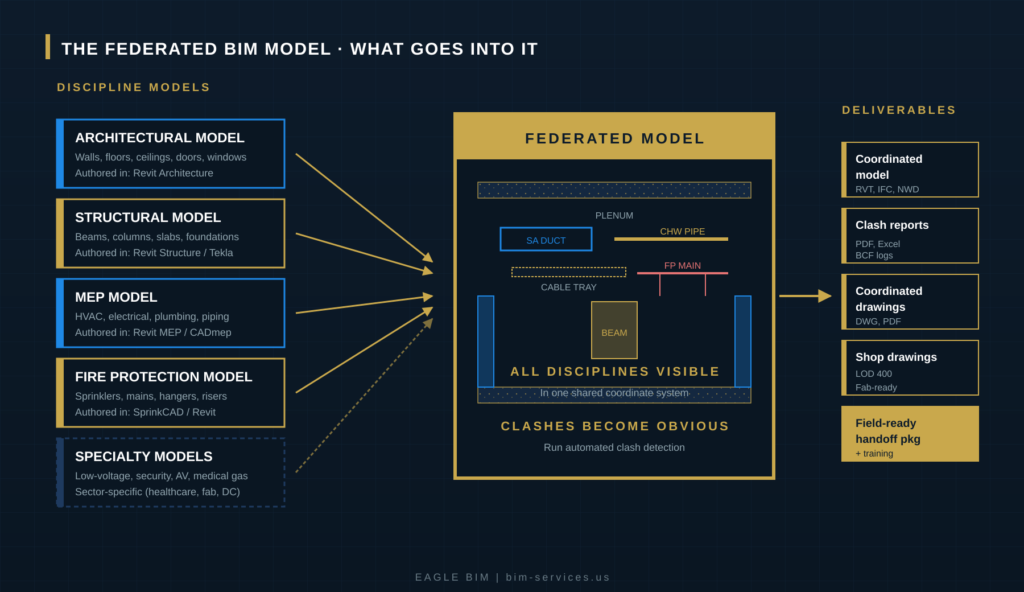
A federated BIM model is a single combined model that links every discipline’s individual Revit, Tekla, or other authoring model into one shared coordinate environment. Each discipline keeps their own model as the authoring source. Architects keep their Revit Architecture model, structural engineers keep their Revit Structure or Tekla model, MEP engineers keep their Revit MEP model. But those models are linked into a federated environment where the BIM coordination team runs clash detection across the entire project. The federated model is the single source of truth used by the coordination team, not a separate authoring model.
The federated BIM model approach matters because it preserves authoring control while enabling coordination at scale. Architects don’t want MEP coordinators editing their architectural model. MEP engineers don’t want structural engineers editing their HVAC routing. Federation lets each discipline own their authoring model while the coordination team owns the federated coordination model. Updates propagate from authoring models into the federation automatically (in Revit-to-Revit setups) or through controlled refresh cycles (in Navisworks setups).
Modern federated BIM model workflows live in cloud-based common data environments (CDEs) like Autodesk Construction Cloud (ACC), formerly BIM 360. The CDE hosts the linked models, manages versioning, tracks issues with BCF (BIM Collaboration Format) files, and supports remote OAC meetings. Some firms use Revizto as the coordination platform layered on top of the authoring models. The platform choice is less important than the discipline: every project needs one designated source of truth for coordination.
What Software Is Used for BIM Coordination
BIM coordination uses three main software categories. First, authoring tools: Autodesk Revit (the industry standard), Tekla Structures (steel and precast), CADmep (mechanical fabrication), SprinkCAD (fire protection). (2) Federation and clash detection tools, including Autodesk Navisworks Manage (the dominant clash detection platform), Revizto (cloud-based federation and issue tracking), Solibri Office (model checking and code compliance). (3) Common data environment platforms such as Autodesk Construction Cloud (ACC) / BIM 360, Procore, Bluebeam Studio. Most US commercial projects standardize on Revit + Navisworks + ACC.
Revit is the dominant authoring platform in US commercial construction. The vast majority of BIM coordination services engagements involve Revit-authored models from architects, structural engineers, and MEP designers. Specialty trades sometimes work in CADmep (mechanical fabrication), SprinkCAD (fire protection), or AutoCAD-based platforms. Those non-Revit models get federated into the coordination environment through IFC export or NWC publishing.
Navisworks Manage is the dominant clash detection tool. It aggregates models from any source (Revit, Tekla, CAD, IFC), runs rule-based clash detection, manages clash groups and selection sets, and exports clash reports. Revizto is increasingly common as a cloud-based alternative that integrates federation, clash detection, and issue tracking in a single platform. BIM 360 Coordinate (now part of ACC) provides Navisworks-style clash detection in a cloud-native environment.
The BIM coordination workflow cadence is anchored in Autodesk Construction Cloud (ACC) for most US projects. ACC hosts the linked models, manages the issues log, runs the OAC meetings through screen-share, and provides field teams mobile access to the coordinated model. The choice of CDE is usually dictated by the GC or owner, and Eagle BIM works in whichever environment the project standardizes on.
What Deliverables Come From BIM Coordination
BIM coordination produces five core deliverables. (1) The coordinated federated model in RVT, IFC, and NWD formats. (2) Clash reports documenting every conflict found and resolved, exported as PDF or Excel with BCF issue tracking. (3) Coordinated drawings, including plan views, sections, and details extracted from the coordinated model in DWG and PDF. (4) Shop drawings at LOD 400 for MEP fabrication when scoped. (5) The field-ready handoff package including the issue log, the model viewer, and field support documentation. Some projects also receive 4D simulation, quantity takeoffs, and as-built model updates.
The BIM coordination deliverables scope varies by contract. Some engagements stop at the coordinated model and clash report. Others continue through shop drawings, prefab support, field RFI response, and as-built model maintenance. Eagle BIM’s standard scope includes the federated model, clash reports, coordinated drawings, and weekly OAC meeting facilitation. Shop drawings, prefab support, scan-to-BIM as-built updates, and 4D simulation are scoped as additions based on project requirements.
How Long Does BIM Coordination Take
BIM coordination on a typical mid-size commercial project takes six to twelve weeks from kickoff to handoff. Smaller projects (single-story commercial, simple multifamily) can compress to four to six weeks. Larger or more complex projects (multi-tower hospitals, semiconductor fabs, hyperscale data centers) can extend to six to twelve months for full coordination. The duration is driven by project size, system complexity, LOD target, number of trades involved, and how clean the source discipline models are at intake.
Eagle BIM’s typical engagement on a commercial project follows an eight-week coordination cadence: week one for kickoff and BEP review, week two for model intake and first clash run, weeks three to five for active coordination cycles, week six for shop drawing preparation, week seven for QC and constructability review, and week eight for handoff. We covered this cadence in detail in our
Revit MEP coordination workflow blog. Larger projects scale the cadence. Multifamily 200-plus unit builds typically run 12 to 16 weeks of active coordination, healthcare bed towers can run 16 to 24 weeks, and data center or fab work can run six to twelve months across multiple phases.
When to Hire BIM Coordination Services
Hire external BIM coordination services when (1) your project has more than two MEPFP trades and ceiling-plenum complexity, (2) your in-house team is at capacity and the project is on a schedule, (3) the project requires LOD 400 fabrication-ready models, (4) the owner contract requires coordinated BIM deliverables, (5) the project crosses sector specialty depth you don’t have in-house (healthcare ICRA, fab cleanroom, data center mission-critical), or (6) the project schedule can’t absorb the ramp time of hiring and training in-house coordinators.
The most common trigger for hiring BIM coordination services is contract requirement. Owner contracts on healthcare, data center, federal, and Class A commercial projects increasingly mandate coordinated BIM deliverables at specific LOD targets. If your firm doesn’t have a dedicated BIM coordination team, hiring an external partner is faster and more reliable than scaling in-house. We covered the math on this decision in our
in-house BIM team vs outsourced BIM coordination blog. The short version: outsourcing wins for variable pipelines and specialty work, in-house wins for steady single-sector pipelines, and most firms end up with a hybrid model.
The second common trigger is specialty depth. Healthcare BIM requires ICRA infection control discipline and FGI Guidelines compliance. Data center BIM requires 2N redundancy modeling and underfloor coordination. Semiconductor fab BIM requires ISO 14644 cleanroom compliance and sub-fab utility routing. Multifamily BIM requires podium transition discipline and stacked riser alignment. Hiring a coordination partner with proven specialty depth in your sector is faster and lower risk than building it in-house from scratch.
| Scoping a Project That Needs BIM Coordination?
Eagle BIM delivers BIM coordination services across Texas and the USA for general contractors, MEP subcontractors, architects, and owners. Healthcare, multifamily, data center, fab, and commercial sectors. LOD 300 through LOD 400 fabrication-ready output. |
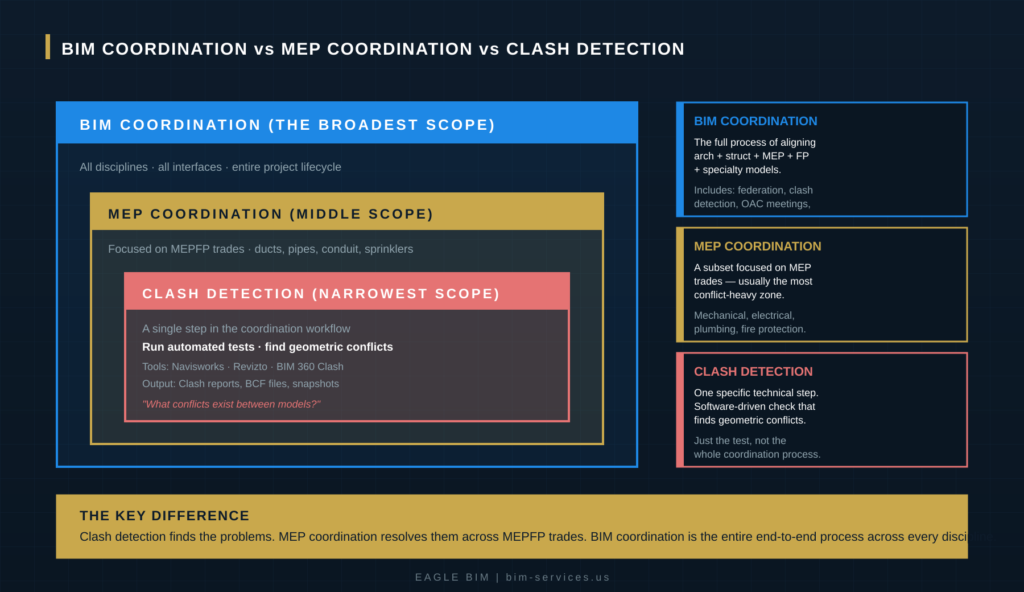
BIM Coordination vs MEP Coordination vs Clash Detection
These three terms are often confused. BIM coordination is the broadest scope, the entire process of aligning every discipline’s model. MEP coordination is a subset focused specifically on MEPFP (mechanical, electrical, plumbing, fire protection) trades, which is usually the most conflict-heavy zone of any building. Clash detection is the narrowest scope, a single technical step within the coordination process where software runs automated tests to find geometric conflicts. Clash detection finds problems, MEP coordination resolves them across MEPFP trades, and BIM coordination is the end-to-end process across every discipline.
The confusion comes from sales messaging. Vendors often use the three terms interchangeably to describe the same service. In practice, the three terms describe different scopes. When a GC asks for MEP BIM coordination, they typically mean the full coordination workflow scoped to MEPFP trades. When they ask for clash detection, they typically mean just the software-driven test step. When they ask for BIM coordination services generally, they mean the full end-to-end coordination across architectural, structural, MEPFP, and specialty disciplines.
Eagle BIM’s typical engagement covers the full BIM coordination services scope including all disciplines. Some clients scope us only to MEP BIM coordination because they have architectural-structural coordination handled in-house. Other clients scope us only to clash detection because they want a second-opinion check on their internal coordination work. We work with whichever scope the project needs.
Common BIM Coordination Challenges
The most common BIM coordination challenges are (1) source models arriving at the wrong LOD or with incorrect origin coordinates, (2) trade subcontractors not engaging in OAC meetings or missing resolution deadlines, (3) version drift between authoring models and the federated model, (4) clash reports piling up without disciplined resolution cadence, (5) the BEP being treated as a formality instead of an enforceable contract document, and (6) shop drawings being treated as an afterthought rather than a first-class deliverable.
Source model quality is the single biggest predictor of coordination success. A clean intake, with correct origin, correct LOD, correct families, and no warnings, sets up the rest of the workflow for success. A messy intake, with wrong origin, mixed LOD, broken families, and hundreds of warnings, creates wasted clash detection cycles and frustrated OAC meetings. Eagle BIM’s intake audit catches most of these issues in week one, but recovering from a bad source model takes additional weeks.
Trade engagement is the second predictor. If MEPFP subs don’t show up to OAC meetings, don’t update their models on schedule, and don’t take resolution ownership, the BIM coordination process stalls. Good coordination engagements have written engagement expectations in the BEP, enforceable through the GC’s subcontractor agreements. Bad engagements rely on informal goodwill and fall apart when schedule pressure hits.
We covered the seven most common BIM coordination workflow mistakes in detail in our separate common BIM coordination mistakes blog. The short version: start the coordination early, enforce the BEP, audit source models, hold trades accountable to OAC commitments, and don’t let clash reports pile up.
How Eagle BIM Runs the Coordination Workflow
Eagle BIM runs BIM coordination on an eight-week base cadence customized to project scope. We start with a BEP review and federation setup in week one, move through weekly clash detection and OAC coordination cycles in weeks two through six, and close with QC, shop drawings, and handoff in weeks seven and eight. Our team is based in Texas in association with BIMPRO LLC (Pflugerville, TX), with over 10 years of project experience across healthcare, multifamily, data centers, semiconductor fabs, and commercial sectors. We work in Autodesk Construction Cloud, BIM 360, Procore, Bluebeam, and Revizto depending on the project’s standard CDE.
Our coordination engagements are scoped by discipline, not bundled. We can deliver full multi-discipline BIM coordination services (architectural, structural, MEP, fire protection, specialty), MEP BIM coordination only, or clash detection only as a second-opinion service. We integrate with the GC’s in-house team rather than competing with it. Most of our engagements involve serving as the third-party BIM coordinator who facilitates OAC meetings, drives resolution, and produces deliverables, leaving the GC’s superintendent focused on the field.
Eagle BIM works across Texas (Houston, Dallas-Fort Worth, Austin, San Antonio) and the broader USA. Our published
Houston BIM coordination services covers our Houston-specific workflow. Our sector-specific work includes BIM for healthcare construction, BIM for data centers Texas, BIM for semiconductor fabs Texas, and BIM for Texas multifamily construction. Cross-sector projects (multi-tower hospitals with attached parking and retail, mixed-use multifamily with ground-floor commercial) get coordinated under one unified team.
Industry data from the Dodge Construction Network continues to show that disciplined BIM coordination services reduce field rework by 40 to 60 percent on complex commercial projects. Eagle BIM has delivered that reduction across hospital expansions, multifamily podium builds, data center expansions, and Class A commercial projects throughout Texas. The math works because the upfront coordination investment is measured in weeks and the field rework prevention is measured in months.
Frequently Asked Questions
What is BIM coordination in simple terms?
BIM coordination is the process of combining every building system’s 3D model into one shared digital environment, then running automated tests to find conflicts between systems before construction starts. Architects, structural engineers, and MEP engineers each build their own model. The coordination team links those models together, finds where systems clash, and works with the trades to fix every clash in the model so the field doesn’t have to.
How is BIM coordination different from clash detection?
Clash detection is one step within the BIM coordination process. Clash detection is just the automated software test that finds where systems geometrically conflict. BIM coordination is the entire workflow that wraps around clash detection, including the BEP setup, model intake, federation, OAC meetings, resolution cycles, and final handoff. Clash detection finds the problems. BIM coordination resolves them.
What software is most commonly used for BIM coordination?
Autodesk Revit for authoring, Autodesk Navisworks Manage for clash detection, and Autodesk Construction Cloud (ACC) or BIM 360 for the common data environment. Revizto is increasingly common as an alternative federation platform. Tekla Structures is standard for structural steel and precast. CADmep is used for mechanical fabrication shop drawings. The exact tool stack varies by project, but the Revit + Navisworks + ACC combination covers the majority of US commercial projects.
How long does BIM coordination take?
Typical mid-size commercial projects take six to twelve weeks. Smaller projects compress to four to six weeks. Larger or more complex projects (hospitals, fabs, data centers) extend to six to twelve months. Duration depends on project size, system complexity, LOD target, number of trades, and source model quality. Eagle BIM’s default cadence is eight weeks for a typical commercial coordination engagement.
Who needs BIM coordination services?
General contractors running commercial projects with multiple MEP trades. MEP subcontractors who need their work coordinated against architectural and structural. Architects who want their design intent preserved through construction. Project owners who want fewer change orders and a cleaner handover. Almost every commercial project over a few million dollars in value now uses some form of BIM coordination.
What is a federated BIM model?
A federated BIM model is a single combined model that links every discipline’s individual authoring model into one shared coordinate environment. Each discipline keeps their own authoring model. The federated model is the coordination team’s view across all of them. Federation lets coordination happen without forcing one team to edit another team’s model.
What are the deliverables from BIM coordination services?
The coordinated federated model in RVT, IFC, and NWD formats. Clash reports in PDF and Excel with BCF issue tracking. Coordinated drawings extracted from the model in DWG and PDF. Shop drawings at LOD 400 when scoped. The final handoff package including the issue log, model viewer access, and field RFI support setup. Some projects also include 4D simulation and as-built model maintenance.
Does BIM coordination really reduce construction costs?
Yes, when done properly. Dodge Construction Network research shows projects with disciplined BIM coordination reduce field RFIs by 40 to 60 percent and reduce change orders driven by design conflicts by similar margins. The investment in upstream coordination pays back many times over in avoided field rework, prevented change orders, and reduced superintendent time managing conflicts. Projects that skip coordination or do it poorly tend to bleed money during construction.
| Ready to Scope BIM Coordination on Your Next Project?
Send Eagle BIM your project scope, drawings, or BEP draft. We will come back with a coordination proposal that covers federation, clash detection, OAC meeting facilitation, shop drawings, and handoff. Texas and USA coverage. Healthcare, data center, multifamily, fab, and commercial. |
| FAQ SCHEMA MARKUP (FOR DEV TEAM)
Add this JSON-LD FAQPage schema to the blog post for AI Overview citation eligibility. Drop it inside the <head> tag of the published page. FAQPage JSON-LD: see end of document for full schema block ready for copy-paste. |