Why Healthcare Is the Most Demanding Build Type in the Country
BIM for healthcare construction is one of the most technically demanding applications of Building Information Modeling in the entire AEC industry. Every construction project has complexity — but healthcare construction sits in a category entirely of its own.
Hospitals, outpatient surgery centers, and medical campuses carry thousands of interconnected mechanical, electrical, plumbing, and life-safety systems — all running simultaneously, all governed by strict code requirements, and all compressed into building spaces that were never designed to be simple. MEP systems alone account for 28 to 32 percent of total hospital construction expenditure. That share climbs even higher in outpatient surgery centers and imaging suites, where specialized HVAC filtration, medical gas, and radiation shielding requirements push MEP costs significantly higher.
For general contractors, MEP subcontractors, and healthcare owners working on projects in Texas and across the USA, the coordination challenge is substantial. A single unresolved clash between a structural beam and an HVAC duct can cascade into field rework, delayed commissioning, and cost overruns that ripple through the entire project budget.
This is precisely why BIM for healthcare construction has moved from a best practice to a baseline expectation. BIM for healthcare construction gives every discipline — architecture, structure, MEP, fire protection — a shared, coordinated environment to work from, catching problems in the model before they become problems on the job site.

What Makes Healthcare Construction So Uniquely Complex
Before diving into how BIM for healthcare construction solves the core coordination problems, it is worth understanding why those problems exist in the first place. BIM for healthcare construction addresses a specific problem set that no other building type replicates at the same intensity.
Density of MEP systems. A hospital ceiling space contains more systems in a tighter footprint than almost any other building type. HVAC ductwork, medical gas piping, electrical conduit, plumbing, fire suppression, nurse call systems, data cabling, and pneumatic tube lines all compete for the same overhead real estate. Getting them to coexist without clashing — and without violating clearance requirements for maintenance access — requires precision coordination from the earliest design stage.
Regulatory compliance requirements. Healthcare facilities in the USA must comply with FGI Guidelines, NFPA 99, ASHRAE 170, ADA standards, and in Texas, TDSHS regulations. BIM for healthcare construction makes compliance visible from the earliest design stage by embedding these constraints directly into the Revit modeling environment. Designs that look clean on a 2D drawing can violate code requirements that only become visible in a fully coordinated 3D model.
Zero tolerance for operational disruption. Hospitals operate 24 hours a day, 7 days a week. Even during new construction, adjacent wings may be fully occupied with patients. This means phasing matters, access routes matter, and rework is not just expensive — it can be genuinely dangerous. Getting it right the first time is a clinical requirement, not a preference.
Equipment integration complexity. Medical imaging equipment, surgical lighting, OR booms, sterilization units, and air handling systems all have specific structural and MEP requirements from equipment vendors. Those requirements must be coordinated with the building’s structural frame, ceiling systems, and rough-in design before procurement is finalized. Late coordination here creates severe cost consequences.
How BIM for Healthcare Construction Solves These Problems
Federated Modeling Brings Every Discipline Into One Space
The foundation of BIM for healthcare construction is the federated model. In hospital MEP BIM workflows, this is a single combined model that brings together the architectural, structural, and MEP-FP models produced by different design teams. In a hospital project, this federated model can contain thousands of elements across dozens of systems.
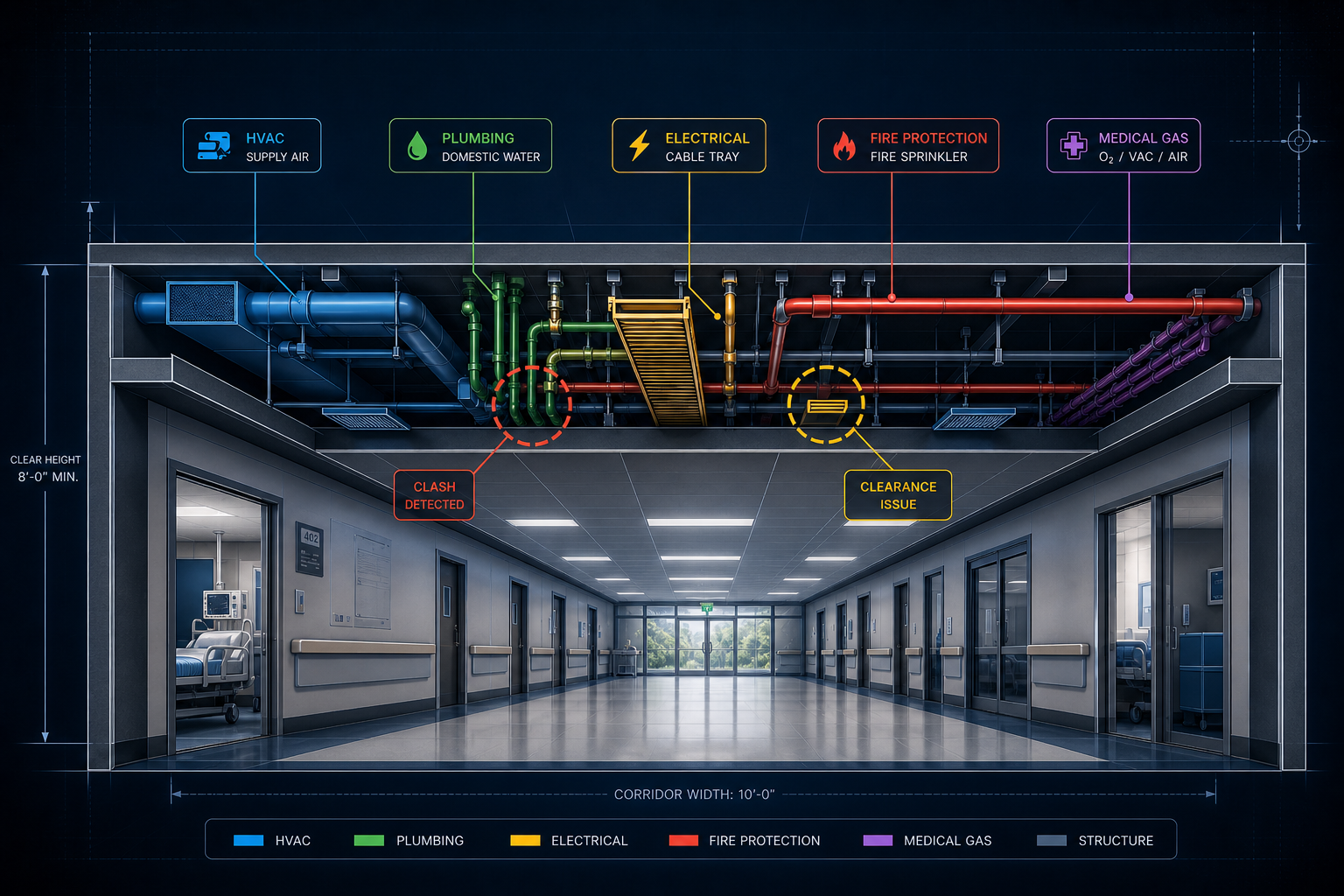
When you run clash detection against a federated model, you can identify hard clashes — two elements physically occupying the same space — soft clashes — elements violating clearance buffers — and workflow clashes — sequencing conflicts that create installation problems even without spatial overlap. Medical facility clash detection in Navisworks or Revizto gives the coordination team a structured, prioritized issue log that drives every subsequent coordination meeting.
At Eagle BIM, every healthcare BIM modeling engagement begins with federated model setup — aligning shared coordinates, confirming discipline model standards, and establishing the clash test rules and tolerances that reflect the project’s actual requirements. According to research tracking BIM adoption in US healthcare construction (ISI Professional Services, 2025), BIM integration has measurably reduced construction delays by 15 percent on healthcare projects while improving stakeholder coordination across all disciplines.

Clash Detection Eliminates the Most Expensive Field Problems
Medical facility clash detection resolves problems virtually that would otherwise become catastrophically expensive on site. Studies across the construction industry estimate that each unresolved clash costs an average of $1,500 or more — and dense MEP environments like hospitals can contain hundreds of potential conflicts across a single floor. Resolving those conflicts in the model, before field installation begins, is far cheaper than resolving them with crews on site.
Overhead corridor congestion. Corridors in hospitals must maintain specific clearance heights for patient transport and emergency equipment movement. MEP systems routed in these zones must stay within strict elevation bands — and when four or five disciplines compete for that space, coordination without BIM is essentially guesswork.
Operating room and ICU mechanical requirements. ORs require precise HVAC zoning for pressure differentials, filtration levels, and air change rates. Medical gas outlets, electrical panels, and surgical lighting fixtures all need specific rough-in locations coordinated with architectural layout and structural framing simultaneously.
Electrical redundancy routing. Life-safety electrical systems must be routed separately from standard circuits, which means duplicate conduit paths through already-congested spaces. Healthcare BIM modeling makes those routing conflicts visible before installation begins.
Medical gas coordination. Oxygen, nitrous oxide, medical air, and vacuum lines must be coordinated with HVAC equipment, fire suppression lines, and electrical conduit. Cross-contamination risks mean that proximity requirements are regulatory, not discretionary.
Revit Modeling Supports Every Phase of Hospital Design
One of the most important advantages of BIM for healthcare construction is that the same model supporting design coordination also drives documentation, shop drawing production, and construction administration.
At the schematic design stage, a well-built Revit model lets architects and MEP engineers test spatial layouts and equipment placements before committing to design decisions. At the design development stage, the model becomes the coordination environment where disciplines align. At the construction document stage, Revit modeling hospital drawing production ensures that plans, sections, details, and schedules reflect the actual coordinated design — not a diverged 2D version.
This continuity is especially valuable in healthcare BIM modeling because hospital designs change frequently during design development as equipment selections are finalized, clinical workflow requirements evolve, and owner requests trigger scope adjustments. A BIM-based workflow captures those changes in the model and propagates them through the documentation automatically.
Ready to coordinate your hospital project? Share Your Healthcare Project Scope with Eagle BIM →
Healthcare BIM Modeling in Texas — A Market That Cannot Slow Down
Texas is experiencing one of the most significant healthcare construction booms in its history. Population growth across Dallas-Fort Worth, Houston, Austin, and San Antonio is driving massive investment in hospital capacity, outpatient facilities, cancer centers, and specialty clinics.
The $2.5 billion expansion of MD Anderson Cancer Center at the UT Austin Medical Center — with pre-RFP construction services set to begin in 2026 — is one of the largest single healthcare construction projects in Texas history. Across the state, smaller but equally complex projects are breaking ground every quarter, from community hospital expansions to surgery center clusters built around growing suburban populations.
According to industry reporting on the US healthcare construction surge through 2025 and 2026 (For Construction Pros), Texas leads national healthcare construction growth alongside Florida, California, and North Carolina — with projects ranging from major hospital expansions to specialized outpatient clinics.
For MEP contractors, structural firms, and general contractors working in this environment, the demand for precise BIM for healthcare construction is not abstract. It is the difference between a project that coordinates cleanly and one that generates RFIs, change orders, and field rework at every milestone.
BIM healthcare Texas is not just about having the technology. It is about having a coordination partner who understands the clinical requirements, code environment, and documentation standards specific to medical construction. At Eagle BIM, our BIM for healthcare construction workflows are purpose-built for Texas projects — from community hospital expansions in suburban Dallas to large medical campus coordination in Houston and Austin.
Scan to BIM for Healthcare Renovations and Expansions
Not every healthcare BIM project starts from a clean slate. Many of the most complex hospital construction projects in Texas involve renovation and expansion of existing facilities — which means the BIM for healthcare construction workflow must begin with accurate documentation of existing conditions.
By capturing point cloud data from 3D laser scans of existing floors, mechanical rooms, and utility corridors, Eagle BIM produces accurate as-built Revit models that reflect what is actually built — not what the original drawings showed. In active hospital environments where decades of renovation work may have diverged significantly from legacy documentation, scan-derived as-built models are the only reliable foundation for a new coordination effort.
For renovation projects in occupied hospitals, scan to BIM also supports phasing planning. The as-built model becomes the starting point for understanding how new systems will integrate with existing ones, where shutdowns will be required, and which access routes must remain clear for patient and clinical staff movement during construction.
Shop Drawings and Prefabrication — How BIM for Healthcare Construction Accelerates Delivery
One of the most significant shifts in healthcare construction delivery over the past five years is the rapid adoption of prefabrication and modular construction for MEP systems. Prefabricated MEP racking, bathroom pods, headwall assemblies, and ceiling coordination packages are now standard on major hospital projects — and they all depend on BIM for healthcare construction to work.
Prefabricated components have reduced construction timelines by four to six months on large hospital tower projects. One Texas hospital’s modular expansion delivered a fully functional wing six months ahead of schedule while saving $15 million in operational costs. BIM for healthcare construction makes that possible by providing the coordinated, fabrication-ready geometry that prefab shop production depends on.
BIM-derived shop drawings are the link between the coordination model and the fabrication shop. When shop drawings are produced directly from a coordinated Revit or coordination model, they reflect the actual routed and coordinated geometry. That accuracy is what allows prefabricated assemblies to arrive on site and fit without adjustment. At Eagle BIM, shop drawing production for MEP and structural scopes is integrated with the coordination workflow — extracted from the same model that has been clash-detected and reviewed.

What to Look for in a Healthcare BIM Partner
Not every BIM firm is prepared for the coordination demands of hospital and medical facility projects. Healthcare BIM modeling requires a specific combination of technical capability, code awareness, and workflow discipline that goes beyond standard commercial coordination work. BIM for healthcare construction demands a partner who has done it before and can deliver without ambiguity.
Multi-discipline modeling capability. Hospital projects require coordination across architectural, structural, mechanical, electrical, plumbing, fire protection, and specialty systems simultaneously. A partner who handles only one or two disciplines cannot provide genuine federated coordination.
Code-aware modeling standards. Your BIM partner needs to understand the clearance requirements, routing restrictions, and system separation rules that govern healthcare construction. A clash that technically clears hard collision rules can still violate NFPA 99 medical gas separation requirements or ASHRAE 170 HVAC zoning standards.
Structured deliverable packages. Healthcare projects move fast and involve many stakeholders. Your BIM partner should deliver coordinated models, clash reports, issue logs, discipline-specific shop drawings, and revision tracking in formats your team can use — RVT, IFC, NWC, DWG, or PDF.
Scan to BIM capability for existing conditions. If your project involves existing facilities, point cloud processing and as-built modeling is the only way to build a coordination model that reflects reality.
Flexible engagement models. Some healthcare projects need a full coordination team from schematic design through construction administration. Others need clash detection support at specific milestones. Your BIM partner should be able to scope to your actual project needs without locking you into a fixed retainer.
Eagle BIM’s Healthcare BIM Workflow
Eagle BIM supports architects, MEP engineers, general contractors, and healthcare owners across Texas and the USA with the full range of BIM services needed for hospital and medical facility projects. BIM for healthcare construction at Eagle BIM is a disciplined, milestone-driven workflow built around the specific demands of medical facility coordination.
BIM Coordination: Federated modeling, clash detection, issue management, and coordination meeting support across architectural, structural, and MEP-FP disciplines — the core of BIM for healthcare construction.
MEP BIM Services: Revit modeling hospital-grade mechanical, electrical, plumbing, and fire protection systems built for coordination, constructability, and downstream shop drawing production.
Clash Detection Services: Structured medical facility clash detection using Navisworks, Revizto, and Revit, with clear reports, dashboards, and issue logs ready for review at every coordination milestone.
Scan to BIM Services: Point cloud processing and as-built Revit model production for renovation, expansion, and facility management projects in active healthcare environments.
Shop Drawing Services: MEP and structural shop drawings produced directly from coordinated models and formatted to your standards — extracted from the same models that have been clash-detected and reviewed.
Structural BIM Services: Steel, concrete, and precast models aligned with design intent and coordinated with MEP and architectural systems for healthcare BIM modeling at every level of development.
Working on a hospital, clinic, or medical campus project? Explore Eagle BIM’s MEP BIM Services →
The Bottom Line
Healthcare construction is the most demanding build environment in the country — and the hospital MEP BIM coordination challenge at the center of every hospital project is exactly what BIM for healthcare construction was built to solve.
Federated modeling, medical facility clash detection, code-aware MEP coordination, prefab-ready shop drawings, and scan to BIM for existing conditions all work together to give your project team the clarity and confidence they need to build right the first time. When BIM for healthcare construction is implemented correctly and early, the results are measurable: fewer RFIs, fewer change orders, faster approvals, and buildings that commission on schedule.
Texas healthcare construction is booming. Dallas, Houston, Austin, and San Antonio are all seeing major hospital expansions and new medical campuses breaking ground through 2026 and beyond. The teams that bring disciplined healthcare BIM modeling workflows to these projects will deliver better outcomes — cleaner submittals, shorter punch lists, and buildings that work the way they were designed.
BIM for healthcare construction is not optional on complex medical projects. It is the coordination foundation that everything else depends on. Eagle BIM is here to be that foundation. Share your scope and let us build it right — together.
Start your project the right way. Share Your Healthcare Project Scope with Eagle BIM →
Call Eagle BIM: +1 (346) 588-2960 | Visit: bim-services.us