
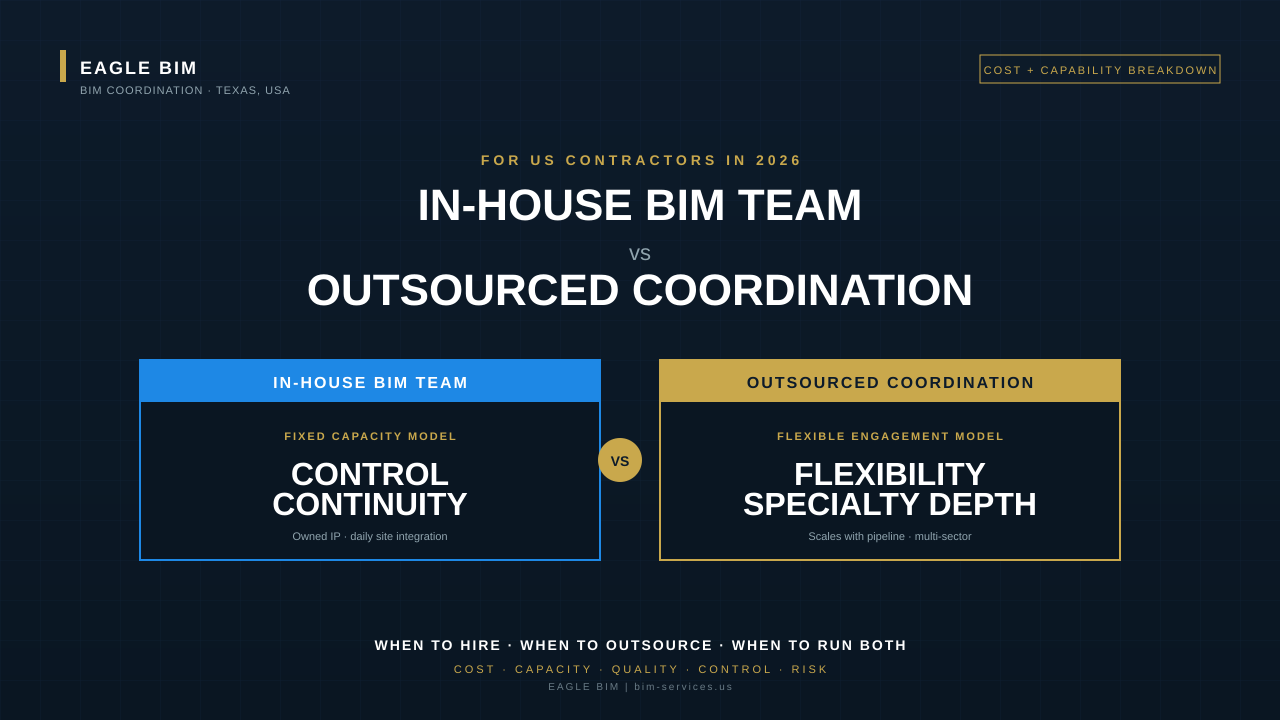
Every general contractor and MEP subcontractor eventually faces the same question. Do we build an in-house BIM team or do we outsource the coordination work? It’s framed as a cost question, but it almost never actually is. The honest answer involves capacity, pipeline predictability, specialty depth, project control, and a half dozen other factors that don’t show up in any salary spreadsheet. This blog walks through the in-house BIM vs outsourced BIM decision the way it actually plays out in 2026, with real cost structure, real capability tradeoffs, and a decision framework you can use.
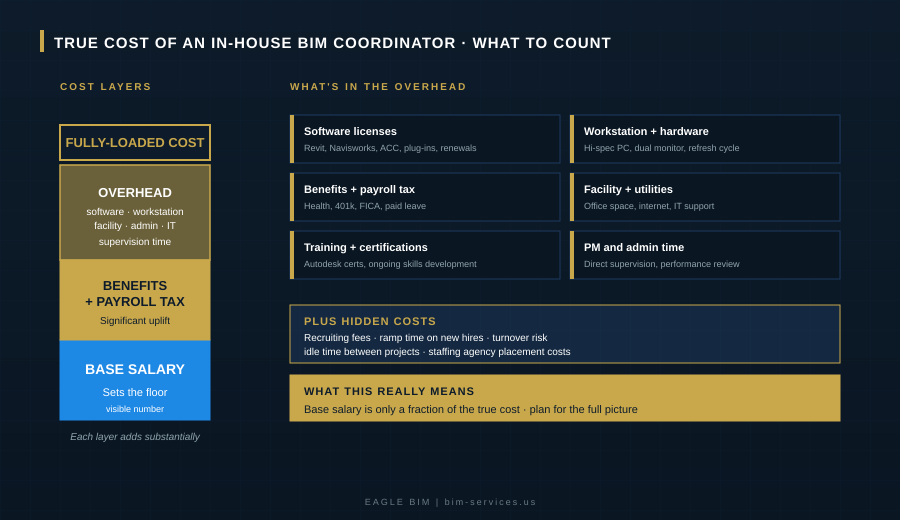
Quick context. A BIM coordinator in the US in 2026 carries a base salary that sets the floor of the conversation, but the base salary is not what the role actually costs. Add benefits, payroll taxes, software licenses, workstation hardware, training, facility overhead, and direct supervision time, and the fully-loaded annual cost runs substantially higher than the base number. AEC industry overhead multipliers add meaningful weight on top of every direct labor dollar, according to standard industry studies like the Deltek Clarity A&E Industry Study. That fully-loaded number, not the salary number, is the actual comparison point for the in-house BIM vs outsourced BIM math.
Most contractors who read this blog land in one of three places by the end. Some need to hire in-house. Some need to outsource. And most end up running a hybrid model with a small in-house team handling strategic work and an external partner handling production volume and specialty depth. There’s no universally correct answer. There’s a right answer for your firm, your pipeline, and your project mix. The goal of this blog is to help you find it.
The True Cost of an In-House BIM Coordinator
Start with the salary databases. Salary.com, PayScale, Glassdoor, and Indeed all track US BIM coordinator salary data, and the ranges they report cluster reasonably close together for a typical US BIM coordinator. High-cost coastal markets sit above the national average. Mid-size interior markets sit below it. The point is not the specific number on any one database. The point is that the base salary is just the starting line for the BIM coordination cost analysis. Anyone running a serious comparison starts with the salary range that fits their market, then layers everything else on top.
But salary is not cost. The in-house BIM vs outsourced BIM comparison only makes sense if you’re using fully-loaded cost, which means salary plus benefits plus overhead. AEC industry overhead multipliers add a substantial uplift on top of every direct labor dollar, and that uplift covers benefits, payroll tax, software, hardware, facility, IT, training, and the supervisory time the coordinator consumes from senior project staff. The BIM coordination cost math has to account for all of it, not just base salary. If you want the deeper view on what drives BIM coordination cost variables in 2026, we covered the full breakdown in a separate blog.
Most contractors look at the base salary number and assume they’re getting BIM coordination capacity at the equivalent hourly rate. The math doesn’t work that way. The loaded annual cost spread across the standard billable hours per year produces a much higher effective hourly cost, and the break-even billing rate for an in-house coordinator (the rate at which you recover their cost without any margin) is meaningfully higher than the base hourly equivalent. If you’re billing internal BIM work at less than the break-even, you’re losing money on every project.
Hidden Costs Most Firms Forget
The fully-loaded number assumes the coordinator is already working. Getting them to the desk has its own costs. Staffing agency placement fees typically run as a meaningful share of first-year compensation, which represents a significant one-time hiring cost on top of everything else. A new hire needs weeks to reach full output in a new firm’s environment: learning the project template, the BIM standards, the naming conventions, and the team workflow. That ramp time costs in two ways: lower direct output from the new hire, and higher supervision time from project leads.
Then there’s turnover risk. BIM coordinators are one of the more mobile roles in AEC right now because demand is high and the skills are portable. A coordinator hitting their stride in year two often has external offers meaningfully above their current BIM coordinator salary. Hold them, lose them, or counteroffer them. All three options have costs. If the coordinator leaves, you absorb several weeks of recruiting plus another stretch of ramp time for the replacement, on top of the lost project continuity. Industry tenure for BIM coordinators tends to be relatively short by AEC standards.
Finally, idle time. An in-house coordinator is paid every week of the year. The project pipeline rarely demands coordination every week of the year. On a typical mid-size GC, realistic utilization runs well below full capacity. A meaningful chunk of the year, the coordinator is doing administrative work, internal training, or filling time. That’s not their fault. It’s the structural mismatch between fixed labor and variable project demand. BIM coordination cost that includes idle time is meaningfully higher than the fully-loaded number suggests.
What Outsourced BIM Coordination Actually Costs
Outsourced BIM coordination services are priced on engagement rather than on labor. Most BIM service provider firms quote either by project, by phase, or by hour, with rates varying based on the work scope, LOD target, and specialty depth required. The honest answer about pricing on the open market: it varies. A standard commercial coordination project at LOD 300 will run different rates than a healthcare or fab project at LOD 400. A US-based BIM service provider generally charges more than a nearshore or offshore provider, but with faster turnaround, US-compatible time zones, and tighter coordination on the project. The outsource BIM modeling market in 2026 has matured enough that pricing benchmarks are increasingly transparent and project-specific quotes are easy to compare across vendors.
The structural advantage of outsourced coordination in the in-house BIM vs outsourced BIM comparison is that there’s no fixed monthly cost when projects are slow. You pay for project hours, you don’t pay for idle time. You don’t pay for benefits, you don’t pay for software licenses, you don’t pay for workstation refresh cycles, you don’t pay for recruiting, you don’t pay for the ramp time on a new hire. The math compresses dramatically when project flow is variable, which it almost always is for general contractors and MEP subs. The US contractor BIM market is structurally lumpy: project starts cluster around bid wins, which don’t follow a predictable schedule.
Outsourcing doesn’t eliminate cost, it transforms cost. Instead of fixed annual labor cost per coordinator regardless of pipeline, you pay a project-based fee that scales with actual work. On any given project, the outsourced cost flexes with the actual coordination hours required. On the same project run in-house, you’re allocating a share of the coordinator’s annual loaded cost whether or not the project’s coordination demand justifies it. The outsourced model wins on cost when in-house utilization runs below full capacity. For most firms, utilization runs below full capacity. The BIM coordination cost on a project basis generally ends up running well below the equivalent in-house allocation when realistic utilization is factored in.
Capability Comparison Beyond Cost
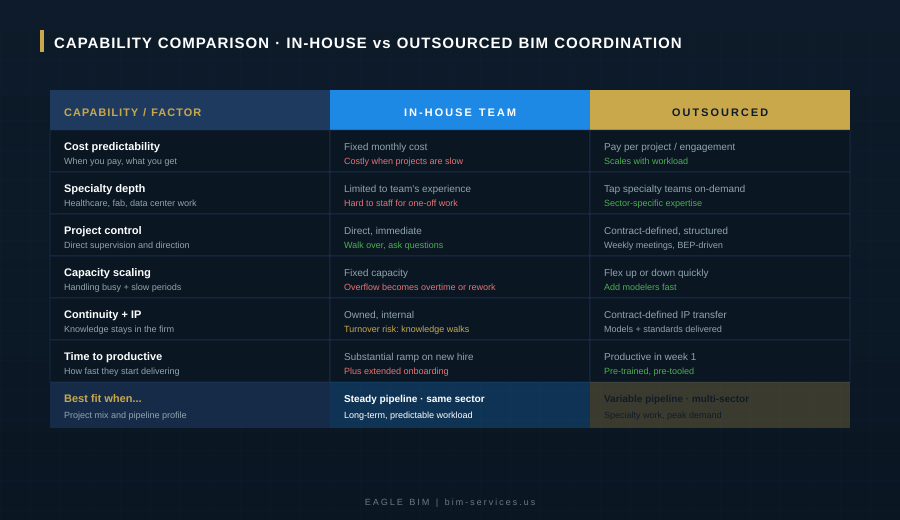
Cost is one factor in the in-house BIM vs outsourced BIM decision. It’s rarely the deciding factor. Most contractors who think they’re deciding on cost end up actually deciding on capability, control, or capacity. Here’s how the major capability factors break down honestly.
Specialty Depth
Specialty depth is the single biggest gap between the two models. An in-house BIM coordinator who has spent five years on commercial office and multifamily projects is excellent at commercial office and multifamily projects. They are not, by default, experienced in healthcare medical gas coordination, ISO 14644 cleanroom modeling, sub-fab utility routing in semiconductor fabs, or 2N redundancy modeling on hyperscale data centers. Specialty depth is built one project at a time over years. You can’t shortcut it by hiring.
Outsourced BIM coordination services firms typically maintain bench depth across multiple sectors. A specialty BIM service provider working on Texas semiconductor fabs has done it before, has the families and templates set up, has the workflow documentation, and can be productive on a new fab in week one. An in-house team without that experience needs months to ramp on the specialty, and the first project of that specialty is going to surface gaps the team didn’t know existed. For contractors with multi-sector portfolios, specialty depth is the strongest argument for outsourcing, regardless of cost.
Project Control and Site Integration
This is where in-house teams have a real, unambiguous advantage. An in-house BIM coordinator sits 20 feet from the project manager. They walk to the trailer for site meetings. They take field photos and update the model the same day. They handle RFIs in real time. When the project manager has a quick question, the coordinator answers in 90 seconds. Outsourced coordination, even with the best communication protocols, has higher friction. Weekly OAC meetings, scheduled clash detection cycles, structured RFI workflows. The discipline of structured communication has real benefits for documentation and audit, but it’s slower than walking next door.
For projects where field decisions get made hourly and the coordination model has to keep pace, in-house teams are almost always the better fit. For projects where the coordination work is bounded, the BEP is well-defined, and the project schedule has weekly coordination rhythms baked in, outsourced models work fine. Most projects sit somewhere in between, which is why the hybrid model is so common.
Capacity Scaling and Surge Demand
Pipeline volume drives this one. An in-house team has fixed capacity. If you have two BIM coordinators, you can run two coordinator-units of work, give or take. When a major project lands and demand spikes well above baseline, you either work overtime, deprioritize other projects, or watch quality slip. Hiring takes months minimum. The new hire then needs weeks to ramp before they’re fully productive. Total time from “we need more capacity” to “we have more productive capacity” is a substantial window. Most surge events don’t wait that long.
Outsourced BIM coordination services flex up in days, not weeks. A serious MEP BIM service provider can add modelers to a project within a week, and the modelers are pre-trained, pre-tooled, and ready to be productive immediately. For contractors who win big jobs occasionally rather than predictably, this surge capacity is one of the strongest practical arguments for outsourcing. The in-house BIM vs outsourced BIM tradeoff is starkly different for firms with a predictable pipeline versus firms with a lumpy one.
| Need Surge BIM Capacity Without the Hiring Lag?
Eagle BIM scales up or down on demand. Multi-sector specialty depth (healthcare, data center, semiconductor fab, multifamily, industrial). Texas-based BIM service provider with the bench to handle pipeline spikes that in-house teams cannot absorb. |
Knowledge Continuity and IP Ownership
This is the strongest argument for keeping work in-house. When BIM coordination happens internally, the project knowledge, the family library, the firm-specific BIM standards, the worked solutions to recurring problems, all of that stays inside the firm. When a coordinator leaves, the next coordinator inherits the work. The institutional learning compounds over years.
Outsourced work transfers IP through contracts. A good engagement specifies what gets delivered (models, standards, families, documentation) and what stays with the outsourcing partner (internal workflows, productivity tools, project management methodology). A bad engagement leaves you with project models but no template, no families, no standards, and no continuity to the next project. The in-house BIM vs outsourced BIM comparison on this dimension depends heavily on contract structure. Firms working with serious outsource BIM modeling partners usually negotiate IP transfer clauses that protect long-term continuity. Firms working with cheap offshore vendors often don’t, and the gap shows up later.
Time to Productive
In-house team: 4 to 8 weeks ramp on a new hire to reach full output, plus 90 days of typical onboarding before they’re really part of the team. Outsourced team: productive in week one. The reason is mechanical. The outsourced team is already trained on Revit, Navisworks, Autodesk Construction Cloud, and the specialty workflows for your project type. They’ve already got the families, templates, and tools. They don’t have to learn anything except your specific project. An in-house new hire is learning everything at once.
This matters most when projects have aggressive timelines, which most of them do in 2026. The current US contractor BIM market is running at peak demand across most major metros. Schedule compression is the norm. A coordination team that needs three months to ramp before they’re productive is not viable on a project that needs coordination output in week two. For peak-demand projects, outsourced beats in-house on time-to-productive almost every time.
When In-House Wins
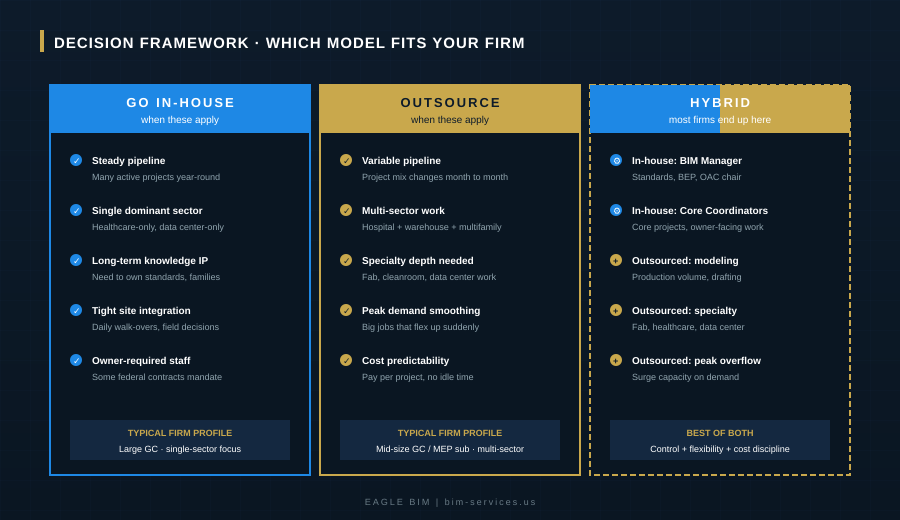
Some firms should hire in-house. The in-house BIM vs outsourced BIM decision tips toward in-house in five specific situations:
First, steady pipeline. If you’ve got many active projects running year-round with predictable workload, in-house utilization can hit the high range where fixed labor cost works out. Second, single dominant sector. If your firm builds only healthcare, only data center, or only multifamily, the specialty depth you build in-house compounds. The third project in a sector is dramatically faster than the first. Third, long-term knowledge IP requirements. If you’re building proprietary families, custom standards, or sector-specific workflows that need to stay in-house, hiring is the only way.
Fourth, tight site integration. Projects where daily field walks, hourly decisions, and continuous model updates are part of the workflow need the BIM coordinator physically embedded with the project team. This is common on hospital renovations, data center commissioning, and any project where the coordination model has to track field reality minute-by-minute. Fifth, owner-required staffing. Some federal contracts, some Tier 1 healthcare owners, and some institutional clients explicitly require named staff on the project. In-house coordinators can be named. Outsourced teams typically cannot.
Firms that hit several of these conditions should absolutely hire in-house. The cost premium pays for itself in the quality of work, the speed of decisions, and the institutional learning. The typical firm profile that justifies a full in-house BIM team is a large general contractor working primarily in one or two sectors with a substantial steady pipeline. Smaller firms or more diverse portfolios usually find the math harder to make work.
When Outsourcing Wins
Outsourced BIM coordination services are the better fit in five different conditions:
First, variable pipeline. If your project mix changes month to month and you can’t predict next quarter’s coordination load, outsourcing protects you from carrying labor cost in slow periods. Second, multi-sector work. If you’re running a mix of hospital, warehouse, multifamily, and commercial projects, you need specialty depth across sectors that’s hard to staff in-house. A serious BIM service provider maintains that depth across their bench. Third, specialty depth requirements. For one-off fab work, cleanroom coordination, hyperscale data center work, or other specialty scopes that don’t recur, hiring is impractical.
Fourth, peak demand smoothing. Contractors who win big jobs occasionally need surge capacity that flexes up in a week, not a quarter. Fifth, cost predictability. Project-based pricing scales with actual work. No fixed monthly cost. No idle time. For firms with disciplined project accounting, this is often the simpler model to manage. The typical firm profile that justifies outsourcing is a mid-size GC or MEP subcontractor working across multiple sectors with a pipeline that flexes quarter to quarter. This describes most US contractors in 2026.
When Hybrid Wins (Most of the Time)
Most firms end up in the hybrid column when they actually run the in-house BIM vs outsourced BIM math against their pipeline. The structure that works for the majority of mid-size contractors is straightforward: keep a small in-house core team handling strategic work and tap external partners for production volume and specialty depth.
Typical hybrid staffing: one in-house BIM Manager owning standards, the BEP, OAC meeting chair, and quality oversight. One or two in-house coordinators handling core projects, owner-facing work, and field integration. External outsource BIM modeling partner handling production drafting volume, sheet generation, specialty coordination work (healthcare, data center, fab), and peak overflow when projects spike. This structure gives the firm the control and continuity of in-house staffing combined with the cost discipline and capacity flexibility of outsourcing. Most US contractor BIM programs that have been running for more than three years have evolved into some version of this hybrid by trial and error.
The hybrid model also handles the failure modes of both pure approaches. Pure in-house fails on specialty depth and capacity scaling. Pure outsource fails on site integration and IP continuity. Hybrid covers the gaps. The contractors who run this well treat the external partner as an extension of the in-house team rather than as a separate vendor. Same BEP, same standards, same coordination protocols, same accountability. The external partner becomes a flex resource that the in-house team directs. A serious outsource BIM modeling engagement under a hybrid model looks very different from pure-outsource work because the integration depth is much higher.
How to Make the Decision for Your Firm
Five concrete questions to answer before you decide the in-house BIM vs outsourced BIM split for your firm.
One, what’s your actual pipeline volatility? Pull the last 24 months of project starts and chart the BIM coordination hours by month. If the chart is flat, in-house works. If it spikes and dips, hybrid or full outsource is the better fit. Two, what’s your sector mix? If the vast majority of your work is one sector, in-house can build the depth. If you’re spread across multiple sectors, you need a partner with specialty bench. Three, what’s the realistic utilization rate of an in-house BIM coordinator at your firm? If it’s substantially below full capacity, the effective loaded cost of an in-house coordinator runs well above any reasonable outsourced rate, simply because you’re paying for hours you’re not using.
Four, what’s the cost of a coordination delay on your typical project? On large projects with multi-year schedules, even short coordination delays can erode meaningful soft cost. If your in-house team can’t surge to handle a delay risk, the cost of an outsourced surge partner is essentially insurance. Five, what’s your owner-facing exposure? If your owner contracts require named staff, in-house is non-negotiable for those scopes. For everything else, the decision is open.
Run the math honestly. Most US contractor BIM teams that do this exercise land in the hybrid column. The ones who don’t usually have either a single-sector pipeline that justifies in-house or a small-volume operation that justifies pure outsource. There’s no universally correct answer. There’s a right answer for your firm, and the only way to find it is to walk through the questions above.
How Eagle BIM Works With Contractors
Eagle BIM is based in Texas, in association with BIMPRO LLC out of Pflugerville. We function as the external BIM service provider partner for general contractors, MEP subcontractors, architects, and owners across the United States. Our work spans healthcare, data center, semiconductor fab, multifamily, commercial, and industrial sectors, with bench depth in each.
On hybrid engagements, we work directly under the contractor’s in-house BIM Manager. We follow the firm’s BEP, integrate into their Autodesk Construction Cloud or BIM 360 environment, attend the firm’s coordination meetings, and deliver coordinated federated models that flow back into the contractor’s release process. Our team becomes an extension of the in-house team rather than a separate vendor. The contractor maintains control. We provide capacity and specialty depth on demand. The in-house BIM vs outsourced BIM decision becomes “both, with structure” rather than “either, with tradeoffs.”
For contractors evaluating their BIM staffing strategy more broadly, the Autodesk BIM solutions overview is a useful reference for tooling and platform decisions that affect both in-house and outsourced models. The core platform choices (Revit, Navisworks, ACC) are the same regardless of staffing approach, so the platform investment carries forward whether the firm hires in-house, outsources, or runs hybrid. That portability is one reason the in-house BIM vs outsourced BIM decision can be revisited as the firm’s pipeline changes without sunk-cost fear.
The Bottom Line
In 2026, the in-house BIM vs outsourced BIM question is rarely binary. Most successful contractors run hybrid models that combine a small strategic in-house team with an external partner providing production volume, specialty depth, and surge capacity. The cost discipline of outsourcing combined with the control discipline of in-house staffing produces the best outcomes for most firms.
If you’re considering the decision, start with honest pipeline data, an honest assessment of your sector mix, and an honest read on your realistic in-house utilization rate. The fully-loaded cost of an in-house BIM coordinator in 2026 is substantially higher than the base BIM coordinator salary once benefits and overhead are factored in. The math has to make sense against your actual project flow, not against an idealized pipeline. For most US contractor BIM teams with variable pipelines and multi-sector portfolios, outsourcing or hybrid wins on both cost and capability. For specialized firms with steady pipelines in single sectors, in-house wins. The right answer is the one that matches your firm’s actual operating reality.
Eagle BIM works with both ends of the spectrum: contractors building their first BIM coordination services engagement to test the model, and contractors with mature hybrid programs scaling their external partner relationship. Whether you’re at the early stage of deciding the in-house BIM vs outsourced BIM question or refining a hybrid you’ve been running for years, the workflow scales to the engagement. A serious outsource BIM modeling partner integrates with your in-house team rather than competing with it, and the US contractor BIM market has matured to the point where the integration patterns are well understood. Pick a partner who has done the work before.
| Talk to Eagle BIM About Your BIM Staffing Strategy
Send us your project mix and pipeline volume and we’ll come back with a proposal that maps an in-house BIM vs outsourced BIM approach against your real workload. Honest numbers, honest tradeoffs, no “contact us for pricing” runaround. |