
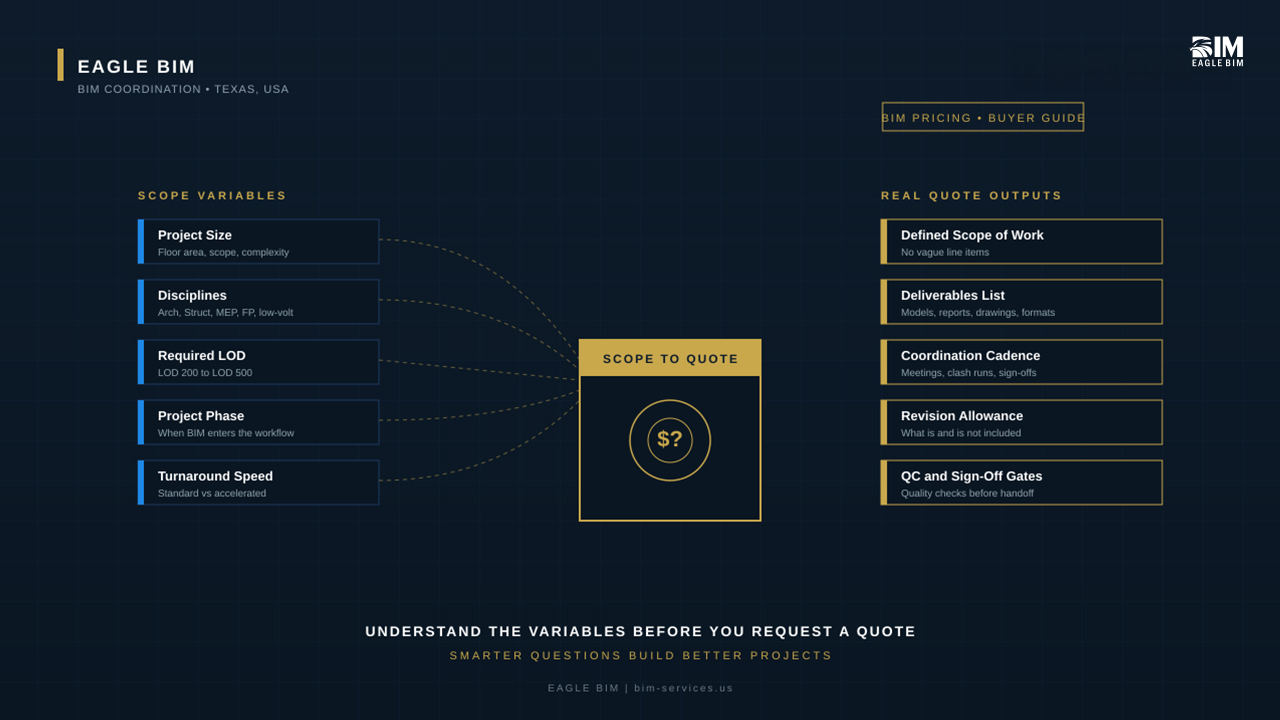
If you’ve ever asked a BIM firm what a project will cost and gotten back “send us your drawings, we’ll put together a quote,” you already know the frustration. Nobody wants to publish numbers, and there’s actually a good reason for that. Two projects that look identical on paper can price three times apart. Same square footage, same building type, same city. The difference is in the variables nobody talks about until you’re already on a sales call.
So we’re going to do something different here. Instead of giving you fake price ranges that won’t apply to your project anyway, this guide breaks down the actual scope variables that drive BIM coordination cost, the three pricing models firms use, and the questions you should be asking before you sign anything. By the time you finish reading, you’ll know enough to spot a bad quote in about thirty seconds.
This is written for the people who actually have to make the decision. General contractors, MEP subs, project managers, and owners who are sitting on a quote and trying to figure out whether it makes sense. If that’s you, keep reading. If you just want a number to plug into a spreadsheet, no article is going to give you that honestly. The variables matter too much.
Why BIM Coordination Pricing Is Rarely Published Online
Walk through ten BIM company websites and you’ll see the same line on nine of them. “Contact us for a custom quote.” It’s annoying, and a lot of people read it as evasive. The truth is more boring than that. BIM coordination cost depends on so many project-specific variables that publishing a flat rate would either misrepresent what the firm actually delivers or scare off every project that doesn’t fit the average.
Think about how a GC prices a building. Nobody quotes a hospital and a strip mall at the same dollar-per-square-foot. The systems are different, the schedule is different, the risk profile is different. BIM coordination has the same problem at a smaller scale. A dense MEP coordination job on a 200,000-square-foot data center has almost nothing in common with a simple architectural model for a retail buildout, even if both are technically called “BIM coordination.”
The other reason firms don’t publish is competitive. Once a number is on a website, every competitor undercuts it on the proposal stage and every client uses it as the anchor in negotiation. So the industry defaults to silence, and buyers are left guessing. The point of this article is to help you stop guessing and start asking better questions.
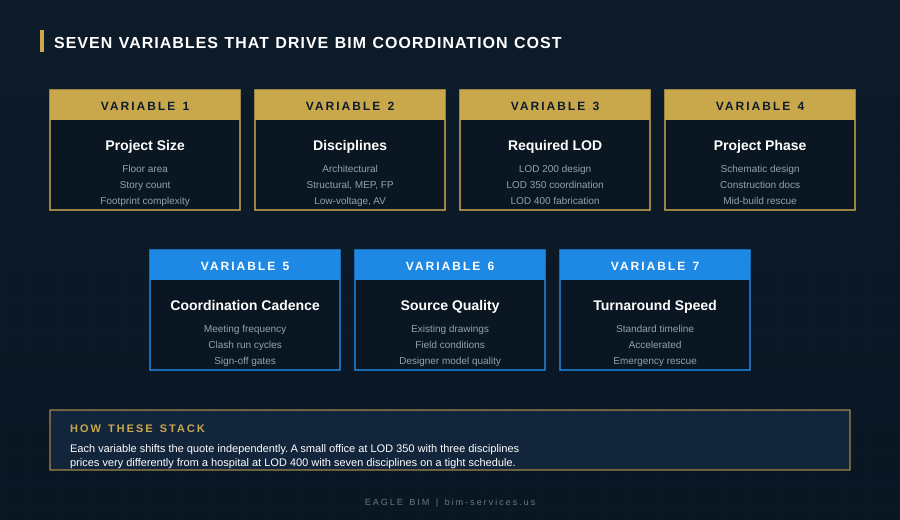
The Seven Variables That Drive BIM Coordination Cost
After enough projects, you start to see the same variables show up in every estimate. These are the seven that matter most. Get a clear answer on all seven before you accept a quote, and you’ll have a much better sense of whether the price is fair.
Project Size and Floor Area
This one’s obvious but worth being precise about. A bigger project means more model elements, more clash points, and more coordination meetings. Floor area is the headline number, but story count and footprint complexity matter just as much. A flat 100,000-square-foot warehouse and a 100,000-square-foot ten-story office tower are not the same job. The tower has ten times the vertical coordination work, more risers, more shaft alignment, and more discipline interaction per floor.
What matters in a quote: ask the firm how they’re scoping square footage. Are they pricing the whole building, or just the coordinated portions? Some quotes exclude unfinished spaces, mechanical penthouses, and parking. That can be fine, or it can be a problem later when you realize the underground levels weren’t in the scope.
Number of Disciplines Coordinated
Every additional discipline multiplies the coordination work, not adds to it. Two disciplines have one interface to manage. Three have three. Four have six. By the time you’re coordinating architectural, structural, mechanical, electrical, plumbing, fire protection, and low-voltage, you’re managing twenty-one interfaces. That’s why MEP-heavy projects price differently from simpler architectural-only jobs.
In a real quote, the firm should list every discipline they’re modeling and coordinating. “MEP” alone is too vague. Mechanical, electrical, plumbing, and fire protection should each be called out, plus any specialty systems like medical gas, pneumatic tube, refrigeration, or process piping if they apply.
Required Level of Development (LOD)
LOD is one of the biggest cost drivers and one of the most misunderstood. A model at LOD 200 is roughly the size and shape of the real component. A model at LOD 350 includes connections and clearances. A model at LOD 400 is fabrication-ready, with every fitting, hanger, and connection point detailed exactly the way it’ll be installed. The work involved at each level is dramatically different.
Asking for LOD 400 when you really only need LOD 350 can double the cost of an MEP scope without giving you any practical benefit. On the other hand, accepting a quote at LOD 300 when your contract requires LOD 400 sets you up for a very expensive surprise during fabrication. The BIMForum LOD specification is the industry reference, and any decent BIM firm will write LOD into the quote by discipline.
Project Phase When BIM Starts
This is the variable people forget. Bringing a BIM team in during schematic design is one job. Bringing them in to coordinate construction documents is another. Bringing them in mid-build to fix coordination problems that have already gone vertical is a third, and it’s the most expensive of the three by a wide margin.
The earlier BIM enters the project, the more the model can shape decisions. The later it enters, the more it has to work around decisions that were already made. “Rescue” coordination, where a contractor is mid-construction and discovers that the design model was never properly coordinated, often runs at a premium. Not because BIM firms are gouging anyone, but because reverse-engineering a half-built building is genuinely harder than coordinating one before it goes up.
Coordination Frequency and Meeting Cadence
How often the team meets, how often clash detection runs, and how the project handles sign-offs all affect cost. A weekly clash run with a thirty-minute coordination call is one cadence. Daily clash runs with full-day OAC meetings are something else. Most commercial projects land somewhere in the middle, but it’s worth being explicit about it in the quote.
Ask the firm how many coordination meetings are included, how long each meeting is, and what happens if the project needs more. Hourly overage rates, additional meeting blocks, and field-support visits should all be priced separately and clearly so there’s no surprise invoice three months in.
Quality of Source Drawings or Existing Models
If the design team is delivering a clean, properly modeled Revit file, the BIM coordination team can hit the ground running. If they’re delivering 2D PDFs, AutoCAD drawings, or worse, a Revit file that was modeled by someone who didn’t really understand Revit, the BIM team has to rebuild before they can coordinate. That can easily double the front-end work.
Same problem applies to existing buildings. Renovation projects with good as-built drawings are very different from renovations where the only documentation is fifty-year-old microfiche and field measurements. If the building hasn’t been laser-scanned, expect the quote to include scan-to-BIM time, or expect to find that scope missing later.
Turnaround Speed and Project Urgency
Tight schedules cost money. A standard coordination project might run on a six- to twelve-week cycle. An accelerated one running parallel to a fast-track build might compress that to three or four weeks. The math on accelerated work isn’t complicated. Either the firm puts more people on the job, or the same people work longer hours. Either way, the rate goes up.
Be honest with the BIM firm about your real schedule. “I need this done as fast as possible” tells them nothing useful. “I need a clash-free model by November 15 because steel goes up November 22” tells them exactly how to staff the project.
| Want a Real Scope-Based Quote on Your Project?
Eagle BIM scopes every quote against the seven variables in this article. No vague line items, no “contact us for pricing” runaround. Send us your project info and we’ll send back a detailed quote with deliverables, LOD, cadence, and revision allowances spelled out. |
Pricing Models Explained — Hourly, Per Project, or Retainer
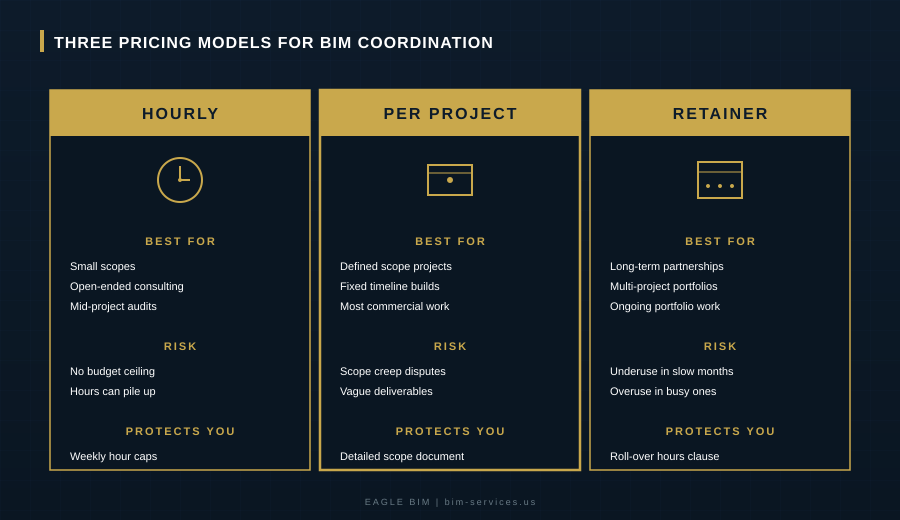
Once you understand the variables, the next question is how the firm packages their pricing. There are three common models, and each one fits a different kind of project. The right model depends on how well-defined your scope is, how long the engagement runs, and how much risk each side wants to carry.
Hourly
Hourly pricing makes sense when the scope is genuinely open-ended. Mid-project audits, BIM consulting engagements, troubleshooting work, and short-term staff augmentation all fit this model. The firm tracks hours by team member and bills against an agreed rate, usually with a weekly or monthly cap so things don’t spiral.
The risk for the contractor is obvious. Without a cap, hourly engagements can blow past any reasonable budget. The protection is to negotiate a not-to-exceed amount up front, plus a weekly hour-tracking report so there are no surprises. Avoid hourly engagements for any work that has a clearly defined deliverable. That’s what the next model is for.
Per Project (Lump Sum)
This is the most common model for BIM coordination cost on commercial projects. The firm prices the entire scope as a fixed amount, tied to a specific deliverable list and timeline. The contractor knows exactly what they’re paying, the firm knows exactly what they’re delivering, and as long as the scope document is clear, both sides can plan around it.
Where this model breaks is on scope creep. If the design changes mid-project, or the contractor wants additional disciplines added, or the LOD requirement gets bumped up, that’s a change order. A good lump-sum quote includes a clear definition of what’s in scope, what’s out, and how change orders are priced. A bad one is vague about all three, which is how disputes happen later.
Retainer
Retainers work for long-term partnerships. Developers running multiple projects, GCs with a steady portfolio of similar builds, or owners who want a BIM partner on standby for ongoing work all benefit from a retainer model. The contractor pays a monthly amount and gets a guaranteed block of hours or services in return.
The math is similar to a gym membership. If you use the hours, the rate per hour comes out lower than buying ad-hoc. If you don’t, you’re paying for capacity you didn’t need. A good retainer agreement has a roll-over clause so unused hours carry forward for a quarter or two, and a clear escalation path if a single month requires significantly more capacity than the retainer covers.
What Should Be Included in a Real BIM Coordination Quote
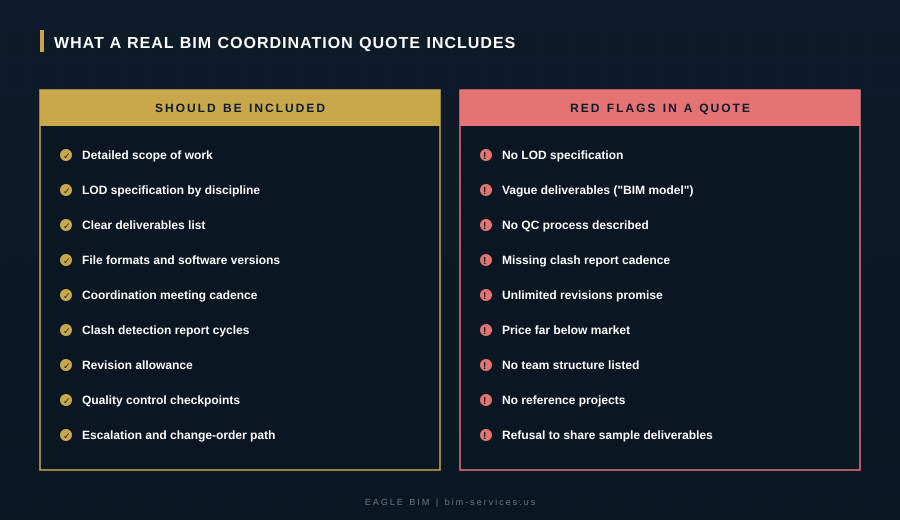
Once you’ve figured out which pricing model fits, the next question is what the quote itself should look like. A real BIM coordination cost quote has specific line items. A weak one has vague promises and a price tag. Here’s what to look for.
First, a detailed scope of work. Every discipline should be listed, with the LOD specified for each. The model coverage should be defined (whole building, specific floors, specific systems). Any phasing or sequencing should be spelled out. Generic phrases like “BIM coordination services” are red flags. You want specifics.
Second, a deliverables list. What native files does the firm produce? Revit, Navisworks, IFC, 2D drawings? At what stages? What clash detection reports come with the engagement, and at what cadence? Are coordination meeting minutes included? What about as-built or record models? All of this should be in writing before you sign.
Third, file formats and software versions. Revit 2024 versus Revit 2026 matters. Whether the firm delivers in IFC, NWC, or DWG affects how the model integrates with your existing workflow. If the project requires Autodesk Construction Cloud or Trimble Connect, that should be specified too.
Fourth, coordination meeting cadence and clash detection cycles. How often does the team meet? Weekly? Twice a week? How long are meetings? Who attends? When does clash detection run, and how is it reported? A good quote has all of this on paper.
Fifth, a revision allowance. Models change. Designs evolve. The quote should specify how many revisions are included before change orders kick in, and what counts as a revision versus a change of scope. This is one of the most common dispute points later, and clarity up front saves a lot of pain.
Sixth, quality control checkpoints and sign-off gates. What QC happens before deliverables go out? Who signs off internally? What’s the escalation path if a deliverable comes back with errors? Firms that don’t have a QC process are firms that will deliver inconsistent work.
Red Flags in a BIM Quote That Looks Too Cheap
Cheap quotes are tempting, especially when you’ve gotten three other proposals that all came in higher. But a BIM coordination cost quote that’s significantly below market is almost always a sign of one of three things. Either the firm is lowballing to win the work and plans to make it up on change orders, or they’re cutting corners on QC and team experience, or they’ve misunderstood the scope and the real number is going to surface later.
Specific things to watch for. No LOD specification anywhere in the quote. Deliverables listed as “BIM model” with no further detail. No QC process described. No team structure listed (you don’t know who’s actually doing the work). Vague language about clash detection cadence. Promises of unlimited revisions. Refusal to share sample deliverables from past projects.
Any one of these alone might just be a sign of a rushed quote. Multiple of them together usually means you’re about to sign a problem. The cheapest quote that delivers what you actually need is fine. The cheapest quote that doesn’t tell you what it delivers is going to cost more than the second-cheapest one before the project’s done.
Questions to Ask Before You Sign a BIM Coordination Agreement
Before you commit to any BIM coordination cost quote, run through these questions with the firm. A real partner will answer them clearly and put the answers in writing. A weak one will dodge.
What’s the LOD by discipline? Who specifically is on my project team, and what’s their experience level? Can I see two or three sample deliverables from past projects similar to mine? How is clash detection reported, and at what cadence? What software versions are you delivering in? What’s the revision allowance, and how are change orders priced? What’s the QC process before deliverables come to me? How do you handle scope creep? What happens if my schedule slips, do I pay for the firm’s idle time? What’s the escalation path if I’m not happy with a deliverable?
Most firms will be able to answer most of these. The ones who can answer all of them, in writing, are the ones worth working with. According to research from the
According to Engineering News-Record coverage of construction project disputes, the single most common cause of BIM-related disagreements is unclear scope at the contracting stage. The questions above are how you avoid that. They take an extra meeting to work through. They save months of pain later.
How Eagle BIM Scopes a Coordination Quote
Our process is built around the variables in this article. When a contractor reaches out about a project, the first thing we do is a scoping call. Not a sales call. A scoping call. We want to understand the building type, square footage, story count, disciplines involved, target LOD, project phase, schedule, and the quality of the source drawings or existing models. That conversation usually takes thirty to forty-five minutes.
From there, we put together a proposal that lists every variable we discussed and exactly how it shows up in the quote. Each discipline is named. LOD is specified per discipline. Coordination cadence is documented with a meeting count and clash detection schedule. Deliverables are listed by file format and stage. Revisions are capped with a clear change-order path. QC checkpoints are described. There’s no vague line item that means “we’ll figure it out later.”
The proposal goes back to the contractor in writing. They can challenge any line, ask for substitutions, and adjust scope before signing. We’d rather have ten honest conversations during the quote stage than one painful one in week six. According to
Industry guidance from Building Design + Construction has consistently flagged that the projects which succeed with BIM are the ones where the scope was defined precisely up front. That’s how we work, and it’s how Texas contractors get a quote they can actually plan around.
The Bottom Line
BIM coordination cost varies because every project is different. That’s not an excuse from the industry, it’s just how the work scales. What you can do is understand the variables, ask the right questions, and make sure the quote you accept is clear about scope, deliverables, and what happens when things change.
If you’re walking into a quote conversation right now, here’s the short version. Know your project size and story count. Know which disciplines you need coordinated. Know your target LOD by discipline. Be clear about when BIM enters the project. Have a sense of meeting cadence. Be honest about source drawing quality. Tell the firm your real schedule. Then ask the questions in this article and make sure the answers are in writing.
Do that, and the BIM coordination cost conversation stops being a guessing game. You’ll know what you’re paying for, you’ll know what you’re getting, and you’ll have a partner who’s accountable to the scope you both signed off on. That’s how good projects start.
| Get a Detailed BIM Coordination Quote From Eagle BIM
Send us your project scope and we’ll come back with a quote that lists every discipline, LOD, deliverable, meeting cadence, and revision allowance in writing. Texas-based, contractor-facing, transparent on scope. No “contact us for pricing” runaround. |