Most construction problems do not begin on site. They begin much earlier, when different teams are working hard on the same building but not always through the same lens. The architect is shaping space, daylight, circulation, and intent. The structural engineer is making sure the building stands the way it should. The MEP team is threading services through ceilings, shafts, risers, plant rooms, and technical zones that are already under pressure. Nobody is necessarily wrong, yet the building can still begin to disagree with itself. A duct wants the same space as a beam. A pipe lands where a wall was never meant to open. A maintenance access zone disappears because another system quietly took over the room around it.
That is usually the moment when a project stops being a drawing exercise and starts becoming a coordination exercise. It is also the moment when BIM Modeling Services begin to matter in a very practical way.
In the United States, the National BIM Standard–United States positions BIM as a structured way to organize and classify electronic object data so owners, designers, suppliers, constructors, and facility managers can communicate more clearly across the life cycle of a built asset. In other words, BIM is not just about producing a model; it is about creating a more reliable environment for decisions and information exchange. That distinction is important, because the real value of BIM is not visual polish. It is a coordinated understanding.
This matters even more in an industry where delay, rework, and fragmented delivery are hardly rare. McKinsey has repeatedly noted that construction has struggled with low productivity growth and that large projects continue to run late and over budget with uncomfortable regularity. Digital approaches, when adopted properly, are part of the answer precisely because they help teams work from better information earlier in the process.
So when firms invest in BIM Modeling services, they are not really buying “better 3D.” They are buying a better chance of catching problems before those problems become expensive.
Introduction to BIM Modeling Services
For a long time, construction relied on layered drawings, coordination meetings, markups, and a lot of professional interpretation. That method can still work, but it becomes less forgiving as buildings become more complex. More systems, more specialists, more dependencies, and less room for error change the stakes. What once felt manageable in drawings alone can become risky when dozens of systems need to fit inside the same envelope with tight tolerances and hard deadlines.
That is where BIM Modeling Services fit naturally into the modern AEC workflow. Instead of asking each discipline to describe the building separately and trust that coordination will somehow happen downstream, BIM brings those systems into a shared digital environment. The model becomes a working space where design intent, structural logic, and service routes can be reviewed together rather than in fragments.
This is also why BIM has become part of a broader conversation about digital project delivery. McKinsey’s work on construction productivity and digital transformation points to the need for better implementation, not just more technology. In practice, that means tools matter, but workflows and information discipline matter more. A model is valuable only if teams can rely on it to make decisions.
A good BIM workflow therefore does not begin with software. It begins with one practical question: how do we help every team understand the same building more clearly, earlier, and with less ambiguity?
What are BIM Modeling Services?
At the simplest level, BIM Modeling services help create a digital representation of a building that multiple disciplines can coordinate within. But that short definition does not really explain why the service matters.
A BIM model is not only geometry. It carries relationships, attributes, objects, quantities, and structured information that can travel through design, coordination, documentation, construction, and in many cases operations as well. That is why the “I” in BIM matters just as much as the “M.” The model is useful not because it looks intelligent, but because it contains usable intelligence.
This broader role is reinforced by standards bodies rather than software vendors alone. The National BIM Standard–United States focuses on information exchange and life-cycle use, while buildingSMART’s openBIM framework emphasizes interoperability across platforms through standards such as IFC and BCF. buildingSMART’s point is especially relevant for real projects: if information cannot move cleanly between teams, tools, and workflows, coordination becomes weaker no matter how sophisticated the model looks in one application.
That is why BIM Modeling services are best understood as a coordination service supported by Modeling, not merely a Modeling service with coordination as a side effect.
A good model helps teams answer useful questions sooner. Will this fit? Can this be built the way it is currently drawn? Are the disciplines aligned? Is the documentation likely to hold up when procurement and site execution begin? Those are not software questions. They are project questions. BIM simply gives teams a better place to ask them.
Types of BIM Modeling used across projects
Not every project needs the same kind of BIM support, and not every Modeling package serves the same purpose. The service becomes valuable when it matches the project’s actual pressure points.
Architectural Modeling is usually where the spatial story of the building takes shape. Walls, floors, openings, roofs, room configurations, façade elements, and circulation are developed in a way that helps the design team visualize intent and generate coordinated documentation.
Structural Modeling supports a different kind of clarity. Here the concern is not just shape, but load paths, framing logic, slab relationships, support systems, and how structural elements affect everything around them. A clean structural model makes coordination discussions less abstract and helps both engineers and contractors see how the building is actually meant to hold together.
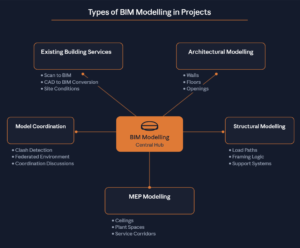
MEP Modeling is where BIM often stops sounding theoretical and becomes immediately valuable. Mechanical, electrical, plumbing, and fire protection systems compete for space in ways that drawings often flatten too neatly. In practice, ceilings, plant spaces, shafts, access zones, and service corridors become pressure points quickly. This is why MEP BIM Services are so often tied to coordination-heavy projects.
Then there is model coordination itself, which is often where teams feel the real commercial value of BIM. When architecture, structure, and services are federated into one environment, clashes stop hiding in separate files. Autodesk’s clash-detection guidance is useful here because it states the benefit in plain terms: BIM can identify conflicts between building systems before construction begins, which saves time and money. That may sound obvious, but on complex projects it is the difference between solving a coordination issue in a meeting and solving it in the field.
Projects involving existing buildings often add another layer. Renovation, adaptive reuse, and retrofit work rarely begin with clean, dependable conditions. Existing data may be incomplete, outdated, or just wrong in subtle but expensive ways. That is where Scan to BIM Services and CAD to BIM Conversion become useful. They help teams begin from something closer to reality rather than from assumptions that site conditions may later embarrass.
How BIM Modeling Services usually work in practice
A lot of BIM content explains the idea but skips the workflow. The workflow is where trust is built.
It usually begins with project inputs. That may sound basic, but it is a serious step. CAD drawings, PDFs, markups, concept sketches, specifications, point clouds, and client standards all influence what the model can become. Weak inputs do not always produce obviously weak models. Sometimes they produce models that look convincing but carry hidden coordination risk. That is more dangerous.
From there, teams establish model structure and rules. Coordinates, naming conventions, file segmentation, ownership, level-of-development expectations, and information exchange protocols are set before Modeling gets too far ahead of itself. This is one reason the U.S. standards ecosystem keeps returning to information exchange. NBIMS-US explicitly treats information flow as a central part of BIM maturity, not a side note.
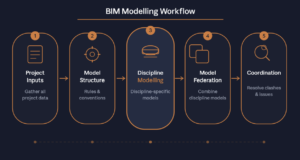
Discipline-specific Modeling follows. Architects develop spaces and envelopes. Structural teams build the support systems. MEP teams work through service networks, equipment, clearances, and spatial logic. On many projects, these models are developed in parallel, which is exactly why federation matters later. Problems rarely show up dramatically inside one discipline file. They show up when the systems meet.
Once models are federated, coordination begins in earnest. This is the stage where clashes, access issues, spatial conflicts, and constructability concerns start to surface. buildingSMART’s BCF standard is a useful context here because it exists specifically to support model-based communication around issues and topics. That tells you something important about modern BIM workflows: coordination is not just about “finding clashes.” It is also about how issues are communicated, assigned, tracked, and resolved between teams.
Coordination then moves through cycles. Issues are reviewed, filtered, assigned, revised, and checked again. Mature BIM teams understand that not every clash matters equally. Some are noisy. Some are sequencing concerns. Some are major buildability issues. The value lies not in producing the longest clash list, but in helping the team focus on the clashes that actually change decisions.
Once the model has reached the required level of coordination, it begins to support documentation more reliably. Drawings, schedules, views, and quantities can be extracted from a coordinated environment rather than assembled from disconnected parts. At that point, the model starts behaving less like a presentation asset and more like a project asset.
And increasingly, the story does not stop there. NBIMS-US and buildingSMART both point toward life-cycle value and structured information exchange beyond design. That is why BIM is steadily becoming part of a larger digital thread that runs from design into construction and, in many cases, operations.
Why teams keep investing in BIM
The easiest way to make BIM sound generic is to list its “benefits” without context. The more honest way is to tie those benefits to the kind of friction projects deal with every day.
One major advantage is that BIM moves problem-solving forward in time. Autodesk’s official BIM benefits guidance notes that clash detection can identify conflicts between systems before construction begins. That matters because problems are always cheaper when they are still decisions rather than disruptions.
Another advantage is that BIM gives teams a better shared reference point. Drawings can describe a building, but a coordinated model lets teams interrogate it. That is a meaningful difference when design, engineering, procurement, and construction all need to stay aligned.
BIM also supports stronger documentation discipline. When drawings, schedules, and views are derived from a coordinated model, there is a better chance that the project’s outputs remain consistent with one another. That does not remove the need for review, but it reduces the drift that so often appears when documentation develops in silos.
And perhaps most importantly, BIM improves the quality of conversations. Instead of debating a condition in abstraction, teams can review the actual relationship between systems. Instead of finding out late, they have a better chance of finding out early.
Real use cases in construction
The value of BIM modeling services becomes even clearer when you stop talking about BIM as a concept and start talking about buildings.
Commercial office and mixed-use projects often rely heavily on coordinated service zones. As soon as ceilings become dense with ductwork, cable trays, sprinkler lines, and lighting integration, the usefulness of BIM becomes obvious. A coordinated model helps teams understand whether the building’s service logic actually fits the architecture and structure that were approved.
Healthcare projects raise the stakes further. Hospitals and clinical spaces combine architectural sensitivity with dense MEP systems, equipment requirements, access constraints, and operational pressure. Here BIM is not just about visual coordination. It is about reducing the chance that highly specialized spaces become coordination casualties.
Residential towers often benefit from BIM in a different way. Repetition across floors means that once teams resolve core coordination issues, they can carry that discipline more consistently across the project. A coordinated digital workflow supports both efficiency and documentation quality.
Industrial and manufacturing facilities bring another kind of complexity. Equipment interfaces, service routes, clearances, structural demands, and maintenance needs all interact. These are exactly the kinds of environments where teams need more than drawings. They need a way to pressure-test the building before the building is built.
Retrofit projects may be the clearest example of BIM’s practical value. Existing conditions are notorious for refusing to match the record set perfectly. When teams begin with accurate scan-based information and then move into coordinated Modeling, they give themselves a better chance of designing to reality instead of to memory.
Why businesses outsource BIM support
Not every firm needs a large in-house BIM team all year, and not every phase of every project demands the same Modeling capacity. This is one reason outsourcing has become a practical operating model rather than just a cost decision.
Sometimes the driver is bandwidth. Sometimes it is specialist expertise. Sometimes it is the need to move quickly without expanding permanent overhead. Increasingly, cloud-based coordination environments make this easier because external BIM support can work more like an embedded project capability and less like a detached drafting vendor. Autodesk’s coordination platforms are built around shared models, automated clash detection, and team-based issue workflows, which is one reason distributed BIM delivery is far more workable now than it was a decade ago.
The best outsourcing relationships do not feel like files disappearing into a black box. They feel like project capacity arrives exactly where the team needs it.
Where BIM is heading next?
The future of BIM is not just more Modeling. It is a better continuity of information.
buildingSMART’s push around openBIM, IFC, BCF, and open workflows makes that direction clear. The point is not simply to create models inside proprietary islands. It is to enable information to move more cleanly across the project ecosystem. That matters more and more as BIM connects to digital twins, operations, asset management, and long-term facility intelligence.
McKinsey’s broader work on construction digitization also points in the same direction. The opportunity is not just in adopting tools, but in connecting them to real process improvement. In that sense, BIM’s future is tied less to visual sophistication and more to better implementation, better standards, and better decision-making over the life of an asset.
Conclusion
Construction does not usually suffer from a lack of effort. It suffers from fragmentation. Information is split across disciplines, files, assumptions, and timelines. Teams are competent, but competence alone does not guarantee alignment.
That is why BIM modeling services matter. They help turn a fragmented design process into a more coordinated project conversation. They give architecture, structure, and services a shared place to be tested against one another. They make issues easier to see, documentation easier to trust, and decisions easier to make before construction turns them into expensive negotiations.
In the end, the value is not that BIM gives a project a shinier digital model.
It is that it gives the project a clearer version of the building while there is still time to improve it.
Frequently Asked Questions
Q1. What are BIM Modeling Services and how do they work?
BIM Modeling Services create a digital representation of a building that multiple disciplines can coordinate within. The model is not only geometry — it carries relationships, attributes, objects, quantities, and structured information that travel through design, coordination, documentation, construction, and operations. That’s why the ‘I’ in BIM matters as much as the ‘M’ — the model is valuable not because it looks intelligent, but because it contains usable intelligence. The National BIM Standard–United States positions BIM as a structured way to organize and classify electronic object data so owners, designers, suppliers, constructors, and facility managers can communicate clearly across the life cycle of a built asset.
Q2. What types of BIM Modeling are used across construction projects?
BIM Modeling Services break into discipline-specific types that combine into a federated model. Architectural Modeling shapes the spatial story — walls, floors, openings, roofs, façade, and circulation. Structural Modeling supports load paths, framing logic, slab relationships, and how the building actually holds together. MEP Modeling handles mechanical, electrical, plumbing, and fire protection — usually where BIM becomes immediately valuable because these systems compete for space in ways drawings flatten. Add scan-to-BIM for existing conditions, shop drawing modeling for fabrication, and 4D/5D modeling for scheduling and quantities, and you have the full range of BIM Modeling Services available to a modern AEC workflow.
Q3. What is the difference between BIM Modeling Services and 3D CAD modeling?
3D CAD modeling produces geometry — shapes that look like the building but carry no data and don’t coordinate across disciplines. BIM Modeling Services produce intelligent objects that know what they are: a wall knows its layers, materials, fire rating, and acoustic properties; a beam knows its load capacity and connection details; a duct knows its airflow, size, and routing. When teams using BIM Modeling Services change one element, every dependent view, schedule, and quantity updates together. CAD requires manual updates across every sheet. The shift from CAD to BIM isn’t visual — it’s the shift from drawing buildings to modeling them with embedded intelligence.
Q4. What does a typical BIM Modeling Services workflow look like?
A typical BIM workflow starts with a BIM Execution Plan (BEP) defining LOD progression, naming conventions, and shared coordinates. Each discipline then builds its model — architectural, structural, MEP — at the agreed LOD for the project phase. Models federate into a coordinated environment (usually Navisworks), where clash detection runs at every milestone. Issues get tracked through BCF (BIM Collaboration Format) and resolved in coordination meetings. Once coordinated, the model produces construction documents, shop drawings, quantity takeoffs, and visualization outputs. The workflow is iterative — coordination cycles continue through CDs and into shop drawing reviews, with the model staying the single source of truth.
Q5. What standards govern BIM Modeling Services in the USA and internationally?
Two standards do the heavy lifting. The National BIM Standard–United States (NBIMS-US) focuses on information exchange and lifecycle use — defining how data should be organized so it travels cleanly between owners, designers, contractors, and facility managers. Internationally, buildingSMART’s openBIM framework emphasizes interoperability across software platforms through open standards: IFC (Industry Foundation Classes) for model exchange, BCF (BIM Collaboration Format) for issue tracking, and IDS (Information Delivery Specification) for requirements. ISO 19650 covers information management on BIM projects. These standards matter because if information cannot move cleanly between teams, tools, and workflows, BIM Modeling Services lose most of their value — no matter how sophisticated the model looks in one application.
Q6. What are the real benefits and use cases of BIM Modeling Services?
Real-world use cases for BIM Modeling Services include pre-construction coordination on healthcare campuses where dense MEP systems need conflict-free routing, scan-to-BIM for renovation and adaptive reuse where existing drawings are unreliable, 4D scheduling for phased construction on operational facilities, shop drawing extraction for prefabrication and modular construction, and 6D modeling for owner handover and facility management. The measurable benefits are consistent: fewer site RFIs (60–80 percent reduction is typical on coordinated projects), faster permit approvals, reduced rework, better stakeholder communication, and a coordinated as-built model that supports the building’s full lifecycle — not just the moment of handover.