Quick Summary
- BIM Modeling Services replace flat 2D drawings with intelligent, data-rich 3D digital models of entire buildings.
- Stakeholders can visualize every design decision before a single foundation is poured.
- Clash detection inside a BIM model catches conflicts between structural, MEP, and architectural systems weeks before they become expensive field problems.
- Studies consistently show BIM reduces construction rework costs by up to 40% and compresses review timelines significantly.
- Residential, commercial, infrastructure, and industrial projects all benefit from BIM visualization and coordination.
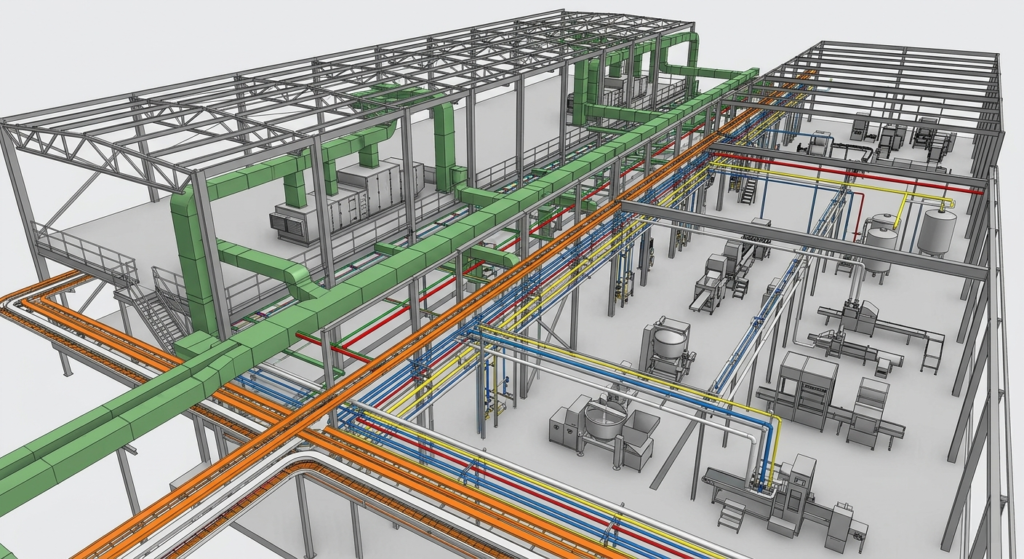
Figure 1: A Revit BIM modeling output showing a multi-story commercial building with structural, architectural, and MEP system annotations at LOD 350.

What Is BIM Modeling in Construction Projects?
BIM Modeling Services — Building Information Modeling — represent a fundamental shift in how construction projects are designed, coordinated, and delivered. A BIM model is an intelligent, data-rich digital representation of a building that stores far more than geometry. Every wall, beam, duct, pipe, and electrical conduit carries embedded information about its material, manufacturer, cost estimate, installation sequence, and maintenance schedule.
When a project team uses professional BIM Modeling Services, they are essentially building the structure twice: once digitally in complete three-dimensional detail, and once physically on the construction site. The digital build is where all the problems get found, resolved, and coordinated — at a fraction of the cost of discovering them in the field.
According to Autodesk’s BIM resource hub, project teams that adopt BIM-based workflows consistently report fewer RFIs (Requests for Information), faster project approvals, and significantly lower rates of construction rework compared to teams relying on traditional 2D CAD drawings.
The core platforms used in BIM Modeling Services include Autodesk Revit, Navisworks, and ArchiCAD. Of these, Revit BIM modeling is the industry standard for architectural, structural, and MEP disciplines in the United States. Revit models are parametric, meaning that changing one element automatically updates all dependent elements, maintaining BIM design accuracy across every discipline simultaneously.
Challenges of Traditional 2D Drawings in Project Visualization
Before BIM Modeling Services became widely adopted, construction projects ran on stacks of 2D plan drawings, elevations, and sections. Contractors would paper-print dozens of drawing sheets, compare them manually, and rely on experience to mentally assemble a three-dimensional building from two-dimensional slices. This process was expensive, slow, and failure-prone in predictable ways.
Limited Design Understanding
Most building owners, city officials, and non-technical stakeholders cannot accurately interpret 2D architectural plans. Without BIM Modeling Services, the result is approval delays, scope changes mid-construction, and disappointed clients who say “this is not what I imagined” — after the concrete has already been poured.
Miscommunication Between Stakeholders
A 2D drawing package distributed across disciplines often results in three teams building slightly different mental models of the same project. Without a shared 3D environment enabling genuine BIM collaboration, these discrepancies only surface when the work is already built — or worse, when two systems physically collide in the ceiling plenum.
Increased Risk of Design Errors
The McKinsey Global Institute’s landmark report on construction productivity found that large construction projects routinely run 20% over budget and 80% behind schedule — and that the majority of these overruns originate in design and planning errors. BIM design accuracy tools exist precisely to catch these errors before they reach the field.
Difficulty in Detecting Design Conflicts
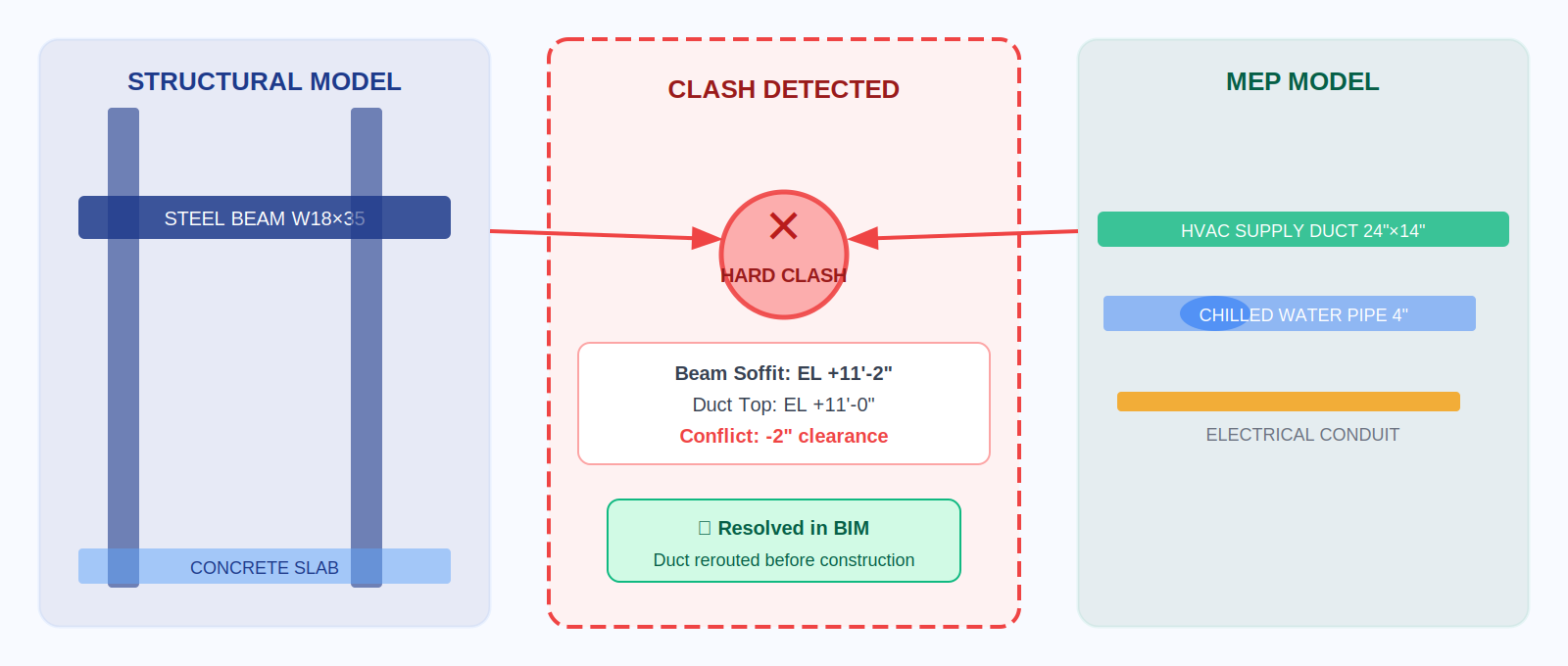
In a traditional 2D workflow, a structural beam and a mechanical duct can occupy the exact same physical space on paper — because no one tool is checking spatial relationships across disciplines. A professional Architectural BIM Service with integrated clash detection eliminates this category of problem entirely, at the design stage.
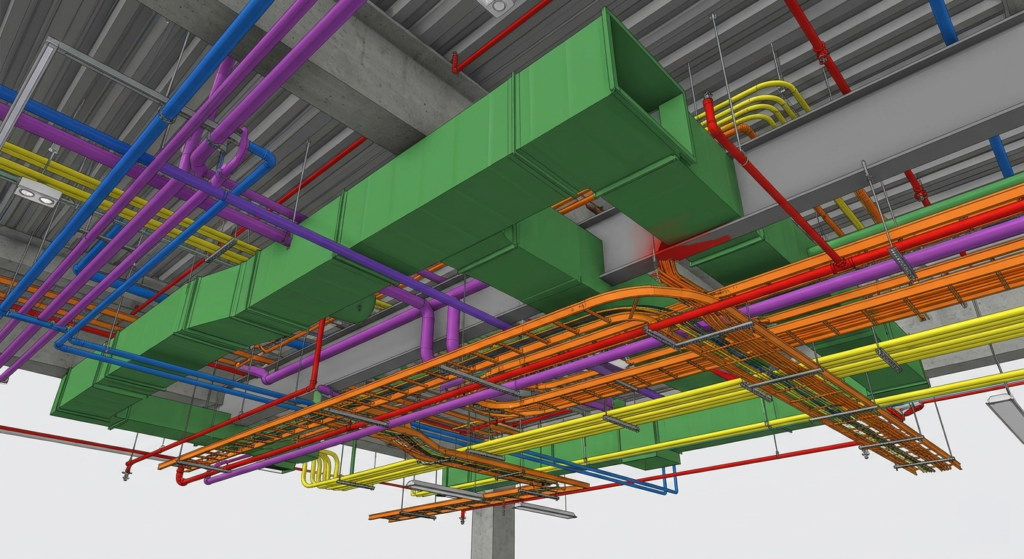
Figure 2: BIM clash detection — a steel beam and HVAC supply duct occupying the same spatial coordinate. Identified and resolved inside the BIM model before construction begins.
How BIM Modeling Services Improve Project Visualization
3D Visualization of Building Design
The most immediate impact of BIM Modeling Services is the ability to view a fully three-dimensional representation of a project before any physical work begins. Unlike a rendered architectural image, a 3D BIM model is a functional database. Every element contains real data — the exact specification of a curtain wall panel, the routing path of an HVAC duct — all delivered with genuine BIM design accuracy.
Realistic Project Representation
Modern Revit BIM modeling workflows support photorealistic rendering and virtual walkthrough capabilities directly within the BIM environment. Project teams can generate exterior renderings that reflect actual material finishes, interior views that show daylighting conditions, and fly-through animations that help clients understand spatial flow.
Better Design Understanding for Stakeholders
One of the most underappreciated benefits of professional BIM Modeling Services is how they democratize design comprehension. When all parties are looking at the same 3D BIM model and navigating the same spaces, communication quality improves immediately. Questions get asked earlier. Decisions get made faster.
Improved Design Accuracy
Because all disciplines — architecture, structure, MEP, civil — work within a shared federated BIM environment, every change made by one team is visible to all others in near real-time. This interconnected workflow is the technical foundation of BIM coordination. When an architect raises a ceiling height, the structural model flags affected framing, the mechanical model highlights duct routing conflicts, and the electrical team can assess conduit clearances.
Enhanced Client Presentations
In competitive bid environments, BIM Modeling Services give project teams a powerful differentiation tool. Presenting a fully coordinated 3D model with material takeoffs and phasing animations demonstrates a level of pre-construction rigor that 2D drawing sets simply cannot match.
Key Features of BIM Modeling That Improve Visualization
3D BIM Models
At the core of every BIM Modeling Services engagement is the creation of discipline-specific 3D models — architectural, structural, and MEP — that are federated into a single coordinated model. This federated model becomes the project’s single source of truth. Every drawing sheet, every quantity takeoff, and every coordination report derives from this model.
Walkthrough and Virtual Simulation
Virtual walkthroughs, generated directly from Revit BIM modeling environments or exported to platforms like Autodesk Navisworks and Enscape, allow clients and project managers to navigate a building’s spaces as though walking through the completed structure.
Clash Detection and Coordination
BIM coordination using clash detection software identifies hard clashes, soft clashes, and workflow clashes. According to research published in Automation in Construction, a single hard clash resolved in the field costs 10 to 20 times more than the same clash resolved during BIM coordination.
Real-Time Design Updates
Parametric Revit BIM modeling means that design changes propagate automatically through the entire model. This real-time synchronization, the technical backbone of effective BIM collaboration, eliminates the version-control nightmares that plague 2D CAD workflows.
Industry insight: The U.S. General Services Administration (GSA) now requires BIM deliverables on all federally funded building projects exceeding certain thresholds — underscoring how thoroughly BIM Modeling Services have become the professional standard across the US construction industry.
Benefits of Improved Project Visualization Using BIM Modeling Services
Better Decision Making
BIM Modeling Services give decision-makers the visual clarity to evaluate options and trade-offs with confidence, rather than relying on abstract descriptions or speculative renderings.
Reduced Design Errors
The interconnected nature of a federated BIM model means that inconsistencies surface automatically. These are precisely the kinds of BIM design accuracy issues that cost thousands of dollars per occurrence in the field and are completely preventable with a coordinated Architectural BIM Service.
Improved Collaboration
True BIM collaboration means that architects, structural engineers, MEP engineers, specialty contractors, and owners all work from the same model — not parallel, potentially contradictory drawing sets. Platforms like Autodesk Construction Cloud enable distributed teams to coordinate across time zones while maintaining a single federated model.
Faster Project Approval
Permit submissions that include BIM-derived drawing sets move through review faster than 2D drawing packages. Many US jurisdictions now accept or prefer BIM-native submission formats, particularly for complex commercial and institutional projects.
Reduced Construction Rework
BIM Modeling Services attack rework at its root: by finding and resolving coordination conflicts before construction, they eliminate the need to demolish and rebuild incorrectly installed work. Projects using professional BIM coordination consistently report rework reductions of 30–40% compared to projects coordinated using traditional 2D methods.
Industries That Benefit from BIM Visualization
- Residential Construction: Custom homes, multi-family, luxury developments — BIM helps owners visualize finishes and layouts before construction locks them in.
- Commercial Buildings: Office towers, retail centers, hotels — complex MEP systems and tight floor-to-floor clearances demand coordinated BIM.
- Infrastructure Projects: Bridges, tunnels, transit stations — infrastructure BIM enables clash-free utility coordination in congested underground environments.
- Industrial Projects: Data centers, manufacturing plants, pharmaceutical facilities — equipment-dense industrial projects depend on BIM for process pipe and structural coordination.
The Sheet Metal and Air Conditioning Contractors’ National Association (SMACNA) has documented that MEP contractors using BIM coordination on complex commercial projects report RFI volumes 50–70% lower than on equivalent non-BIM projects.
Why Use BIM Modeling Services Before Construction Begins
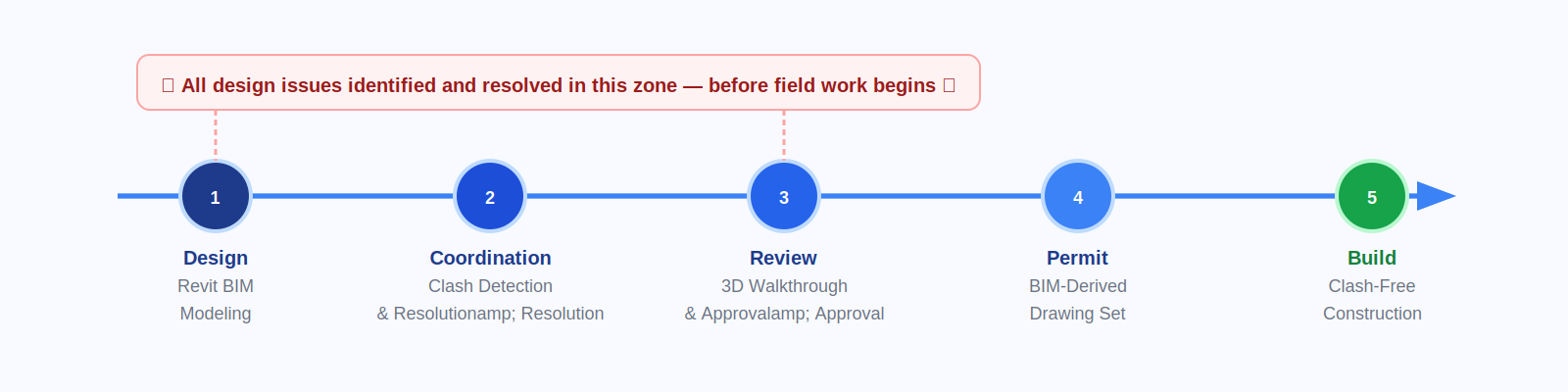
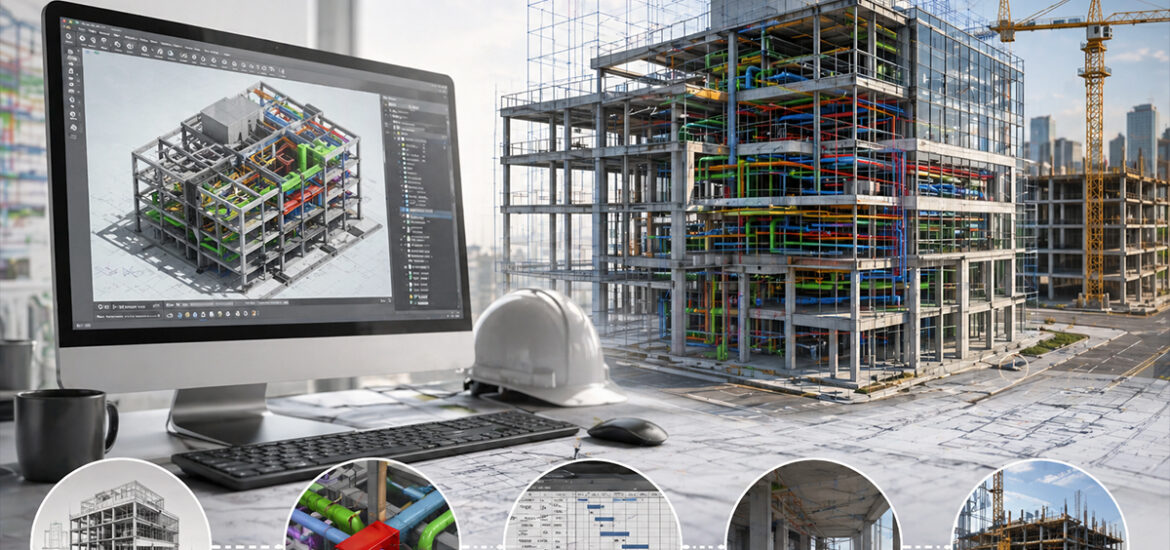
Figure 3: The BIM workflow from initial Revit modeling through clash-free construction. Issues caught in stages 1–3 cost a fraction of the same issues discovered during or after construction.
The economic argument for investing in BIM Modeling Services before construction is straightforward: the cost to resolve a design conflict increases by a factor of 10 to 100 as a project progresses from design through construction to completion. A clash found in a BIM model during design coordination costs the price of an engineer’s time to reroute a duct. The same clash found during construction costs demolition, reinstallation, inspection, and schedule delay.
The BIM collaboration environment also creates a comprehensive digital record of every design decision — who approved it, when, and why — providing valuable protection in dispute resolution and supporting the building’s long-term facility management through a rich as-built dataset.
How Eagle BIM Services Improves Project Visualization with BIM Modeling
Eagle BIM delivers professional BIM Modeling Services to architects, MEP engineers, general contractors, and building owners across the United States. Our team specializes in creating coordinated 3D models that serve as the project’s authoritative source of information — from early design through construction documentation and as-built delivery.
Our Revit BIM modeling workflow follows a disciplined, phased approach. We begin with discipline-specific model creation — architectural, structural, and MEP — at the appropriate Level of Development (LOD) for the project phase. We then federate those models and run systematic clash detection using Navisworks, generating documented clash reports with resolution status. Once the model is clash-free, we extract coordinated drawing sets, quantity schedules, and 3D visualizations for client review and permit submission.
Our Architectural BIM Service capabilities include LOD 200 through LOD 400 modeling, virtual walkthrough production, interference management, shop drawing coordination, and as-built model delivery. Our BIM coordination services include full clash detection across all building systems, coordination drawing production, and spool drawing extraction for fabrication. Every project benefits from genuine BIM design accuracy — a thorough, coordinated model that eliminates the coordination conflicts and visualization gaps that drive construction cost overruns.
To learn more about our BIM Modeling Services, visit: https://bim-services.us/bim-Modeling-services/
Get in touch for a free BIM consultation: https://bim-services.us/contact/
Conclusion
The construction industry has spent decades absorbing the cost of poor visualization. BIM Modeling Services represent a proven, technology-backed solution to all of these problems.
By replacing 2D drawing sets with intelligent 3D models, enabling true BIM collaboration across all disciplines, and catching coordination conflicts before they reach the field, professional BIM Modeling Services fundamentally change the economics of construction project delivery. The investment in Revit BIM modeling, BIM design accuracy, and coordinated Architectural BIM Service is not a premium — it is the most reliable cost-control measure available to a modern construction project team. Eagle BIM is ready to deliver them.