

Quick Summary
Construction projects around the world consistently struggle with two problems: going over budget and falling behind schedule. These are not random events. They are the result of fragmented communication, undetected design errors, inaccurate estimates, and poor coordination between teams. BIM services for construction tackle all of these problems at the root by giving every stakeholder access to a single, shared, intelligent model of the building throughout the entire project lifecycle.
This article explains what BIM services are, why construction projects fail financially and on schedule, and exactly how BIM coordination services, BIM modeling services, and BIM for contractors help prevent those failures. We also look at real-world examples where BIM in construction delivered measurable cost and time savings.
What Are BIM Services in Construction Projects?
Building Information Modeling, or BIM, is a process in which all parties involved in a construction project collaborate through a shared digital model. That model is not just a 3D drawing. It is an intelligent database that contains geometry, materials, structural specifications, MEP systems, cost data, and scheduling information all in one place.
BIM services for construction include the creation and management of that model from early design through to construction completion and handover. Depending on the scope, BIM services can cover initial concept modeling, coordination between structural and MEP disciplines, quantity extraction for cost estimation, 4D scheduling where the construction sequence is simulated visually, and 6D modeling for facilities management after handover. As Plannerly explains in their comprehensive BIM cost guide, projects that adopt BIM methodologies see cost reductions of 10 to 20 percent compared to traditional approaches.
The key difference between BIM and traditional CAD-based workflows is that BIM is live and connected. When an architect changes a wall dimension, every connected view, schedule, and quantity automatically updates. When the MEP engineer moves a duct, the coordination model flags any new conflicts with structural elements. This real-time connectivity is what makes BIM modeling services so powerful at eliminating the communication failures that drive up costs and delay programmes.
BIM for construction companies is no longer optional on large commercial, infrastructure, or healthcare projects. Many public sector clients across the UK, Singapore, the United States, and Australia now mandate BIM at specific levels of development. According to NBS, the UK government targeted savings of 15 to 20 percent on construction budgets specifically because of BIM adoption.
Major Reasons for Construction Cost Overruns and Delays
Before exploring how BIM coordination services solve these problems, it is worth being clear about what causes them. The same root causes appear on project after project, regardless of size or geography.
Poor Project Planning
Most construction problems are created before a single shovel touches the ground. When scope is not fully defined, when risk is not properly allocated, and when the construction sequence has not been thought through in detail, projects enter the field carrying hidden time bombs. Scope changes mid-construction are enormously expensive because they force rescheduling, reordering of materials, and disruption to crews already mobilised on site.
BIM in construction addresses this by enabling virtual design and construction sessions during pre-construction. All trades can review the model together, walk through the construction sequence digitally, identify logistics conflicts, and lock down scope before prices are committed. Autodesk’s Digital Builder blog notes that BIM clash detection is now standard in commercial construction precisely because it catches these issues at the earliest and cheapest point in the project lifecycle.
Design Conflicts and Errors
On a traditionally designed building, architects, structural engineers, and MEP engineers each produce their own drawings independently. Those drawings are then overlaid to check for conflicts, usually by eye and usually late in the design process. Common clashes include HVAC ducts running through structural beams, pipe runs that cannot be installed because there is insufficient clearance, and electrical conduit routes that conflict with structural connections. According to Neuroject’s 2024 BIM guide, between 35 and 40 percent of all construction rework is directly attributed to clashes and coordination issues that were not caught in design.
BIM modeling services eliminate most of these conflicts by running automated clash detection across federated discipline models before any physical work begins. The DBIA published a detailed case study showing that a $200,000 investment in BIM coordination on a single project delivered $2.22 million in rework savings alone — a 10x return on investment.
Inaccurate Quantity Estimation
Traditional quantity takeoffs are performed manually from 2D drawings. This process is slow and prone to error. Underestimating quantities leads to cost overruns mid-project when additional materials need to be procured at short notice, often at a premium. As Arkance notes in their BIM cost savings analysis, a bridge project in Europe shifted from traditional spreadsheets to 5D BIM and reduced material costs by 8 percent simply by negotiating with suppliers using precise, model-derived quantities.
BIM for contractors eliminates the estimation error problem by enabling parametric quantity extraction directly from the model. Because the model is parametric, every change to the design is reflected immediately in the quantities. Quantities update automatically whenever the design changes — no recalculation required.
Lack of Team Coordination
A major construction project involves dozens of separate organisations: architects, engineers of multiple disciplines, the main contractor, dozens of specialist subcontractors, suppliers, and the client. Without a single shared source of information, each party can be working from different versions of drawings at any given time. Revizto’s detailed analysis of clash detection highlights how BIM coordination meetings built around shared models are where the value compounds: large conflicts are resolved virtually, priorities are clarified, and responsibilities are assigned before materials are ordered or crews mobilise.
BIM coordination services solve fragmentation by establishing a common data environment — a central, cloud-based platform where all project information is stored, versioned, and accessed by every party. When everyone works from the same model, the number of RFIs drops dramatically and coordination issues that used to surface on site are resolved weeks or months in advance.
Rework During Construction
Rework is the most visible and painful symptom of all the problems listed above. MarsBIM reports that the US construction industry loses an estimated $177 billion annually to rework and inefficiency, with MEP trade contractors absorbing a disproportionate share of that loss because they install last, they have the least spatial flexibility, and when something does not fit, they pay for the fix even when the conflict was not their fault.
On a 50 million dollar project where rework averages 10 percent of costs, that represents 5 million dollars of avoidable waste. BIM for construction companies, applied rigorously from early design, eliminates most of this rework by ensuring that conflicts are resolved before fabrication begins and before any material is cut.
How BIM Services Help Reduce Construction Costs
Each of the failure modes described above has a direct solution within a well-implemented BIM workflow. Here is how each mechanism works in practice.
Accurate Quantity Takeoffs and Cost Estimation
When a building model is built to the right level of development, every element carries properties: its material, its dimensions, its specification. Quantity surveyors and estimators can query the model directly to extract precise quantities for any element. Desapex explains in their BIM efficiency guide that accurate cost estimation is one of BIM’s most critical contributions: 5D BIM integrates cost data directly with the model so that quantities and cost breakdowns update automatically whenever the design changes.
This capability allows project teams to make value engineering decisions during design development when they are cheapest, rather than discovering the budget impact of a design choice after the project has gone to tender. The result is tighter cost control from the very start of the project.
Early Clash Detection to Avoid Rework
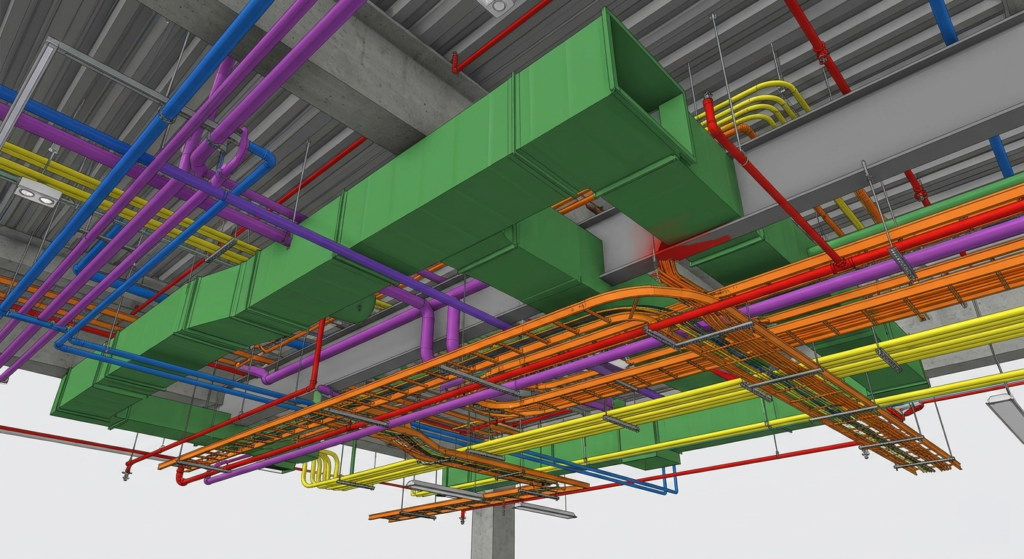
Automated clash detection is one of the most immediate and quantifiable benefits of BIM coordination services. The process works by importing discipline models into a coordination platform such as Autodesk Navisworks or Solibri. The software runs geometric checks across all models simultaneously, flagging every point where elements from different disciplines overlap or where clearance requirements are not met. ENG BIM’s financial analysis of clash detection puts it clearly: if a mid-sized project runs $30 million and rework averages 10 percent of costs, that is $3 million at stake — and early clash resolution can protect most of it.
The financial logic is simple. Fixing a clash in the model during coordination takes an engineer perhaps 30 minutes of design time. The same clash found on site after fabrication means cutting and re-fabricating components, additional installation labour, programme delay, and potentially a delay claim. Revizto’s case study data confirms this: a $200,000 VDC investment on a $230 million food project translated into over $2.5 million in cost and time savings — a 10x return.
Better Resource Planning
BIM for contractors extends into resource planning through 5D modeling, where cost data is attached directly to model elements. When a project manager wants to understand the cash flow profile of a project, they can query the model to see how much work is scheduled in any given period and where labour demand peaks. Architosh reported in their 2023 BIM cost savings feature that 55 percent of BIM users have measurably reduced the time required to communicate, collaborate, make decisions, and build workflows — directly improving resource efficiency across the board.
This visibility allows project teams to smooth the resource curve, avoiding periods of over-commitment that lead to overtime costs and quality problems, and periods of under-utilisation that represent wasted fixed costs. It also improves procurement efficiency: accurate, time-phased material schedules reduce emergency procurement and the cost premiums that come with it.
Improved Construction Scheduling
4D BIM links the three-dimensional model to a construction programme, creating a visual simulation of the build sequence. Teams can watch the building grow day by day in the digital environment, checking whether the planned sequence is physically achievable and whether there are spatial conflicts between concurrent activities.
This visual simulation is particularly valuable for complex projects where multiple trades are working in the same area simultaneously. According to Arkance’s analysis, global data shows that 4D BIM reduces schedule overruns by up to 30 percent and improves site productivity by 15 to 20 percent. A commercial tower in the Middle East used a 4D simulation to replan its core construction sequence and avoided significant programme delay as a direct result.
Reduced Material Wastage
Industry estimates suggest that between 10 and 30 percent of materials delivered to construction sites are wasted through over-ordering, incorrect fabrication, or rework. BIM modeling services reduce waste through precise quantity extraction, detailed fabrication drawings, and support for off-site manufacturing. As ICON BIM highlights, prefabrication and modular workflows become far more reliable with BIM because fabrication shops can manufacture with confidence that assemblies will fit in the field — eliminating the scrap and re-fabrication that plague traditional site-cut methods.
Prefabricated MEP modules designed and coordinated in BIM can reduce MEP installation time on site by 30 to 50 percent and virtually eliminate MEP rework. This approach transfers risk from the weather-dependent site environment to a controlled factory setting, reducing delay exposure at the same time.
Real-World Use Cases of BIM in Cost and Time Savings
The benefits of BIM services for construction are not theoretical. They are documented across hundreds of projects worldwide, in every sector and at every scale.
Healthcare: Major Hospital Expansion, United Kingdom
A 45,000 square metre hospital extension adopted BIM modeling services from the early stages of design. The project team, comprising the architect, structural engineer, mechanical and electrical engineers, and the main contractor, collaborated through a federated coordination model and ran regular clash detection reviews throughout design development. By the time the project reached the construction phase, the coordination process had identified and resolved over 6,800 clashes including 2,743 hard clashes. The team estimated this saved approximately 2.1 million pounds in potential rework costs and avoided a significant programme extension.
Commercial: Grade-A Office Tower, Singapore
A 38-storey commercial office tower in Singapore used BIM for contractors to coordinate structural steel, curtain walling, and complex MEP installations across a tight floor plate. The project team used 4D BIM to simulate the construction sequence and identified a critical conflict where planned tower crane operations during the structural steel phase overlapped with curtain wall installation on the upper floors. The sequence was re-engineered before construction began, avoiding an estimated 12-week programme delay. BCA Singapore’s BIM Roadmap documents how this type of outcome has become repeatable on Singapore projects where BIM is applied at full depth.
Infrastructure: Rail Station Upgrade, Australia
An operational urban rail station undergoing a major accessibility and capacity upgrade used BIM in construction to manage the complex interfaces between new structural works and existing live operational infrastructure. The challenge was compounded by the need to maintain station operations throughout construction, creating severe constraints on when and where different activities could take place. Model-based quantity takeoffs reduced the cost estimate variance from plus or minus 18 percent using traditional manual methods to plus or minus 6 percent, allowing the client to carry a significantly lower contingency reserve throughout the 28-month construction programme.
Manufacturing Facility: Design-Build Food Project, USA
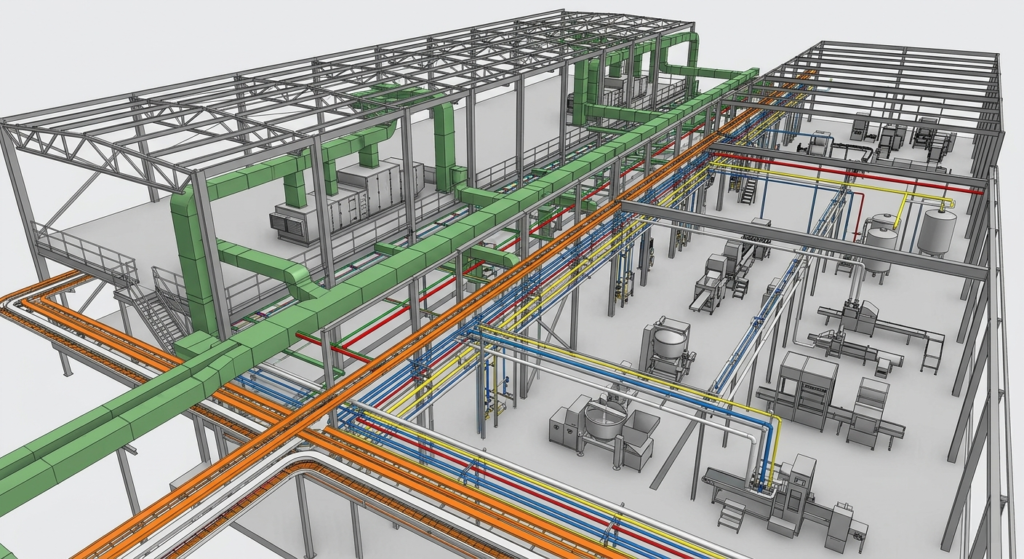
Perhaps the most precisely documented ROI case in the industry is the $230 million design-build food processing facility case study published by DBIA. A $200,000 investment in VDC and BIM coordination delivered $2.22 million in rework savings and $542,000 in schedule savings from a one-month reduction in general conditions costs — a net saving of $2.55 million and a 10x return on the BIM investment. The full case study is available on the DBIA website and is one of the most detailed quantifications of BIM ROI available in the public domain.
Conclusion
The construction industry has a well-documented problem with cost overruns and project delays, and the causes are well understood. BIM services for construction provide a systematic response to each of these failure modes. BIM coordination services resolve design conflicts before they become site problems. BIM modeling services provide accurate quantities that eliminate estimation error. 4D BIM exposes scheduling conflicts in a virtual environment. And the common data environment that underpins all BIM activity eliminates the communication fragmentation that generates RFIs, change orders, and delay claims.
For project owners, adopting BIM as a project requirement from the earliest stages of procurement is one of the most cost-effective risk management decisions available. For main contractors and specialist subcontractors, investing in BIM for contractors capabilities is increasingly a prerequisite for winning and successfully delivering major projects. The evidence is settled: projects delivered using BIM consistently report lower costs, shorter programmes, and higher client satisfaction.
The question for any construction professional today is not whether BIM is worth investing in. The question is how to implement BIM well, how to select the right partners, and how to build the internal capability to use BIM as a genuine management tool rather than simply a documentation platform. The projects that get that right are the projects that come in on time, on budget, and free of the rework disputes that define so much of the industry’s history. To understand how BIM can work specifically for your project type, Plannerly’s step-by-step guide is an excellent practical starting point.
