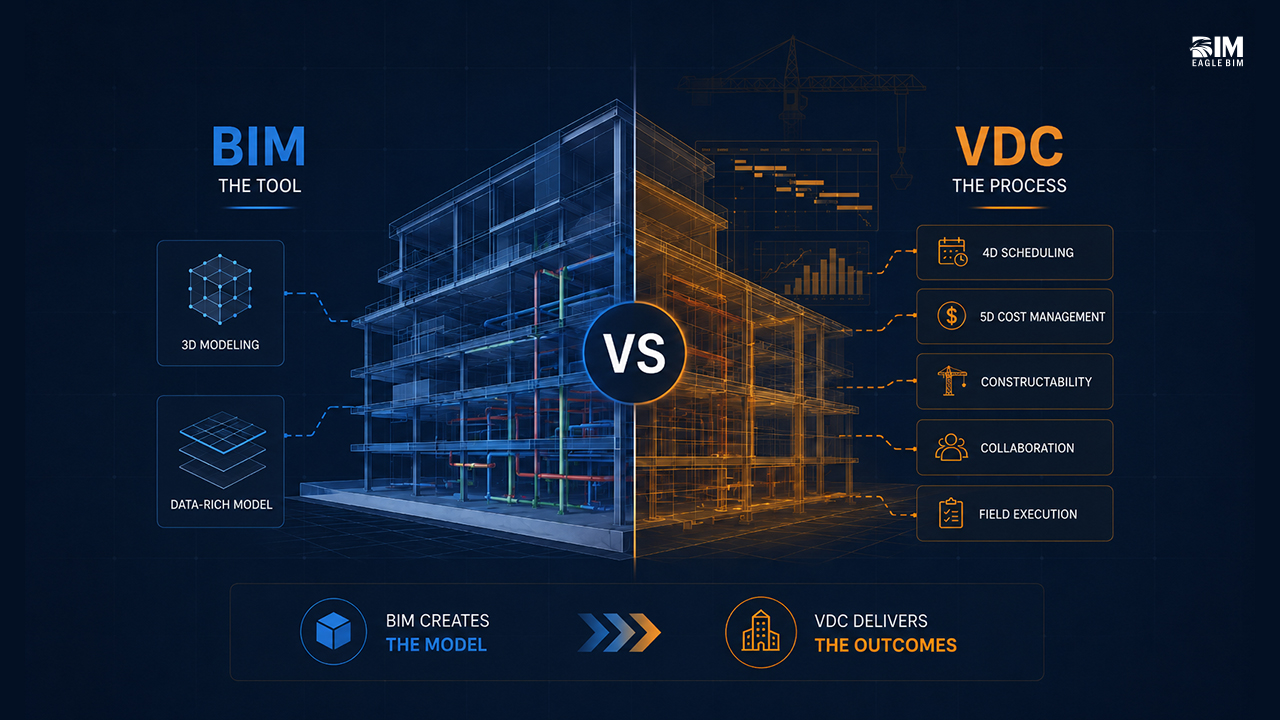
If you have spent any time around a preconstruction meeting in the last few years, you have heard both terms — VDC vs BIM — used interchangeably, sometimes in the same sentence. Project owners ask for BIM deliverables. General contractors hire VDC managers. MEP subs talk about BIM coordination. And somewhere in the middle, everyone nods along hoping nobody asks them to explain the difference on the spot.
Here is the truth: VDC vs BIM is not a choice between two competing technologies. It is a distinction between a tool and the process built around that tool. Understanding exactly where one ends and the other begins is not an academic exercise — it has real implications for how you scope projects, hire partners, write contracts, and deliver outcomes that hold up from preconstruction through closeout.
This guide cuts through the jargon. By the end, you will know precisely what VDC vs BIM means in practice, how the two work together on a commercial construction project, and what general contractors in Texas and across the USA should be asking for — and why.
Defining BIM — The Tool, Not the Process
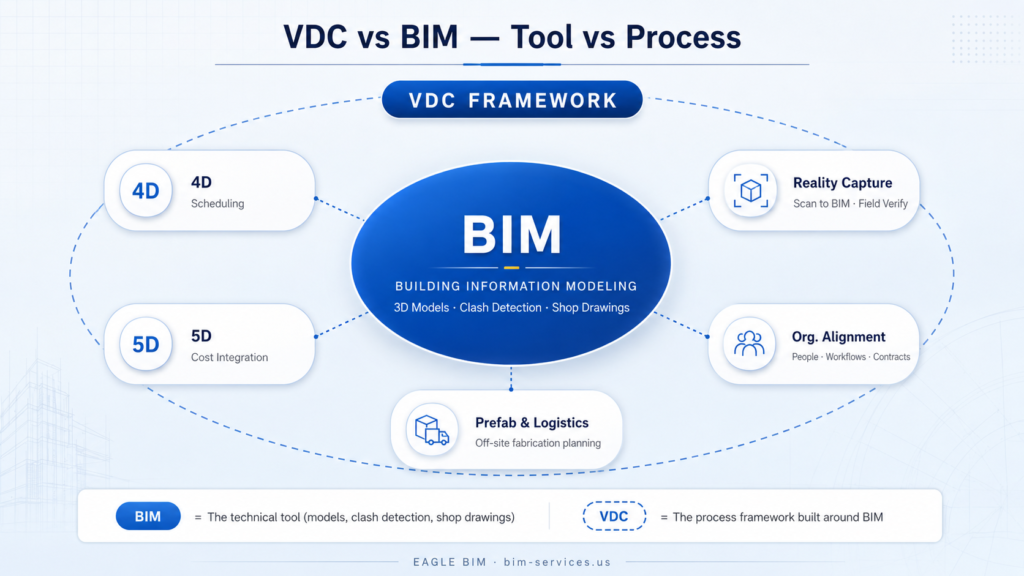
Building Information Modeling — BIM — is the creation and use of a data-rich, three-dimensional digital model of a building or infrastructure asset. That model is not just geometry. It contains parametric data: material properties, system specifications, dimensions, spatial relationships, and — depending on the level of development — cost information, scheduling sequences, and maintenance data.
BIM modeling in Revit, Navisworks, Tekla, or comparable platforms produces the federated model that becomes the shared reference point for every discipline on a project. Architects produce the architectural model. Structural engineers produce the structural model. MEP engineers and subcontractors produce the mechanical, electrical, plumbing, and fire protection models. Those discipline models are combined into a federated model where clash detection can be run, coordination issues can be identified, and build-ready shop drawings can be produced.
BIM services encompass everything that happens within that modeling environment — the creation of the models, the coordination between them, the clash detection cycles, the shop drawing production, and the handover of accurate as-built documentation at project close. BIM is specific. It is a defined technical process with established standards, LOD requirements, and software platforms.
What BIM is not — and this is where the VDC vs BIM confusion starts — is a complete project delivery framework. BIM creates the model. It does not by itself manage the people, the workflows, the contracts, the schedule integration, or the organizational alignment that turns a model into a successfully delivered building.
Defining VDC — The Process, Not Just the Model
Virtual Design and Construction — VDC — is the broader process framework that uses BIM as its digital foundation but extends well beyond model creation. A widely used definition from Stanford University’s Center for Integrated Facility Engineering describes VDC as the use of multi-disciplinary performance models of design and construction projects, including the product, work processes, and the organization of the design-construction-operation team, to support business objectives.
That definition is worth sitting with. VDC is not just about the model — it is about the product, the process, and the people simultaneously. Virtual design and construction brings together 3D BIM modeling, 4D scheduling, 5D cost management, constructability analysis, logistics planning, and real-time collaboration workflows under a single coordinated framework.
In practice, VDC in construction means that a VDC manager or VDC team is responsible not just for producing models but for integrating those models with the project schedule, using them to optimize sequencing, running prefabrication planning against them, managing clash resolution workflows, and making sure that what is built in the field matches what was coordinated in the virtual environment.
The clearest way to understand VDC vs BIM is through this framing from Matterport’s construction research: “BIM creates a detailed model, while VDC ensures that the model becomes a reality without costly surprises.” BIM is the what. VDC is the how, the who, and the when — the process framework that turns a model into a delivered building.
VDC vs BIM — A Side-by-Side Comparison
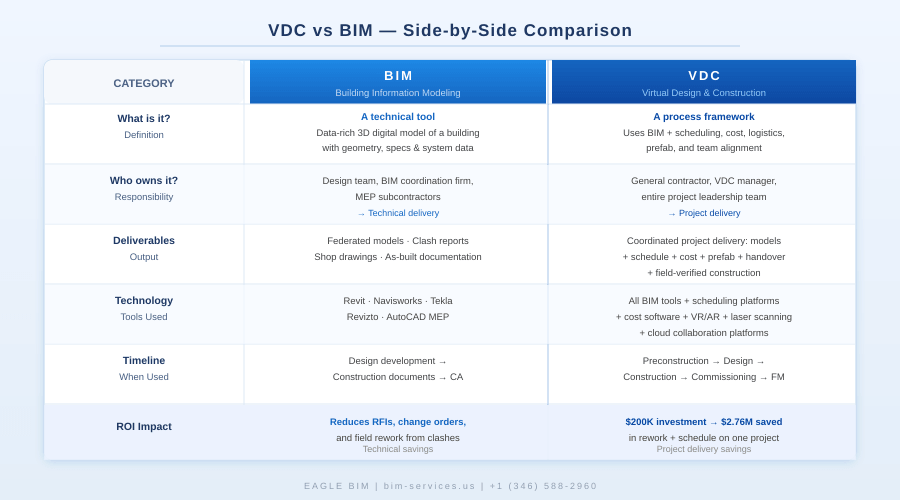
The table below is the clearest way to see exactly how VDC vs BIM differ in scope, responsibility, and application on a real commercial project:
Scope — BIM is a technical process focused on model creation, coordination, and documentation. VDC in construction is a project delivery framework that uses BIM alongside scheduling, cost integration, logistics, and organizational alignment.
Who owns it — BIM modeling is typically owned by the design team, BIM coordination services firm, or MEP subs. VDC is typically owned by the general contractor or a dedicated VDC manager who coordinates across all disciplines.
What it produces — BIM services produce federated models, clash detection reports, shop drawings, and as-built documentation. VDC produces coordinated project delivery — models plus schedules, cost tracking, constructability validation, and field-to-model verification.
When it applies — BIM coordination runs from design development through construction documents and into construction administration. VDC in construction begins at preconstruction and runs through commissioning and handover.
Technology — BIM modeling relies on Revit, Navisworks, Tekla, AutoCAD MEP, and Revizto. VDC uses those same tools plus scheduling platforms, cost management software, VR/AR visualization tools, and reality capture for field verification.
Can you have one without the other? — Yes. BIM can be used without a VDC framework — many projects use BIM modeling and clash detection without full VDC coordination. VDC without BIM is theoretically possible but extremely rare and significantly less powerful.
Why the Confusion Between VDC vs BIM Exists — and Why It Matters
The reason VDC vs BIM gets muddled in the industry is that VDC cannot function without BIM. BIM modeling is the technical engine inside every VDC process. Because they are always used together, and because the outputs — coordinated models, clash reports, shop drawings — look the same whether you call it BIM or VDC, the terms get collapsed into each other.
But the distinction matters enormously for general contractors, project owners, and anyone buying BIM coordination services. When you contract for BIM services, you are purchasing a technical deliverable: a model, a clash report, a set of shop drawings. When you implement a VDC framework, you are purchasing a project delivery methodology — one that requires organizational commitment, clear roles, workflow integration, and leadership alignment to produce results.
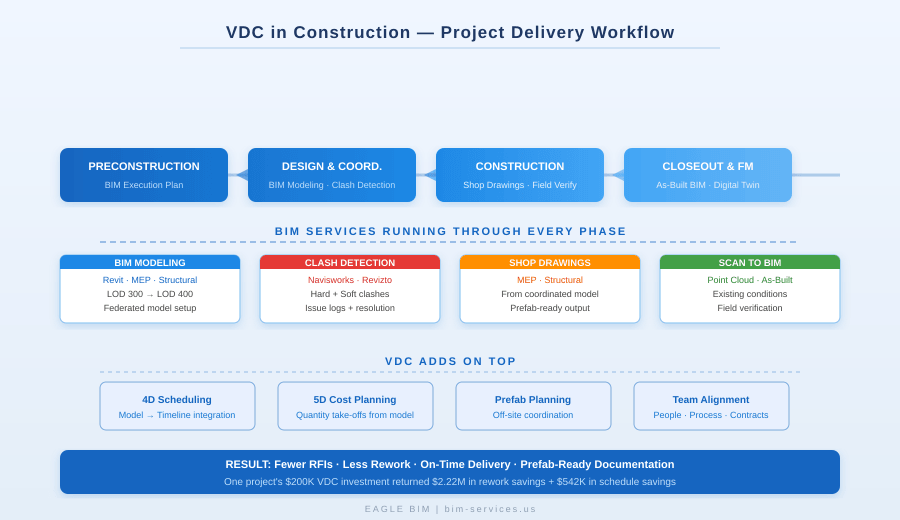
The numbers make the case clearly. According to research cited by Construct Two Group’s VDC implementation guide, a single project’s $200,000 VDC investment saved $2.22 million in rework costs and $542,000 in schedule expenses. That return does not come from the model alone — it comes from the process built around the model.
For a general contractor evaluating a BIM coordination services provider, the right question is not just whether they produce good models. It is whether they can integrate their BIM coordination workflow into your project delivery process — providing clash reports on your schedule, producing shop drawings that align with your procurement timeline, and supporting your field crews with the accurate information they need to build without surprises.
The Four Dimensions of VDC in Construction — Beyond the 3D Model
3D BIM Modeling — The Foundation
Every VDC process begins with disciplined BIM modeling. Architectural, structural, and MEP-FP discipline models are built to defined LOD standards, combined into a federated model, and run through structured clash detection cycles. The federated model becomes the single source of truth for the project — the reference point that every discipline works from and every coordination decision is made against.
The quality of the BIM coordination services at this stage determines the quality of everything downstream. A poorly built federated model — with misaligned shared coordinates, inconsistent LOD across disciplines, or inadequate clash tolerance settings — produces coordination results that cannot be trusted. Eagle BIM’s BIM modeling workflow begins with model setup standards that ensure every discipline model is compatible, every clash test is meaningful, and every issue log is actionable.
4D — Schedule Integration
4D BIM adds the dimension of time to the three-dimensional model. In a VDC in construction workflow, the BIM model is linked to the project schedule, allowing the team to visualize construction sequencing, identify phasing conflicts, and validate that the planned construction sequence is actually achievable given the spatial relationships in the model.
For general contractors managing complex commercial projects — hospital expansions, data centers, multi-phase industrial facilities — 4D BIM is the difference between a schedule that looks reasonable in a spreadsheet and one that has been tested against the actual geometry of the building. Equipment delivery, crane picks, temporary works, and trade sequencing all interact with the model in ways that a Gantt chart alone cannot reveal.
5D — Cost Integration
5D BIM links the model to cost data, enabling quantity take-offs directly from the coordinated model rather than from 2D drawings. When the BIM modeling is accurate and the model reflects the coordinated, clash-free design, quantity take-offs from that model are significantly more reliable than traditional methods. Change orders triggered by design conflicts — the most expensive kind — are dramatically reduced when coordination happens before construction begins.
The cost savings of VDC in construction are well documented. Studies across the industry consistently show 5 to 20 percent total project cost reductions on projects with mature VDC implementation, driven by fewer change orders, reduced rework, and faster approvals.
Reality Capture and Field Verification
The fourth dimension of VDC that separates high-performing implementations from basic BIM coordination is reality capture — using 3D laser scanning and point cloud technology to verify that what is being built matches what was coordinated in the model. Scan to BIM workflows produce as-built documentation that can be compared directly against the design model, catching installation errors before subsequent trades build around them.
For renovation and expansion projects, scan to BIM also forms the foundation of VDC from the start. The existing conditions model — derived from point cloud data rather than potentially inaccurate legacy drawings — becomes the starting point for all new design and coordination work, ensuring that new systems integrate correctly with what is actually there.
Need coordinated BIM models for your next project? Explore Eagle BIM’s BIM Coordination Services →
What VDC vs BIM Means for General Contractors in Texas in 2026
Texas is one of the most active construction markets in the United States, with major hospital expansions, hyperscale data centers, industrial campuses, and commercial towers all breaking ground simultaneously across Dallas-Fort Worth, Houston, Austin, and San Antonio. In this environment, the distinction between VDC vs BIM is not theoretical — it is a competitive reality.
General contractors who understand VDC in construction are winning projects that their competitors are not, because owners increasingly require — not just prefer — coordinated digital delivery. The BIM execution plan is now a standard contract requirement on most major commercial projects in Texas, and the ability to demonstrate VDC capability is becoming a selection criterion alongside safety record and bonding capacity.
The construction industry’s productivity challenge makes VDC even more urgent. According to McKinsey’s research cited by Evans General Contractors, construction has experienced only a 1% annual growth in productivity over decades — compared to the manufacturing sector, which has tripled its efficiency gains over the same period. VDC and BIM coordination services are the primary mechanism through which construction is closing that gap.
For Texas GCs specifically, VDC vs BIM also intersects with the labor shortage that is reshaping project delivery. With skilled trades increasingly difficult to recruit and retain, the ability to prefabricate MEP assemblies off-site — driven by coordinated BIM modeling and LOD 400 shop drawings — is becoming a core delivery strategy. VDC in construction enables prefabrication by producing the fabrication-ready, clash-free geometry that shop production depends on.
General contractors who can tell their owners: our BIM coordination services are fully integrated into our project delivery process, our models drive our shop drawings, and our field crews work from verified, coordinated information — those contractors are winning work. The VDC vs BIM question, understood correctly, is ultimately a question about the quality of your project delivery.
What to Ask When You Are Hiring a BIM Coordination Services Partner
Understanding VDC vs BIM is one thing. Translating that understanding into smart procurement decisions is another. When you are evaluating a BIM coordination services partner for your next project — whether it is a hospital in Houston, a data center in Dallas, or an industrial campus in San Antonio — these are the questions that separate a genuine VDC-capable partner from one that is just producing models:
Can you produce a BIM execution plan at project start? — A BIM execution plan defines LOD requirements for each phase, data exchange protocols, clash detection tolerances, coordination meeting cadence, and handover deliverables. A partner who cannot produce a clear BIM execution plan is not operating within a VDC framework — they are just modeling.
How do your clash detection cycles integrate with our schedule? — BIM coordination services that produce clash reports without aligning to the project schedule create friction rather than value. The coordination cycle needs to run ahead of procurement decisions, not after them.
How do your BIM models connect to shop drawing production? — The most expensive gap in a BIM coordination services workflow is the gap between the coordinated model and the shop drawings. If those are produced separately, you have two sources of truth instead of one — and field problems follow.
Do you support scan to BIM for existing conditions? — On any project involving existing structures, the BIM coordination process must start from accurate as-built data. Point cloud-derived as-built models are the only reliable foundation for coordination work on renovation and expansion projects.
What is your clash resolution process? — Running clash detection is not coordination. Coordination is the structured process of resolving those clashes — assigning ownership, tracking resolution, verifying model updates, and producing a final clash-free model. A VDC-capable BIM services partner has a defined process for all of this.
Eagle BIM’s Role in Your VDC Workflow
Eagle BIM provides the BIM coordination services that sit at the technical core of every VDC process. Our work begins with federated model setup and runs through coordinated, clash-free, build-ready model delivery — giving your VDC framework the technical foundation it needs to perform.
BIM Coordination — Multi-discipline federated model management, structured clash detection using Navisworks and Revizto, coordination meeting support, and issue log management across architectural, structural, and MEP-FP disciplines.
MEP BIM Services — Mechanical, electrical, plumbing, and fire protection Revit modeling built for coordination, constructability, and downstream shop drawing production. The BIM modeling discipline that drives the most complex coordination challenges on commercial projects.
Clash Detection Services — Structured hard and soft clash detection with clear, actionable reports, priority-ranked issue logs, and revision tracking across all coordination cycles.
Shop Drawing Services — MEP and structural shop drawings produced directly from the coordinated federated model — not drafted separately. The link between virtual coordination and field installation.
Scan to BIM Services — Point cloud processing and as-built Revit modeling for renovation, expansion, and facility management projects. The foundation for VDC in construction on any project involving existing structures.
Revit Family Creation — Custom parametric Revit families for equipment, fixtures, and specialty systems — the building blocks of accurate, coordinated BIM modeling.
BIM Execution Plan Support — Guidance on BIM execution plan development and standards alignment, ensuring your project starts with clear deliverable requirements and coordination protocols.
Ready to get your BIM coordination right from day one? Share Your Project Scope with Eagle BIM →
The Bottom Line on VDC vs BIM
The VDC vs BIM question has a clear answer: they are not the same thing, and understanding the difference makes you a better buyer and a better builder.
BIM is the technical foundation — the data-rich, federated model that every discipline on a project contributes to and coordinates against. BIM coordination services produce that model, run clash detection against it, and extract shop drawings and documentation from it. BIM is specific, technical, and measurable.
Virtual design and construction is the process framework that puts BIM to work. VDC in construction integrates BIM modeling with scheduling, cost management, prefabrication planning, constructability analysis, and field verification into a single coordinated delivery process. VDC is broader, organizational, and requires commitment at every level of the project team to produce results.
The most successful projects in Texas and across the USA in 2026 are the ones where BIM coordination services are fully embedded in a mature VDC workflow — where the model drives the schedule, the shop drawings drive the fabrication, and the field crews build from verified, coordinated information rather than best guesses and field fixes.
Eagle BIM provides the BIM coordination services that make that possible. We handle the technical foundation so your VDC framework — and your project — can perform the way it was designed to. Share your scope and let us show you what that looks like on your next project.
Start your next project with coordinated BIM. Contact Eagle BIM Today →
Call Eagle BIM: +1 (346) 588-2960 | bim-services.us