BIM Modeling Services

How BIM Modeling Services Improve Project Visualization Before Construction Begins

Quick Summary

  • BIM Modeling Services replace flat 2D drawings with intelligent, data-rich 3D digital models of entire buildings.
  • Stakeholders can visualize every design decision before a single foundation is poured.
  • Clash detection inside a BIM model catches conflicts between structural, MEP, and architectural systems weeks before they become expensive field problems.
  • Studies consistently show BIM reduces construction rework costs by up to 40% and compresses review timelines significantly.
  • Residential, commercial, infrastructure, and industrial projects all benefit from BIM visualization and coordination.

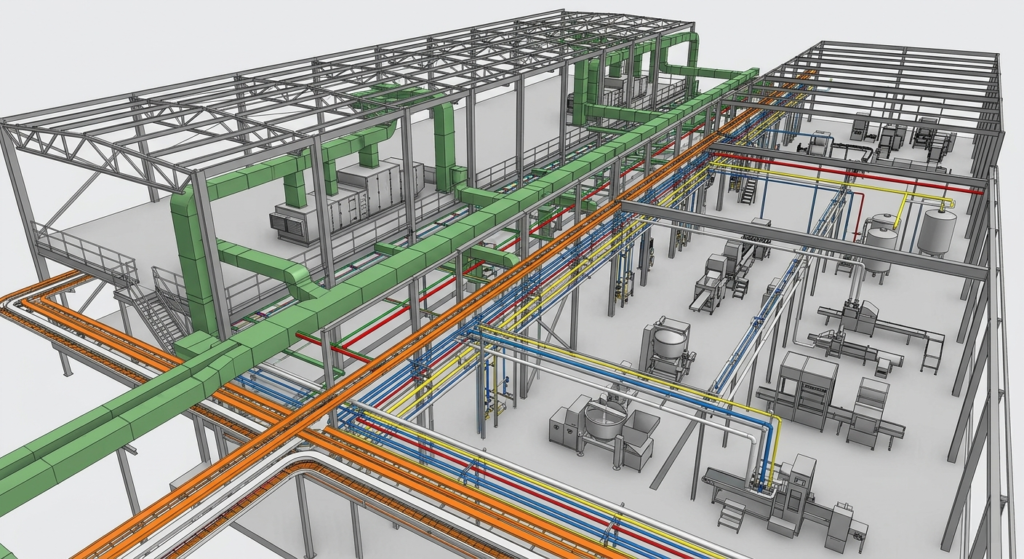
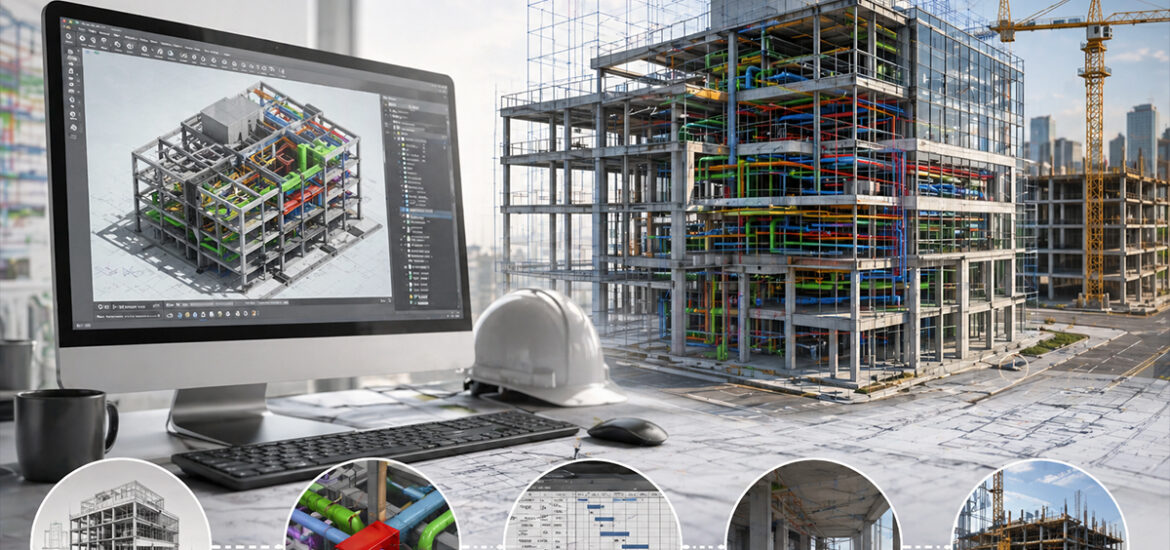
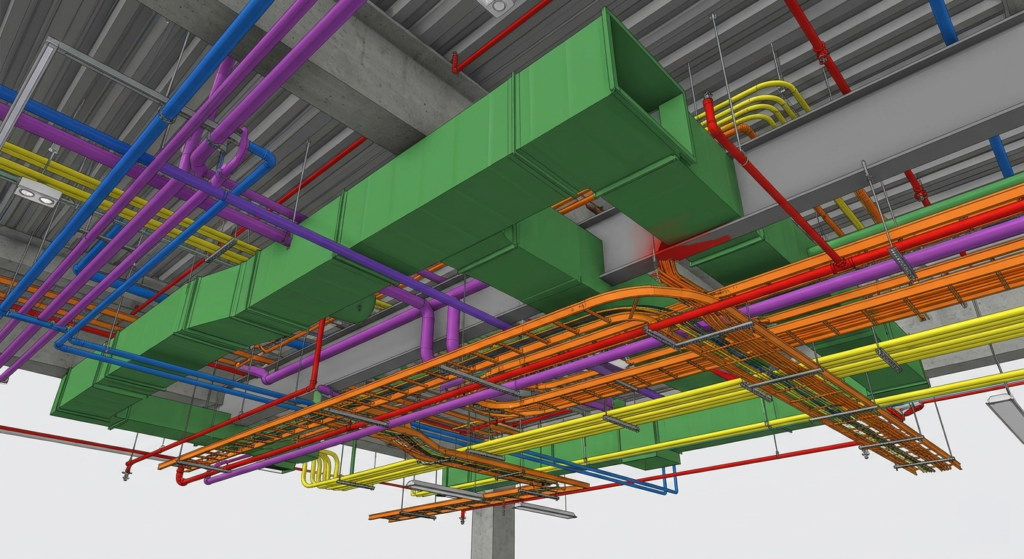
Figure 1: A Revit BIM modeling output showing a multi-story commercial building with structural, architectural, and MEP system annotations at LOD 350.

BIM Modeling Services

What Is BIM Modeling in Construction Projects?

BIM Modeling Services — Building Information Modeling — represent a fundamental shift in how construction projects are designed, coordinated, and delivered. A BIM model is an intelligent, data-rich digital representation of a building that stores far more than geometry. Every wall, beam, duct, pipe, and electrical conduit carries embedded information about its material, manufacturer, cost estimate, installation sequence, and maintenance schedule.

When a project team uses professional BIM Modeling Services, they are essentially building the structure twice: once digitally in complete three-dimensional detail, and once physically on the construction site. The digital build is where all the problems get found, resolved, and coordinated — at a fraction of the cost of discovering them in the field.

According to Autodesk’s BIM resource hub, project teams that adopt BIM-based workflows consistently report fewer RFIs (Requests for Information), faster project approvals, and significantly lower rates of construction rework compared to teams relying on traditional 2D CAD drawings.

The core platforms used in BIM Modeling Services include Autodesk Revit, Navisworks, and ArchiCAD. Of these, Revit BIM modeling is the industry standard for architectural, structural, and MEP disciplines in the United States. Revit models are parametric, meaning that changing one element automatically updates all dependent elements, maintaining BIM design accuracy across every discipline simultaneously.

Challenges of Traditional 2D Drawings in Project Visualization

Before BIM Modeling Services became widely adopted, construction projects ran on stacks of 2D plan drawings, elevations, and sections. Contractors would paper-print dozens of drawing sheets, compare them manually, and rely on experience to mentally assemble a three-dimensional building from two-dimensional slices. This process was expensive, slow, and failure-prone in predictable ways.

Limited Design Understanding

Most building owners, city officials, and non-technical stakeholders cannot accurately interpret 2D architectural plans. Without BIM Modeling Services, the result is approval delays, scope changes mid-construction, and disappointed clients who say “this is not what I imagined” — after the concrete has already been poured.

Miscommunication Between Stakeholders

A 2D drawing package distributed across disciplines often results in three teams building slightly different mental models of the same project. Without a shared 3D environment enabling genuine BIM collaboration, these discrepancies only surface when the work is already built — or worse, when two systems physically collide in the ceiling plenum.

Increased Risk of Design Errors

The McKinsey Global Institute’s landmark report on construction productivity found that large construction projects routinely run 20% over budget and 80% behind schedule — and that the majority of these overruns originate in design and planning errors. BIM design accuracy tools exist precisely to catch these errors before they reach the field.

Difficulty in Detecting Design Conflicts

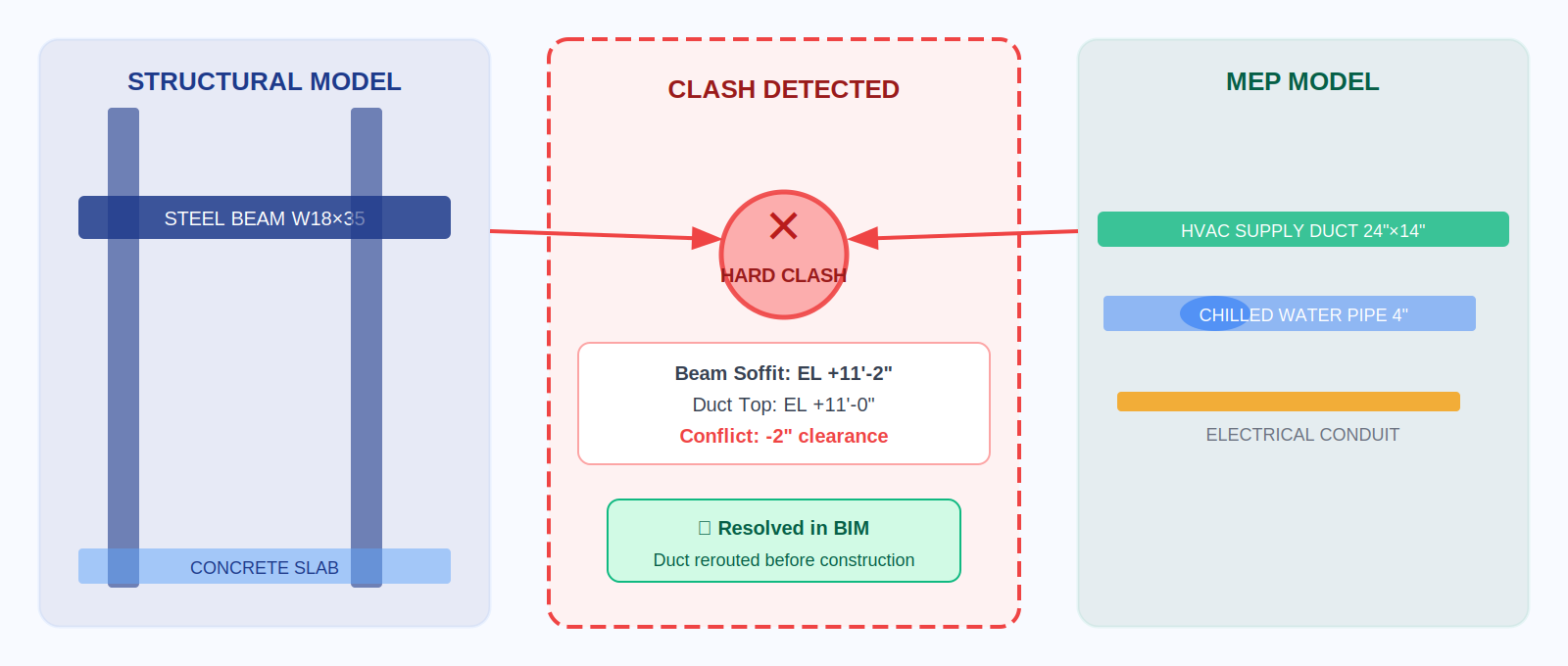
In a traditional 2D workflow, a structural beam and a mechanical duct can occupy the exact same physical space on paper — because no one tool is checking spatial relationships across disciplines. A professional Architectural BIM Service with integrated clash detection eliminates this category of problem entirely, at the design stage.

Figure 2: BIM clash detection — a steel beam and HVAC supply duct occupying the same spatial coordinate. Identified and resolved inside the BIM model before construction begins.
BIM Modeling Services

How BIM Modeling Services Improve Project Visualization

3D Visualization of Building Design

The most immediate impact of BIM Modeling Services is the ability to view a fully three-dimensional representation of a project before any physical work begins. Unlike a rendered architectural image, a 3D BIM model is a functional database. Every element contains real data — the exact specification of a curtain wall panel, the routing path of an HVAC duct — all delivered with genuine BIM design accuracy.

Realistic Project Representation

Modern Revit BIM modeling workflows support photorealistic rendering and virtual walkthrough capabilities directly within the BIM environment. Project teams can generate exterior renderings that reflect actual material finishes, interior views that show daylighting conditions, and fly-through animations that help clients understand spatial flow.

Better Design Understanding for Stakeholders

One of the most underappreciated benefits of professional BIM Modeling Services is how they democratize design comprehension. When all parties are looking at the same 3D BIM model and navigating the same spaces, communication quality improves immediately. Questions get asked earlier. Decisions get made faster.

Improved Design Accuracy

Because all disciplines — architecture, structure, MEP, civil — work within a shared federated BIM environment, every change made by one team is visible to all others in near real-time. This interconnected workflow is the technical foundation of BIM coordination. When an architect raises a ceiling height, the structural model flags affected framing, the mechanical model highlights duct routing conflicts, and the electrical team can assess conduit clearances.

Enhanced Client Presentations

In competitive bid environments, BIM Modeling Services give project teams a powerful differentiation tool. Presenting a fully coordinated 3D model with material takeoffs and phasing animations demonstrates a level of pre-construction rigor that 2D drawing sets simply cannot match.

Key Features of BIM Modeling That Improve Visualization

3D BIM Models

At the core of every BIM Modeling Services engagement is the creation of discipline-specific 3D models — architectural, structural, and MEP — that are federated into a single coordinated model. This federated model becomes the project’s single source of truth. Every drawing sheet, every quantity takeoff, and every coordination report derives from this model.

Walkthrough and Virtual Simulation

Virtual walkthroughs, generated directly from Revit BIM modeling environments or exported to platforms like Autodesk Navisworks and Enscape, allow clients and project managers to navigate a building’s spaces as though walking through the completed structure.

Clash Detection and Coordination

BIM coordination using clash detection software identifies hard clashes, soft clashes, and workflow clashes. According to research published in Automation in Construction, a single hard clash resolved in the field costs 10 to 20 times more than the same clash resolved during BIM coordination.

Real-Time Design Updates

Parametric Revit BIM modeling means that design changes propagate automatically through the entire model. This real-time synchronization, the technical backbone of effective BIM collaboration, eliminates the version-control nightmares that plague 2D CAD workflows.

Industry insight: The U.S. General Services Administration (GSA) now requires BIM deliverables on all federally funded building projects exceeding certain thresholds — underscoring how thoroughly BIM Modeling Services have become the professional standard across the US construction industry.

Benefits of Improved Project Visualization Using BIM Modeling Services

Better Decision Making

BIM Modeling Services give decision-makers the visual clarity to evaluate options and trade-offs with confidence, rather than relying on abstract descriptions or speculative renderings.

Reduced Design Errors

The interconnected nature of a federated BIM model means that inconsistencies surface automatically. These are precisely the kinds of BIM design accuracy issues that cost thousands of dollars per occurrence in the field and are completely preventable with a coordinated Architectural BIM Service.

Improved Collaboration

True BIM collaboration means that architects, structural engineers, MEP engineers, specialty contractors, and owners all work from the same model — not parallel, potentially contradictory drawing sets. Platforms like Autodesk Construction Cloud enable distributed teams to coordinate across time zones while maintaining a single federated model.

Faster Project Approval

Permit submissions that include BIM-derived drawing sets move through review faster than 2D drawing packages. Many US jurisdictions now accept or prefer BIM-native submission formats, particularly for complex commercial and institutional projects.

Reduced Construction Rework

BIM Modeling Services attack rework at its root: by finding and resolving coordination conflicts before construction, they eliminate the need to demolish and rebuild incorrectly installed work. Projects using professional BIM coordination consistently report rework reductions of 30–40% compared to projects coordinated using traditional 2D methods.

Industries That Benefit from BIM Visualization

  • Residential Construction: Custom homes, multi-family, luxury developments — BIM helps owners visualize finishes and layouts before construction locks them in.
  • Commercial Buildings: Office towers, retail centers, hotels — complex MEP systems and tight floor-to-floor clearances demand coordinated BIM.
  • Infrastructure Projects: Bridges, tunnels, transit stations — infrastructure BIM enables clash-free utility coordination in congested underground environments.
  • Industrial Projects: Data centers, manufacturing plants, pharmaceutical facilities — equipment-dense industrial projects depend on BIM for process pipe and structural coordination.


The Sheet Metal and Air Conditioning Contractors’ National Association (SMACNA) has documented that MEP contractors using BIM coordination on complex commercial projects report RFI volumes 50–70% lower than on equivalent non-BIM projects.

Why Use BIM Modeling Services Before Construction Begins
BIM Modeling Services

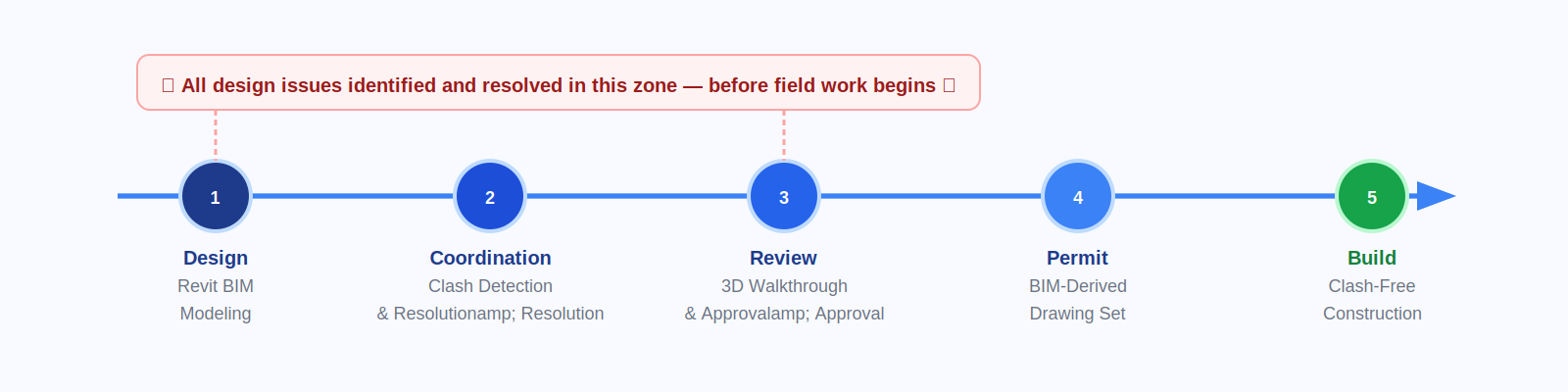
Figure 3: The BIM workflow from initial Revit modeling through clash-free construction. Issues caught in stages 1–3 cost a fraction of the same issues discovered during or after construction.

The economic argument for investing in BIM Modeling Services before construction is straightforward: the cost to resolve a design conflict increases by a factor of 10 to 100 as a project progresses from design through construction to completion. A clash found in a BIM model during design coordination costs the price of an engineer’s time to reroute a duct. The same clash found during construction costs demolition, reinstallation, inspection, and schedule delay.

The BIM collaboration environment also creates a comprehensive digital record of every design decision — who approved it, when, and why — providing valuable protection in dispute resolution and supporting the building’s long-term facility management through a rich as-built dataset.

How Eagle BIM Services Improves Project Visualization with BIM Modeling

Eagle BIM delivers professional BIM Modeling Services to architects, MEP engineers, general contractors, and building owners across the United States. Our team specializes in creating coordinated 3D models that serve as the project’s authoritative source of information — from early design through construction documentation and as-built delivery.

Our Revit BIM modeling workflow follows a disciplined, phased approach. We begin with discipline-specific model creation — architectural, structural, and MEP — at the appropriate Level of Development (LOD) for the project phase. We then federate those models and run systematic clash detection using Navisworks, generating documented clash reports with resolution status. Once the model is clash-free, we extract coordinated drawing sets, quantity schedules, and 3D visualizations for client review and permit submission.

Our Architectural BIM Service capabilities include LOD 200 through LOD 400 modeling, virtual walkthrough production, interference management, shop drawing coordination, and as-built model delivery. Our BIM coordination services include full clash detection across all building systems, coordination drawing production, and spool drawing extraction for fabrication. Every project benefits from genuine BIM design accuracy — a thorough, coordinated model that eliminates the coordination conflicts and visualization gaps that drive construction cost overruns.

To learn more about our BIM Modeling Services, visit: https://bim-services.us/bim-Modeling-services/

Get in touch for a free BIM consultation: https://bim-services.us/contact/

Conclusion

The construction industry has spent decades absorbing the cost of poor visualization. BIM Modeling Services represent a proven, technology-backed solution to all of these problems.

By replacing 2D drawing sets with intelligent 3D models, enabling true BIM collaboration across all disciplines, and catching coordination conflicts before they reach the field, professional BIM Modeling Services fundamentally change the economics of construction project delivery. The investment in Revit BIM modeling, BIM design accuracy, and coordinated Architectural BIM Service is not a premium — it is the most reliable cost-control measure available to a modern construction project team. Eagle BIM is ready to deliver them.
BIM Services

How BIM Services Help Reduce Construction Costs and Project Delays

Quick Summary

Construction projects around the world consistently struggle with two problems: going over budget and falling behind schedule. These are not random events. They are the result of fragmented communication, undetected design errors, inaccurate estimates, and poor coordination between teams. BIM services for construction tackle all of these problems at the root by giving every stakeholder access to a single, shared, intelligent model of the building throughout the entire project lifecycle.

This article explains what BIM services are, why construction projects fail financially and on schedule, and exactly how BIM coordination services, BIM modeling services, and BIM for contractors help prevent those failures. We also look at real-world examples where BIM in construction delivered measurable cost and time savings.

What Are BIM Services in Construction Projects?

Building Information Modeling, or BIM, is a process in which all parties involved in a construction project collaborate through a shared digital model. That model is not just a 3D drawing. It is an intelligent database that contains geometry, materials, structural specifications, MEP systems, cost data, and scheduling information all in one place.

BIM services for construction include the creation and management of that model from early design through to construction completion and handover. Depending on the scope, BIM services can cover initial concept modeling, coordination between structural and MEP disciplines, quantity extraction for cost estimation, 4D scheduling where the construction sequence is simulated visually, and 6D modeling for facilities management after handover. As Plannerly explains in their comprehensive BIM cost guide, projects that adopt BIM methodologies see cost reductions of 10 to 20 percent compared to traditional approaches.

The key difference between BIM and traditional CAD-based workflows is that BIM is live and connected. When an architect changes a wall dimension, every connected view, schedule, and quantity automatically updates. When the MEP engineer moves a duct, the coordination model flags any new conflicts with structural elements. This real-time connectivity is what makes BIM modeling services so powerful at eliminating the communication failures that drive up costs and delay programmes.

BIM for construction companies is no longer optional on large commercial, infrastructure, or healthcare projects. Many public sector clients across the UK, Singapore, the United States, and Australia now mandate BIM at specific levels of development. According to NBS, the UK government targeted savings of 15 to 20 percent on construction budgets specifically because of BIM adoption.

Major Reasons for Construction Cost Overruns and Delays

Before exploring how BIM coordination services solve these problems, it is worth being clear about what causes them. The same root causes appear on project after project, regardless of size or geography.

Poor Project Planning

Most construction problems are created before a single shovel touches the ground. When scope is not fully defined, when risk is not properly allocated, and when the construction sequence has not been thought through in detail, projects enter the field carrying hidden time bombs. Scope changes mid-construction are enormously expensive because they force rescheduling, reordering of materials, and disruption to crews already mobilised on site.

BIM in construction addresses this by enabling virtual design and construction sessions during pre-construction. All trades can review the model together, walk through the construction sequence digitally, identify logistics conflicts, and lock down scope before prices are committed. Autodesk’s Digital Builder blog notes that BIM clash detection is now standard in commercial construction precisely because it catches these issues at the earliest and cheapest point in the project lifecycle.

Design Conflicts and Errors

On a traditionally designed building, architects, structural engineers, and MEP engineers each produce their own drawings independently. Those drawings are then overlaid to check for conflicts, usually by eye and usually late in the design process. Common clashes include HVAC ducts running through structural beams, pipe runs that cannot be installed because there is insufficient clearance, and electrical conduit routes that conflict with structural connections. According to Neuroject’s 2024 BIM guide, between 35 and 40 percent of all construction rework is directly attributed to clashes and coordination issues that were not caught in design.

BIM modeling services eliminate most of these conflicts by running automated clash detection across federated discipline models before any physical work begins. The DBIA published a detailed case study showing that a $200,000 investment in BIM coordination on a single project delivered $2.22 million in rework savings alone — a 10x return on investment.

Inaccurate Quantity Estimation

Traditional quantity takeoffs are performed manually from 2D drawings. This process is slow and prone to error. Underestimating quantities leads to cost overruns mid-project when additional materials need to be procured at short notice, often at a premium. As Arkance notes in their BIM cost savings analysis, a bridge project in Europe shifted from traditional spreadsheets to 5D BIM and reduced material costs by 8 percent simply by negotiating with suppliers using precise, model-derived quantities.

BIM for contractors eliminates the estimation error problem by enabling parametric quantity extraction directly from the model. Because the model is parametric, every change to the design is reflected immediately in the quantities. Quantities update automatically whenever the design changes — no recalculation required.

Lack of Team Coordination

A major construction project involves dozens of separate organisations: architects, engineers of multiple disciplines, the main contractor, dozens of specialist subcontractors, suppliers, and the client. Without a single shared source of information, each party can be working from different versions of drawings at any given time. Revizto’s detailed analysis of clash detection highlights how BIM coordination meetings built around shared models are where the value compounds: large conflicts are resolved virtually, priorities are clarified, and responsibilities are assigned before materials are ordered or crews mobilise.

BIM coordination services solve fragmentation by establishing a common data environment — a central, cloud-based platform where all project information is stored, versioned, and accessed by every party. When everyone works from the same model, the number of RFIs drops dramatically and coordination issues that used to surface on site are resolved weeks or months in advance.

Rework During Construction

Rework is the most visible and painful symptom of all the problems listed above. MarsBIM reports that the US construction industry loses an estimated $177 billion annually to rework and inefficiency, with MEP trade contractors absorbing a disproportionate share of that loss because they install last, they have the least spatial flexibility, and when something does not fit, they pay for the fix even when the conflict was not their fault.

On a 50 million dollar project where rework averages 10 percent of costs, that represents 5 million dollars of avoidable waste. BIM for construction companies, applied rigorously from early design, eliminates most of this rework by ensuring that conflicts are resolved before fabrication begins and before any material is cut.

How BIM Services Help Reduce Construction Costs

Each of the failure modes described above has a direct solution within a well-implemented BIM workflow. Here is how each mechanism works in practice.

Accurate Quantity Takeoffs and Cost Estimation

When a building model is built to the right level of development, every element carries properties: its material, its dimensions, its specification. Quantity surveyors and estimators can query the model directly to extract precise quantities for any element. Desapex explains in their BIM efficiency guide that accurate cost estimation is one of BIM’s most critical contributions: 5D BIM integrates cost data directly with the model so that quantities and cost breakdowns update automatically whenever the design changes.

This capability allows project teams to make value engineering decisions during design development when they are cheapest, rather than discovering the budget impact of a design choice after the project has gone to tender. The result is tighter cost control from the very start of the project.

Early Clash Detection to Avoid Rework

Automated clash detection is one of the most immediate and quantifiable benefits of BIM coordination services. The process works by importing discipline models into a coordination platform such as Autodesk Navisworks or Solibri. The software runs geometric checks across all models simultaneously, flagging every point where elements from different disciplines overlap or where clearance requirements are not met. ENG BIM’s financial analysis of clash detection puts it clearly: if a mid-sized project runs $30 million and rework averages 10 percent of costs, that is $3 million at stake — and early clash resolution can protect most of it.

The financial logic is simple. Fixing a clash in the model during coordination takes an engineer perhaps 30 minutes of design time. The same clash found on site after fabrication means cutting and re-fabricating components, additional installation labour, programme delay, and potentially a delay claim. Revizto’s case study data confirms this: a $200,000 VDC investment on a $230 million food project translated into over $2.5 million in cost and time savings — a 10x return.

BIM Services

Better Resource Planning

BIM for contractors extends into resource planning through 5D modeling, where cost data is attached directly to model elements. When a project manager wants to understand the cash flow profile of a project, they can query the model to see how much work is scheduled in any given period and where labour demand peaks. Architosh reported in their 2023 BIM cost savings feature that 55 percent of BIM users have measurably reduced the time required to communicate, collaborate, make decisions, and build workflows — directly improving resource efficiency across the board.

This visibility allows project teams to smooth the resource curve, avoiding periods of over-commitment that lead to overtime costs and quality problems, and periods of under-utilisation that represent wasted fixed costs. It also improves procurement efficiency: accurate, time-phased material schedules reduce emergency procurement and the cost premiums that come with it.

Improved Construction Scheduling

4D BIM links the three-dimensional model to a construction programme, creating a visual simulation of the build sequence. Teams can watch the building grow day by day in the digital environment, checking whether the planned sequence is physically achievable and whether there are spatial conflicts between concurrent activities.

This visual simulation is particularly valuable for complex projects where multiple trades are working in the same area simultaneously. According to Arkance’s analysis, global data shows that 4D BIM reduces schedule overruns by up to 30 percent and improves site productivity by 15 to 20 percent. A commercial tower in the Middle East used a 4D simulation to replan its core construction sequence and avoided significant programme delay as a direct result.

Reduced Material Wastage

Industry estimates suggest that between 10 and 30 percent of materials delivered to construction sites are wasted through over-ordering, incorrect fabrication, or rework. BIM modeling services reduce waste through precise quantity extraction, detailed fabrication drawings, and support for off-site manufacturing. As ICON BIM highlights, prefabrication and modular workflows become far more reliable with BIM because fabrication shops can manufacture with confidence that assemblies will fit in the field — eliminating the scrap and re-fabrication that plague traditional site-cut methods.

Prefabricated MEP modules designed and coordinated in BIM can reduce MEP installation time on site by 30 to 50 percent and virtually eliminate MEP rework. This approach transfers risk from the weather-dependent site environment to a controlled factory setting, reducing delay exposure at the same time.

Real-World Use Cases of BIM in Cost and Time Savings

The benefits of BIM services for construction are not theoretical. They are documented across hundreds of projects worldwide, in every sector and at every scale.

Healthcare: Major Hospital Expansion, United Kingdom

A 45,000 square metre hospital extension adopted BIM modeling services from the early stages of design. The project team, comprising the architect, structural engineer, mechanical and electrical engineers, and the main contractor, collaborated through a federated coordination model and ran regular clash detection reviews throughout design development. By the time the project reached the construction phase, the coordination process had identified and resolved over 6,800 clashes including 2,743 hard clashes. The team estimated this saved approximately 2.1 million pounds in potential rework costs and avoided a significant programme extension.

Commercial: Grade-A Office Tower, Singapore

A 38-storey commercial office tower in Singapore used BIM for contractors to coordinate structural steel, curtain walling, and complex MEP installations across a tight floor plate. The project team used 4D BIM to simulate the construction sequence and identified a critical conflict where planned tower crane operations during the structural steel phase overlapped with curtain wall installation on the upper floors. The sequence was re-engineered before construction began, avoiding an estimated 12-week programme delay. BCA Singapore’s BIM Roadmap documents how this type of outcome has become repeatable on Singapore projects where BIM is applied at full depth.

Infrastructure: Rail Station Upgrade, Australia

An operational urban rail station undergoing a major accessibility and capacity upgrade used BIM in construction to manage the complex interfaces between new structural works and existing live operational infrastructure. The challenge was compounded by the need to maintain station operations throughout construction, creating severe constraints on when and where different activities could take place. Model-based quantity takeoffs reduced the cost estimate variance from plus or minus 18 percent using traditional manual methods to plus or minus 6 percent, allowing the client to carry a significantly lower contingency reserve throughout the 28-month construction programme.

Manufacturing Facility: Design-Build Food Project, USA

Perhaps the most precisely documented ROI case in the industry is the $230 million design-build food processing facility case study published by DBIA. A $200,000 investment in VDC and BIM coordination delivered $2.22 million in rework savings and $542,000 in schedule savings from a one-month reduction in general conditions costs — a net saving of $2.55 million and a 10x return on the BIM investment. The full case study is available on the DBIA website and is one of the most detailed quantifications of BIM ROI available in the public domain.

BIM Services

Conclusion

The construction industry has a well-documented problem with cost overruns and project delays, and the causes are well understood. BIM services for construction provide a systematic response to each of these failure modes. BIM coordination services resolve design conflicts before they become site problems. BIM modeling services provide accurate quantities that eliminate estimation error. 4D BIM exposes scheduling conflicts in a virtual environment. And the common data environment that underpins all BIM activity eliminates the communication fragmentation that generates RFIs, change orders, and delay claims.

For project owners, adopting BIM as a project requirement from the earliest stages of procurement is one of the most cost-effective risk management decisions available. For main contractors and specialist subcontractors, investing in BIM for contractors capabilities is increasingly a prerequisite for winning and successfully delivering major projects. The evidence is settled: projects delivered using BIM consistently report lower costs, shorter programmes, and higher client satisfaction.

The question for any construction professional today is not whether BIM is worth investing in. The question is how to implement BIM well, how to select the right partners, and how to build the internal capability to use BIM as a genuine management tool rather than simply a documentation platform. The projects that get that right are the projects that come in on time, on budget, and free of the rework disputes that define so much of the industry’s history. To understand how BIM can work specifically for your project type, Plannerly’s step-by-step guide is an excellent practical starting point.

BIM In Construction

Common Construction Challenges Solved by BIM Services

Quick Summary

BIM services help project teams understand the building before it is built. They make it easier to review systems, identify clashes, improve coordination, reduce rework, and make better decisions early in the project. The National Institute of Building Sciences defines BIM as a digital representation of the physical and functional characteristics of a facility, used as a shared resource for decision-making across its lifecycle.

In simple terms, BIM Services help construction teams see more clearly, coordinate earlier, and avoid expensive surprises later.

What Are BIM Services and Why They Matter in Construction

BIM Services refer to a set of digital workflows built around intelligent 3D models. These can include architectural modeling, structural modeling, MEP modeling, clash detection, shop drawings, quantity takeoffs, as-built documentation, and facility information support.

What makes these models useful is that they do more than show geometry. They also carry project information that helps teams understand dimensions, system routing, material quantities, clearances, and relationships between different disciplines.

That matters because construction has become more complex. Buildings today involve tighter spaces, denser MEP systems, faster schedules, and more stakeholders. When coordination is weak, even small gaps in information can become costly.

This is why BIM in construction is no longer just a technical upgrade. It is a practical way to reduce uncertainty before it turns into delay, rework, or budget pressure.

If your team is looking for project support across modeling, coordination, and documentation, you can explore our BIM Services to see how we work with architects, engineers, contractors, and project teams across the USA.

Common Construction Challenges

Most construction challenges may look different on the surface, but they usually begin in the same place: teams do not have enough clarity early enough.

That lack of clarity leads to delays, cost overruns, poor coordination, weak collaboration, and repeated site corrections. Below are some of the most common problems that BIM Services help solve.

1. Project Delays in Construction Projects

Project delays often begin much earlier than anyone notices.

A team may only feel the delay once the site schedule starts slipping, but the actual cause is often hidden in unresolved clashes, incomplete coordination, or design decisions that were never fully reviewed across disciplines.

By the time those issues appear on site, they are no longer simple design questions. They begin affecting procurement, labor planning, approvals, installation sequences, and overall site productivity.

This is where BIM Services help. With coordinated 3D models, teams can review service routes, ceiling congestion, equipment placement, and trade relationships before work begins. Autodesk notes that BIM can identify clashes between different building systems and components before construction begins, helping save time and money.

That early visibility reduces field confusion. Instead of solving problems while crews are already working, teams can address many of them during coordination.

2. Cost Overruns and Budget Issues

Budgets usually do not fail because of one dramatic event.

They get damaged through repeated small issues like rework, site modifications, wasted materials, delayed decisions, change orders, and labor inefficiencies. Poor coordination often sits quietly behind these cost problems.

This is one of the strongest reasons to invest in Building Information Modeling services.

McKinsey has noted that large projects across asset classes typically take 20 percent longer than scheduled and can run up to 80 percent over budget. That does not mean every project will face those numbers, but it does show how vulnerable construction can be when planning and coordination are weak.

When teams work from coordinated models, they can improve quantity confidence, support procurement planning, reduce clashes, and avoid many of the corrections that typically happen later in the project. Better information early often leads to fewer expensive fixes later.

That is the real value of BIM Services. They are not just useful for design teams. They help protect time, effort, and cost across the project lifecycle.

3. Poor Project Visualization Before Construction

A lot of project confusion comes from the fact that different stakeholders interpret the same drawings in different ways.

The architect may understand the design intent. The contractor may focus on constructability. The owner may struggle to visualize the finished result. A trade partner may not notice a routing problem until several systems begin competing for the same space.

This is one of the clearest strengths of BIM Modeling Services.

A coordinated 3D model makes the project easier to review, discuss, and understand. Teams can study service layouts, access zones, equipment locations, and spatial relationships before construction begins.

In simple terms, BIM in construction helps people move from assumption to clarity.

For companies looking to improve preconstruction review and coordination workflows, our Building Information Modeling services support teams with practical BIM solutions built for real construction conditions.

4. Design Conflicts and Coordination Issues

This is one of the biggest reasons project teams rely on BIM Services.

Modern buildings are full of layered systems. Architecture, structure, HVAC, piping, electrical, and fire protection all need room to fit, function, and remain maintainable. Each discipline may complete its own work correctly, but once those packages come together, conflicts begin to show up.

A duct crosses a beam. A cable tray blocks service access. Pipes crowd the ceiling zone. Equipment clearances are ignored. A shaft becomes too tight. Shop drawings still need interpretation because the coordination was never fully resolved.

This is exactly where BIM Services create value. Instead of discovering these issues during installation, teams can review and solve them in the model first.

That means better coordination, fewer site problems, and a smoother path from design to execution.

5. Poor Collaboration Between Stakeholders

Construction depends on collaboration, but not every project has a workflow that supports it well.

Architects, consultants, owners, contractors, subcontractors, and fabricators often work with different priorities, different software, and different timelines. When information is fragmented, people start relying on assumptions.

One team believes something is final. Another is still waiting for clarification. Someone is reviewing an outdated file. Someone else assumes the site team will sort it out later.

That is how coordination risk grows.

BIM Services help by creating a shared reference for discussion, issue tracking, and review. Instead of passing disconnected files back and forth, teams can work around a more coordinated project environment.

Good collaboration is not just about sharing information. It is about making sure everyone is seeing the same reality at the same time.

6. Rework and Construction Errors

Rework is one of the most frustrating costs in construction because it usually feels avoidable once the reason becomes clear.

Once something has been installed incorrectly, the issue affects more than just that one area. It affects labor, materials, sequencing, inspections, and confidence in the drawings. Even small conflicts can create larger ripple effects when multiple trades are involved.

This is where BIM Services help in a very practical way.

When teams coordinate early, the path from model to installation becomes clearer. Shop drawings improve. Fabrication planning becomes more reliable. Field teams work with better information.

The model does not replace experience on site. It helps teams use that experience earlier, when it can prevent mistakes instead of only fixing them.

Key Benefits of BIM Services for Construction Projects

The real value of BIM Services is not only that they create a 3D model. It is that they improve the way decisions are made before those decisions begin affecting cost, schedule, and construction quality.

With BIM Modeling Services, teams can:

  • Improve coordination across trades
  • Review layouts with more clarity
  • Detect clashes before installation
  • Reduce rework and waste
  • Support better quantity planning
  • Improve communication between stakeholders
  • Create stronger project documentation

In practical terms, this means fewer surprises, better project flow, and a stronger link between design intent and construction execution.

Industries That Benefit Most from BIM Services

Almost every construction sector can benefit from BIM Services, but the value becomes even more obvious in projects where coordination is dense and risk is high.

Commercial projects benefit because multiple trades need to work within tight spaces and fast timelines. Residential and mixed-use projects benefit from better consistency across repeated units and systems. Healthcare projects benefit because of dense MEP coordination and strict access requirements. Educational, hospitality, industrial, and infrastructure projects also benefit because they involve many stakeholders and need stronger long-term planning.

That is why Building Information Modeling services are now seen as an important part of modern project delivery, not just an optional support service.

How Eagle BIM Services Solves Construction Challenges

Eagle BIM Services helps project teams solve these challenges by focusing on coordination, clarity, and practical project use.

That means BIM is not treated as just a modeling output. It is approached as a construction support process that helps teams reduce blind spots, resolve conflicts early, and improve execution quality.

Whether the need is architectural BIM, structural BIM, MEP coordination, clash detection, shop drawings, scan to BIM, or as-built modeling, the real value comes from making project information more useful for the people who are actually designing, building, and managing the work.

Strong BIM Services do not just make the model look complete. They make the project easier to understand and easier to deliver.

The Future of BIM Services in Construction Industry

The future of BIM Services is moving toward deeper integration across the full building lifecycle.

What started as a better way to model and coordinate is now becoming part of how teams manage scheduling, quantities, handover data, facility information, and long-term building operations.

Conclusion

Most construction problems are not random.

They come from poor visibility, disconnected teams, unresolved coordination, weak communication, and issues being discovered too late. Delays, budget overruns, rework, and design conflicts may look like separate problems, but they usually begin with the same issue: not enough clarity early in the project.

That is why BIM Services matter.

They help teams coordinate better, visualize more clearly, communicate more effectively, and reduce the kind of preventable mistakes that cost time and money on site. From design review to clash detection to project documentation, BIM Modeling Services help turn fragmented information into a more reliable construction workflow.

In simple terms, Building Information Modeling services help project teams make fewer expensive discoveries in the field.

BIM Modelling Services

BIM Modeling Services Explained: Process, Benefits & Real Use Cases

Most construction problems do not begin on site. They begin much earlier, when different teams are working hard on the same building but not always through the same lens. The architect is shaping space, daylight, circulation, and intent. The structural engineer is making sure the building stands the way it should. The MEP team is threading services through ceilings, shafts, risers, plant rooms, and technical zones that are already under pressure. Nobody is necessarily wrong, yet the building can still begin to disagree with itself. A duct wants the same space as a beam. A pipe lands where a wall was never meant to open. A maintenance access zone disappears because another system quietly took over the room around it.

That is usually the moment when a project stops being a drawing exercise and starts becoming a coordination exercise. It is also the moment when BIM Modeling Services begin to matter in a very practical way.

In the United States, the National BIM Standard–United States positions BIM as a structured way to organize and classify electronic object data so owners, designers, suppliers, constructors, and facility managers can communicate more clearly across the life cycle of a built asset. In other words, BIM is not just about producing a model; it is about creating a more reliable environment for decisions and information exchange. That distinction is important, because the real value of BIM is not visual polish. It is a coordinated understanding.

This matters even more in an industry where delay, rework, and fragmented delivery are hardly rare. McKinsey has repeatedly noted that construction has struggled with low productivity growth and that large projects continue to run late and over budget with uncomfortable regularity. Digital approaches, when adopted properly, are part of the answer precisely because they help teams work from better information earlier in the process.

So when firms invest in BIM Modeling services, they are not really buying “better 3D.” They are buying a better chance of catching problems before those problems become expensive.

Introduction to BIM Modeling Services

For a long time, construction relied on layered drawings, coordination meetings, markups, and a lot of professional interpretation. That method can still work, but it becomes less forgiving as buildings become more complex. More systems, more specialists, more dependencies, and less room for error change the stakes. What once felt manageable in drawings alone can become risky when dozens of systems need to fit inside the same envelope with tight tolerances and hard deadlines.

That is where BIM Modeling Services fit naturally into the modern AEC workflow. Instead of asking each discipline to describe the building separately and trust that coordination will somehow happen downstream, BIM brings those systems into a shared digital environment. The model becomes a working space where design intent, structural logic, and service routes can be reviewed together rather than in fragments.

This is also why BIM has become part of a broader conversation about digital project delivery. McKinsey’s work on construction productivity and digital transformation points to the need for better implementation, not just more technology. In practice, that means tools matter, but workflows and information discipline matter more. A model is valuable only if teams can rely on it to make decisions.

A good BIM workflow therefore does not begin with software. It begins with one practical question: how do we help every team understand the same building more clearly, earlier, and with less ambiguity?

What are BIM Modeling Services?

At the simplest level, BIM Modeling services help create a digital representation of a building that multiple disciplines can coordinate within. But that short definition does not really explain why the service matters.

A BIM model is not only geometry. It carries relationships, attributes, objects, quantities, and structured information that can travel through design, coordination, documentation, construction, and in many cases operations as well. That is why the “I” in BIM matters just as much as the “M.” The model is useful not because it looks intelligent, but because it contains usable intelligence.

This broader role is reinforced by standards bodies rather than software vendors alone. The National BIM Standard–United States focuses on information exchange and life-cycle use, while buildingSMART’s openBIM framework emphasizes interoperability across platforms through standards such as IFC and BCF. buildingSMART’s point is especially relevant for real projects: if information cannot move cleanly between teams, tools, and workflows, coordination becomes weaker no matter how sophisticated the model looks in one application.

That is why BIM Modeling services are best understood as a coordination service supported by Modeling, not merely a Modeling service with coordination as a side effect.

A good model helps teams answer useful questions sooner. Will this fit? Can this be built the way it is currently drawn? Are the disciplines aligned? Is the documentation likely to hold up when procurement and site execution begin? Those are not software questions. They are project questions. BIM simply gives teams a better place to ask them.

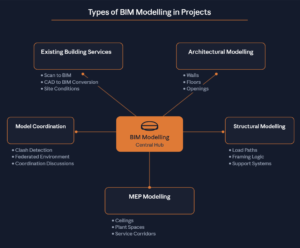
Types of BIM Modeling used across projects

Not every project needs the same kind of BIM support, and not every Modeling package serves the same purpose. The service becomes valuable when it matches the project’s actual pressure points.

Architectural Modeling is usually where the spatial story of the building takes shape. Walls, floors, openings, roofs, room configurations, façade elements, and circulation are developed in a way that helps the design team visualize intent and generate coordinated documentation.

Structural Modeling supports a different kind of clarity. Here the concern is not just shape, but load paths, framing logic, slab relationships, support systems, and how structural elements affect everything around them. A clean structural model makes coordination discussions less abstract and helps both engineers and contractors see how the building is actually meant to hold together.


BIM Modelling Services Types

MEP Modeling is where BIM often stops sounding theoretical and becomes immediately valuable. Mechanical, electrical, plumbing, and fire protection systems compete for space in ways that drawings often flatten too neatly. In practice, ceilings, plant spaces, shafts, access zones, and service corridors become pressure points quickly. This is why MEP BIM Services are so often tied to coordination-heavy projects.

Then there is model coordination itself, which is often where teams feel the real commercial value of BIM. When architecture, structure, and services are federated into one environment, clashes stop hiding in separate files. Autodesk’s clash-detection guidance is useful here because it states the benefit in plain terms: BIM can identify conflicts between building systems before construction begins, which saves time and money. That may sound obvious, but on complex projects it is the difference between solving a coordination issue in a meeting and solving it in the field.

Projects involving existing buildings often add another layer. Renovation, adaptive reuse, and retrofit work rarely begin with clean, dependable conditions. Existing data may be incomplete, outdated, or just wrong in subtle but expensive ways. That is where Scan to BIM Services and CAD to BIM Conversion become useful. They help teams begin from something closer to reality rather than from assumptions that site conditions may later embarrass.

How BIM Modeling Services usually work in practice

A lot of BIM content explains the idea but skips the workflow. The workflow is where trust is built.

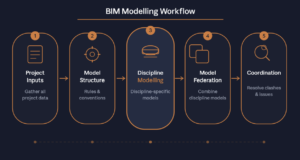
It usually begins with project inputs. That may sound basic, but it is a serious step. CAD drawings, PDFs, markups, concept sketches, specifications, point clouds, and client standards all influence what the model can become. Weak inputs do not always produce obviously weak models. Sometimes they produce models that look convincing but carry hidden coordination risk. That is more dangerous.

From there, teams establish model structure and rules. Coordinates, naming conventions, file segmentation, ownership, level-of-development expectations, and information exchange protocols are set before Modeling gets too far ahead of itself. This is one reason the U.S. standards ecosystem keeps returning to information exchange. NBIMS-US explicitly treats information flow as a central part of BIM maturity, not a side note.

BIM Modelling Workflow

Discipline-specific Modeling follows. Architects develop spaces and envelopes. Structural teams build the support systems. MEP teams work through service networks, equipment, clearances, and spatial logic. On many projects, these models are developed in parallel, which is exactly why federation matters later. Problems rarely show up dramatically inside one discipline file. They show up when the systems meet.

Once models are federated, coordination begins in earnest. This is the stage where clashes, access issues, spatial conflicts, and constructability concerns start to surface. buildingSMART’s BCF standard is a useful context here because it exists specifically to support model-based communication around issues and topics. That tells you something important about modern BIM workflows: coordination is not just about “finding clashes.” It is also about how issues are communicated, assigned, tracked, and resolved between teams.

Coordination then moves through cycles. Issues are reviewed, filtered, assigned, revised, and checked again. Mature BIM teams understand that not every clash matters equally. Some are noisy. Some are sequencing concerns. Some are major buildability issues. The value lies not in producing the longest clash list, but in helping the team focus on the clashes that actually change decisions.

Once the model has reached the required level of coordination, it begins to support documentation more reliably. Drawings, schedules, views, and quantities can be extracted from a coordinated environment rather than assembled from disconnected parts. At that point, the model starts behaving less like a presentation asset and more like a project asset.

And increasingly, the story does not stop there. NBIMS-US and buildingSMART both point toward life-cycle value and structured information exchange beyond design. That is why BIM is steadily becoming part of a larger digital thread that runs from design into construction and, in many cases, operations.

Why teams keep investing in BIM

The easiest way to make BIM sound generic is to list its “benefits” without context. The more honest way is to tie those benefits to the kind of friction projects deal with every day.

One major advantage is that BIM moves problem-solving forward in time. Autodesk’s official BIM benefits guidance notes that clash detection can identify conflicts between systems before construction begins. That matters because problems are always cheaper when they are still decisions rather than disruptions. 

Another advantage is that BIM gives teams a better shared reference point. Drawings can describe a building, but a coordinated model lets teams interrogate it. That is a meaningful difference when design, engineering, procurement, and construction all need to stay aligned.

BIM also supports stronger documentation discipline. When drawings, schedules, and views are derived from a coordinated model, there is a better chance that the project’s outputs remain consistent with one another. That does not remove the need for review, but it reduces the drift that so often appears when documentation develops in silos.

And perhaps most importantly, BIM improves the quality of conversations. Instead of debating a condition in abstraction, teams can review the actual relationship between systems. Instead of finding out late, they have a better chance of finding out early.

Real use cases in construction

The value of BIM modeling services becomes even clearer when you stop talking about BIM as a concept and start talking about buildings.

Commercial office and mixed-use projects often rely heavily on coordinated service zones. As soon as ceilings become dense with ductwork, cable trays, sprinkler lines, and lighting integration, the usefulness of BIM becomes obvious. A coordinated model helps teams understand whether the building’s service logic actually fits the architecture and structure that were approved.

Healthcare projects raise the stakes further. Hospitals and clinical spaces combine architectural sensitivity with dense MEP systems, equipment requirements, access constraints, and operational pressure. Here BIM is not just about visual coordination. It is about reducing the chance that highly specialized spaces become coordination casualties.

Residential towers often benefit from BIM in a different way. Repetition across floors means that once teams resolve core coordination issues, they can carry that discipline more consistently across the project. A coordinated digital workflow supports both efficiency and documentation quality.

Industrial and manufacturing facilities bring another kind of complexity. Equipment interfaces, service routes, clearances, structural demands, and maintenance needs all interact. These are exactly the kinds of environments where teams need more than drawings. They need a way to pressure-test the building before the building is built.

Retrofit projects may be the clearest example of BIM’s practical value. Existing conditions are notorious for refusing to match the record set perfectly. When teams begin with accurate scan-based information and then move into coordinated Modeling, they give themselves a better chance of designing to reality instead of to memory.

Why businesses outsource BIM support

Not every firm needs a large in-house BIM team all year, and not every phase of every project demands the same Modeling capacity. This is one reason outsourcing has become a practical operating model rather than just a cost decision.

Sometimes the driver is bandwidth. Sometimes it is specialist expertise. Sometimes it is the need to move quickly without expanding permanent overhead. Increasingly, cloud-based coordination environments make this easier because external BIM support can work more like an embedded project capability and less like a detached drafting vendor. Autodesk’s coordination platforms are built around shared models, automated clash detection, and team-based issue workflows, which is one reason distributed BIM delivery is far more workable now than it was a decade ago.

The best outsourcing relationships do not feel like files disappearing into a black box. They feel like project capacity arrives exactly where the team needs it.

Where BIM is heading next?

The future of BIM is not just more Modeling. It is a better continuity of information.

buildingSMART’s push around openBIM, IFC, BCF, and open workflows makes that direction clear. The point is not simply to create models inside proprietary islands. It is to enable information to move more cleanly across the project ecosystem. That matters more and more as BIM connects to digital twins, operations, asset management, and long-term facility intelligence.

McKinsey’s broader work on construction digitization also points in the same direction. The opportunity is not just in adopting tools, but in connecting them to real process improvement. In that sense, BIM’s future is tied less to visual sophistication and more to better implementation, better standards, and better decision-making over the life of an asset.

Conclusion

Construction does not usually suffer from a lack of effort. It suffers from fragmentation. Information is split across disciplines, files, assumptions, and timelines. Teams are competent, but competence alone does not guarantee alignment.

That is why BIM modeling services matter. They help turn a fragmented design process into a more coordinated project conversation. They give architecture, structure, and services a shared place to be tested against one another. They make issues easier to see, documentation easier to trust, and decisions easier to make before construction turns them into expensive negotiations.

In the end, the value is not that BIM gives a project a shinier digital model.

It is that it gives the project a clearer version of the building while there is still time to improve it.