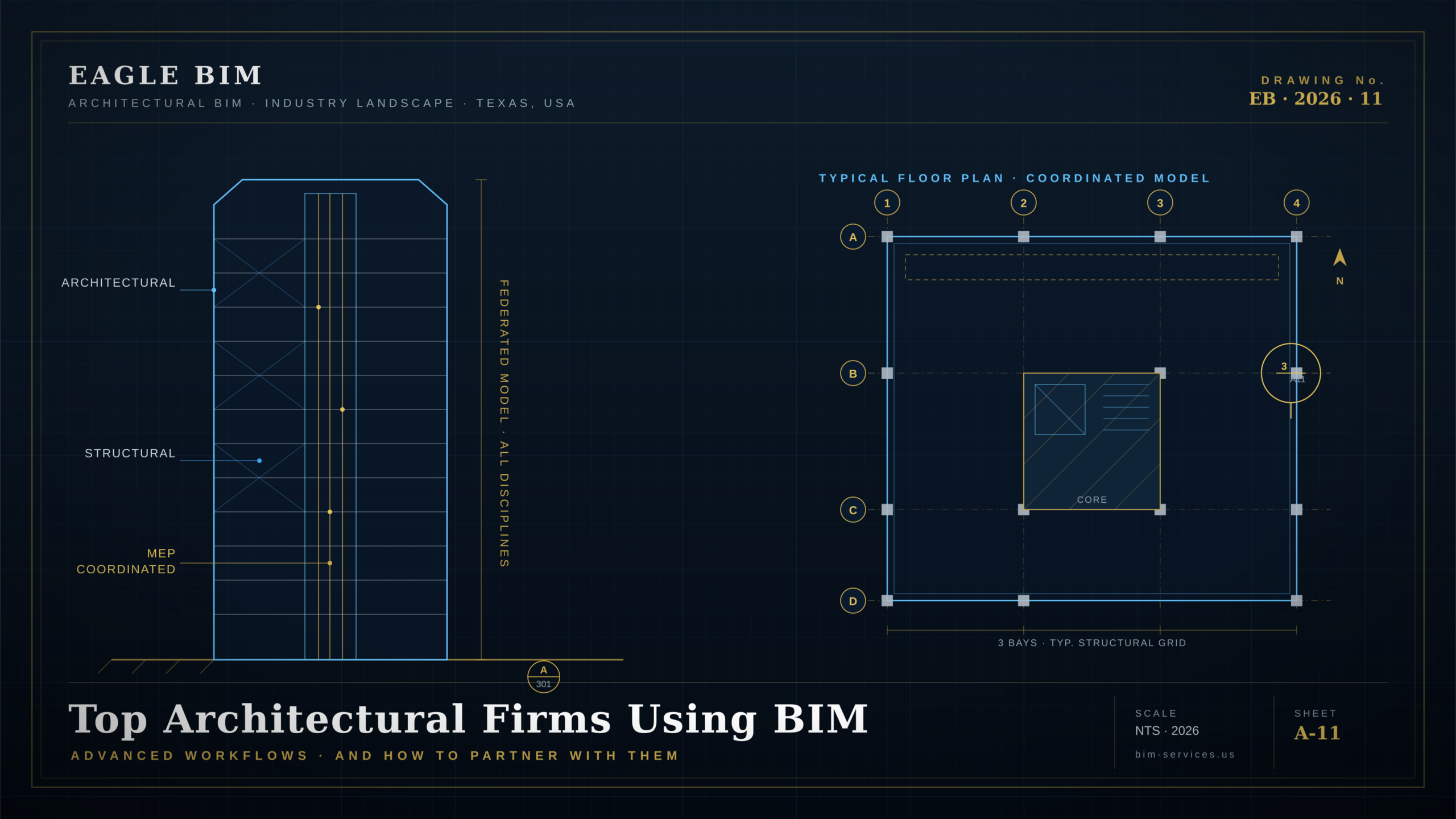
The biggest names in architecture are not just design studios anymore. They are technology operations. When you look closely at the top architectural firms using BIM today, the differentiator is rarely a single signature building. It is the workflow behind hundreds of them: a disciplined model production system that turns ambitious geometry into buildable, coordinated, clash-free documentation at a scale no single in-house team could sustain alone.
This guide maps the 2026 landscape. It profiles the practices that lead the industry, breaks down the large-scale Revit coordination methods they rely on, and explains the criteria that separate a true tier-1 BIM partner from an ordinary drafting vendor. It is written for project directors, BIM managers, and owners who are deciding how to resource their next landmark project. By the end, you will understand not only who the top architectural firms using BIM are, but how to build the same production capability into your own pipeline through architectural BIM outsourcing.
One honest note before the list. Rankings of architecture firms are published every year by sources like Architectural Record and Building Design+Construction, and they are measured by revenue, headcount, or sector. We reference those public rankings here. What no public ranking measures directly is BIM maturity. So this article does two things: it names the leading firms using credible public information, and it explains the workflow patterns that make any firm, large or small, operate like a leader. The names will be familiar; the operating model behind them is what most people never see, and that is where the real lesson sits.
Why does this matter now, in 2026? Because the gap between firms that treat BIM as a deliverable and firms that treat it as an operating system has widened sharply. Owners increasingly write detailed model requirements into contracts. Authorities having jurisdiction in markets like Texas expect coordinated, model-based submissions. Construction managers want a federated model they can build from, not a stack of disconnected drawings. In that environment, the top architectural firms using BIM are not winning because they draw faster. They are winning because their model is trusted, their coordination is documented, and their production scales on demand. Every firm now competes on that axis, whether it realizes it or not.
Why the Top Architectural Firms Using BIM Form Strategic Alliances with VDC Specialists
| Elite practices partner with VDC specialists because design talent and model-production capacity are two different resources. The top architectural firms using BIM keep senior architects focused on design intent while a dedicated tier-1 VDC partner absorbs the surge of detailed Revit modeling, clash detection, and documentation that a landmark project demands. |
Walk into the BIM operation of any large practice and you will find a recurring tension. The design leadership is brilliant at concept, massing, and client relationships. But a 60-story tower or a 1.2-million-square-foot hospital does not get modeled by vision. It gets modeled by hundreds of carefully built Revit families, dozens of linked discipline models, and a relentless large-scale Revit coordination effort that runs for months. That work is essential, but it is not where a principal architect adds the most value.
This is the gap that architectural BIM outsourcing fills. A strategic alliance with a VDC specialist lets a design firm flex its modeling capacity up and down with the project pipeline instead of carrying a permanent, fixed payroll for peak demand that only arrives a few months a year. When three landmark projects hit documentation phase at once, the firm does not panic-hire. It scales its partner team. When the pipeline quiets, the cost scales back down. The top architectural firms using BIM understand that elasticity is a competitive weapon, not a compromise.
There is a second reason, and it is about risk. Landmark project engineering carries enormous coordination exposure. A missed clash between a structural transfer beam and a primary duct run, discovered on site, can cost weeks and trigger claims. A mature VDC partner runs a documented clash detection cycle with a tracked issue log, so coordination becomes a managed process rather than a hope. We explain the discipline behind that in our guide to
what BIM coordination actually involves, and in the deeper breakdown of clash detection in BIM. Both are core to how a serious partner protects a landmark project.
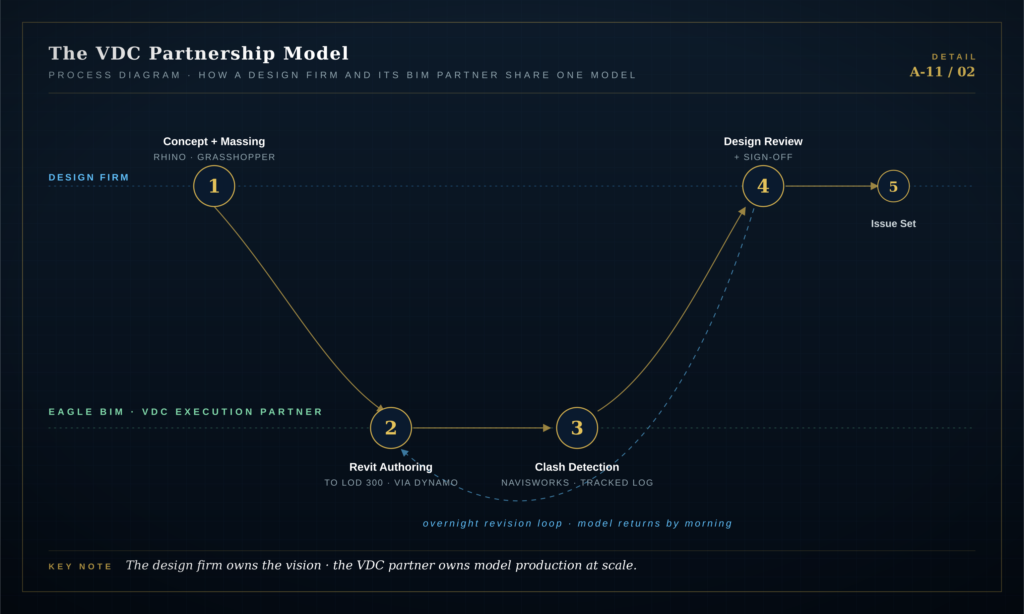
Finally, there is the time-zone advantage. A VDC partner working in an offset time zone can pick up a model at the end of the design firm’s day and return it advanced by the next morning. For the top architectural firms using BIM on aggressive institutional deadlines, that overnight loop is the difference between hitting a milestone and slipping it.
There is also an economic logic that compounds quietly over a project’s life. Every hour a senior architect spends placing families or chasing a clash is an hour not spent on the design moves and client conversations that actually win the next commission. Architectural BIM outsourcing converts that fixed senior-time cost into variable production capacity that is billed only when the project needs it. Over a multi-year landmark program, the firms that protect their senior talent in this way tend to take on more work, deliver it with fewer late-stage surprises, and carry less idle overhead between project peaks. This is not a cost-cutting tactic dressed up as strategy; it is how the top architectural firms using BIM keep their best people pointed at their highest-value work while the model still gets built to a tier-1 standard.
It is worth naming what a strategic alliance is not. It is not a transactional handoff where drawings are thrown over a wall and returned weeks later. The firms that get real value treat the VDC partner as an embedded extension of the studio: shared access to a common data environment, daily or twice-daily coordination touchpoints, and a single agreed BIM execution plan that both sides follow to the letter. The alliance works because responsibilities are split cleanly. The design firm owns intent, aesthetics, and client trust. The partner owns model production, coordination throughput, and documentation quality. When that division is respected, the combined operation behaves like one of the top architectural firms using BIM even when the design studio itself is mid-sized.
| Need senior architects focused on design, not modeling?
Eagle BIM acts as the VDC execution arm for design firms across the USA, absorbing large-scale Revit coordination so your team can stay on the work that wins projects. |
Top Architectural Firms Using BIM: Deconstructing the Workflows of Leading Global Practices
| The top architectural firms using BIM · including Gensler, Foster + Partners, Zaha Hadid Architects, HKS, HOK, Perkins&Will, and SOM · share a common pattern: computational design tools feed a coordinated Revit model, clashes are managed in Navisworks, and complex geometry moves from Rhino and Grasshopper into BIM through Dynamo. The firms differ in style, but the production discipline is strikingly consistent. |
Let us look at who leads, using public information, and then at the workflow patterns underneath. According to Architectural Record’s 2025 Top 300 ranking, Gensler holds the number one position by architecture revenue, with Perkins&Will at number two and HKS at number three. Building Design+Construction’s Giants 400 report puts the same names, including Gensler, Perkins&Will, HKS, Corgan, and Populous, at the top of its largest-firms list. These are the practices most often described as the top architectural firms using BIM, and their scale is exactly why a mature BIM pipeline is non-negotiable for them. Size alone, though, is not the story. Plenty of large firms produce mediocre models. What distinguishes the leaders is that their BIM operation is deliberately engineered, measured, and improved year over year.
The Signature Global Practices
Foster + Partners has published one of the most transparent accounts of large-scale Revit coordination in the industry. On a major terminal project with a complex gridshell roof, the practice has described designing the form in Rhino and MicroStation, then recreating the structure through custom Dynamo scripts so it could be imported accurately into Revit for coordination. At its peak, the effort involved hundreds of BIM models consolidated across specialist consultants, with hundreds of thousands of clashes managed using grouping features in Navisworks, work the firm itself notes would have taken far longer with conventional 2D methods. That work was recognized at Autodesk’s AEC Excellence Awards. It is a textbook example of why the top architectural firms using BIM treat coordination as an engineering discipline.
Zaha Hadid Architects is the other end of the geometry spectrum and the same workflow logic. The practice is known publicly for translating its signature fluid forms into Revit through custom computational workflows, moving geometry and metadata between Rhino, Dynamo, and the cloud. On Beijing Daxing International Airport, BIM supported digital verification across pedestrian-flow simulation, structural-load analysis, and environmental modeling. The lesson for everyone else is simple: even the most sculptural architecture in the world is, underneath, disciplined BIM logic.
What unites these signature studios is not the software they run but the way they treat the model as the authoritative record of the project. At Foster + Partners, an in-house BIM and Design Systems group acts as the guardian of a single source of truth, coordinating information across disciplines so that one digital representation of the building, with all its associated metadata, is always current and consistent. That governance role is precisely what most firms underestimate. The top architectural firms using BIM do not just author models; they police them, assigning dedicated people to enforce the BIM execution plan, audit the federated model, and resolve conflicts before they propagate. The geometry is the visible output, but the discipline behind it is invisible and far more valuable.
Gensler, as the largest practice by revenue, operates BIM at a scale few can match across commercial towers, workplace interiors, and aviation. The firm’s leadership position is not an accident of size; it is sustained by standardized templates, content libraries, and large-scale Revit coordination processes applied consistently across a global office network. When a firm produces work in dozens of cities, the only way to keep quality even is to industrialize the model: shared families, enforced naming, locked-down view templates, and a coordination cadence that does not depend on any one heroic individual. That industrialization is the quiet engine behind almost every name on the list of top architectural firms using BIM.
The Large Institutional Firms
HKS has built a dominant position in healthcare and sports architecture through decades of research and evidence-based design. HOK is widely recognized for aviation and healthcare, and Perkins&Will is known publicly for running in-house research labs that study everything from healthy materials to workplace behavior. Skidmore, Owings & Merrill (SOM) remains a benchmark for supertall towers, where structural and architectural BIM must stay locked together through thousands of iterations. These institutional firms are the engine room of landmark project engineering in the USA, and their model output is enormous. A single large hospital can generate dozens of linked models and tens of thousands of coordinated elements, which is why these practices invest so heavily in standards, content libraries, and dedicated coordination roles. Their advantage is repeatability: the same disciplined large-scale Revit coordination workflow applied to project after project until it becomes muscle memory.
The Mission-Critical Specialists
Some practices win by depth, not breadth. Corgan has become a recognized leader in data center and aviation design. Populous focuses almost exclusively on sports and entertainment venues, which lets it accumulate venue-specific expertise generalists cannot match. NBBJ is known for complex healthcare and corporate campuses. For these specialists, BIM is the medium through which highly specific technical knowledge gets encoded, reused, and coordinated project after project. We have written separately about how this plays out in our overview of
BIM for Texas multifamily and in the specialized world of BIM for data centers, where coordination tolerances are unforgiving. The common thread across all three tiers, from global signature studios to focused specialists, is that BIM is treated as core infrastructure rather than an afterthought. That mindset, more than any single project, is what earns a place among the top architectural firms using BIM.
Managing Complex Geometries on Tight Institutional Deadlines
The hardest problem in landmark project engineering is not drawing a curve. It is keeping that curve coordinated with structure, MEP, and the construction schedule while the design keeps evolving. The top architectural firms using BIM solve this by separating two layers. The design layer lives in flexible tools such as Rhino, Grasshopper, and conceptual Revit massing, where ideas change quickly. The production layer lives in a disciplined Revit environment governed by a BIM execution plan, where geometry is locked to a level of development and coordinated through scheduled clash cycles.
Dynamo is the bridge between those layers. A façade panelization defined parametrically in Grasshopper can be pushed into Revit as rule-based, intelligent families rather than dumb imported geometry. This is precisely the workflow Zaha Hadid Architects has described publicly, and it is the capability you should demand from any partner who claims to handle complex forms. Without it, complex geometry arrives in Revit as a frozen mesh that nobody can coordinate or schedule.
Ensuring Cross-Platform Continuity Across Multi-Trade Schematics
A landmark project is never modeled in one file. It is a federation of linked models: architectural, structural, mechanical, electrical, plumbing, and sometimes a dozen specialist consultants. The top architectural firms using BIM keep these aligned through a single source of truth: a shared coordinate system, a common data environment, and a consistent naming and large-scale Revit coordination standard so that every linked model snaps into the same digital space. Foster + Partners has described consolidating hundreds of models exactly this way. We break down the mechanics of keeping disciplines aligned in our guide to
MEP coordination and the underlying BIM level of development framework that defines how much detail each model carries at each stage.
What the Top Architectural Firms Using BIM Demand From a Tier-1 BIM Partner
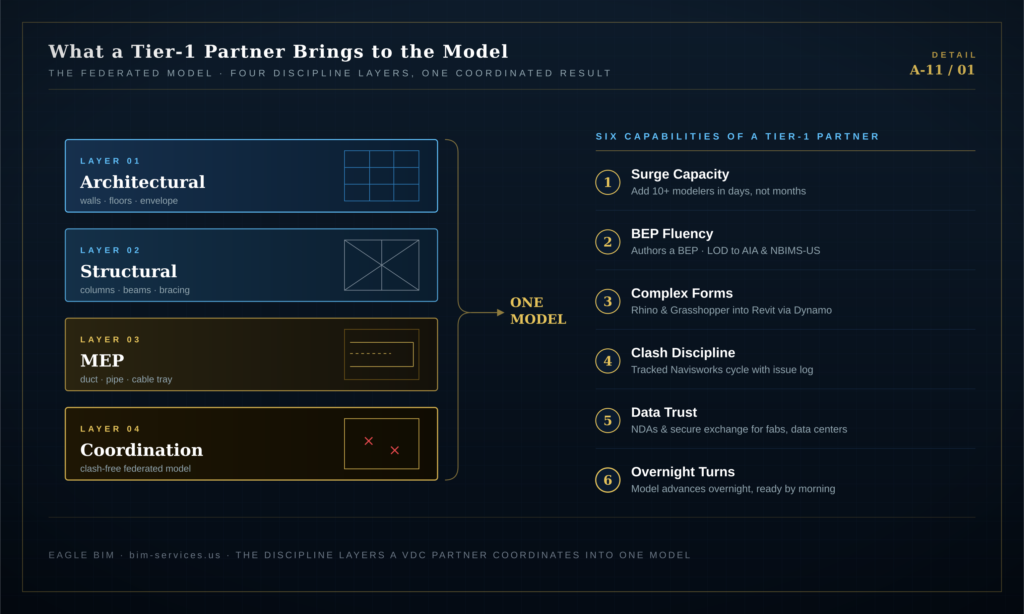
| Choose a tier-1 BIM partner on six criteria: surge capacity, fluency with a BIM execution plan and US standards, the ability to take complex geometry into a parametric Revit model, disciplined clash detection, secure handling of sensitive project data, and a time-zone offset that enables overnight turnaround. These are the same capabilities the top architectural firms using BIM rely on internally. |
Not every provider that calls itself a BIM company belongs anywhere near a landmark project. The difference between a drafting vendor and a tier-1 VDC partner shows up the moment a project gets complex or urgent. Use these six criteria to tell them apart.
Think of these criteria as a scorecard rather than a checklist. A vendor might tick one or two boxes and still be wrong for landmark project engineering, because the criteria compound. Surge capacity without standards fluency produces fast, inconsistent models. Standards fluency without complex-geometry capability stalls the moment a façade gets ambitious. The top architectural firms using BIM demand all six together because a landmark project will eventually test every one of them, often in the same week. Evaluate prospective partners against the full set, weight the criteria by what your specific project demands, and you will quickly separate the genuine tier-1 VDC partners from the firms that simply rebadge offshore drafting as BIM.
First, surge capacity. Ask directly whether the partner can add ten or more qualified modelers to your project within days, not months, without a drop in model quality. The whole point of architectural BIM outsourcing is elasticity. A partner who needs a quarter to staff up cannot support landmark project engineering.
Second, standards fluency. A serious partner authors and follows a BIM execution plan, sets level-of-development targets aligned to recognized US standards, and speaks the language of the
National BIM Standard-United States (NBIMS-US) published by NIBS, the BIMForum USA LOD Specification, and AIA’s documentation. Note that the older AIA E202-2013 Building Information Modeling Protocol has been superseded; current digital-practice protocols are carried by AIA E203-2013 together with the G201 and G202 framework, and a partner should be able to discuss level-of-development targets against the canonical LOD levels (100, 200, 300, 350, 400, and 500) rather than inventing intermediate grades. A partner who cannot discuss these is not operating at tier-1 level.
Third, complex geometry. Confirm the partner can take Rhino and Grasshopper geometry into a clean, parametric Revit model through Dynamo, the same way the top architectural firms using BIM do internally. Ask to see a before-and-after example. Fourth, clash discipline. A tier-1 VDC partner runs a documented clash detection cycle in Navisworks or BIM Collaborate, with a tracked issue-to-resolution log you can audit, not a one-time visual check.
Fifth, data trust. For data centers, semiconductor fabs, and government work, the partner must handle non-disclosure agreements and secure model exchange on sensitive programs. Sixth, time-zone leverage. The right offset turns your partner into an overnight production engine, so large-scale Revit coordination keeps advancing while your design team sleeps. Score every prospective partner against all six. The top architectural firms using BIM would not accept less, and neither should you.
A practical way to apply these criteria is to run a small paid pilot before committing to a landmark project. Give a prospective tier-1 VDC partner a contained but real scope, such as a single coordinated zone or a façade study, and watch how they perform against all six measures at once. How fast did they ramp? Did they ask for a BIM execution plan or improvise without one? Could they take your Rhino geometry into a usable Revit model? Was their clash report auditable? A pilot tells you in two weeks what a glossy capability deck never will, and it is exactly how cautious design directors de-risk architectural BIM outsourcing before scaling it.
Red Flags That Signal a Vendor, Not a Partner
Just as important as the green lights are the warning signs. Be wary of a provider who cannot show a sample BIM execution plan, who promises unlimited capacity with no detail on how they staff it, or who treats clash detection as a single visual pass rather than a tracked, repeatable cycle. Watch for vague answers on data security, no named project lead, or an inability to discuss US standards like NBIMS-US and the BIMForum LOD Specification by name. A genuine tier-1 VDC partner will welcome these questions because answering them well is precisely what sets them apart. The top architectural firms using BIM vet their partners this rigorously, and the discipline pays for itself the first time a serious clash is caught in the model instead of in the field.
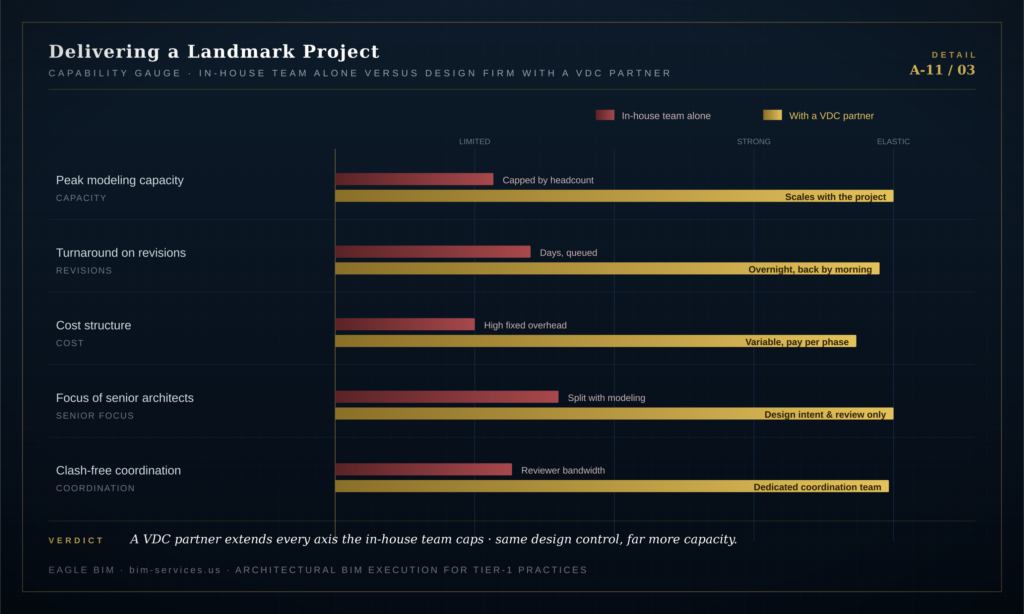
It is worth being clear-eyed about the trade-offs of architectural BIM outsourcing too. A partnership only works with strong communication, a shared common data environment, and a BIM execution plan that both sides actually follow. Hand a partner a vague brief and you will get vague output. The firms that get the most from this model treat their VDC partner as an extension of the studio, with daily coordination and clear ownership of the model. We compare the full picture in our analysis of
in-house versus outsourced BIM, which is worth reading before you commit either way.
How Eagle BIM Helps You Operate Like the Top Architectural Firms Using BIM
| Eagle BIM serves as the VDC execution partner for design firms and owners across the USA. We provide large-scale Revit coordination, clash detection, complex-geometry modeling, and full architectural documentation under a project-specific BIM execution plan, the same production discipline that defines the top architectural firms using BIM. |
That production discipline, the engineering effort behind landmark buildings, is exactly the work Eagle BIM is built to support. We do not compete with design firms. We make them faster. Operating in association with BIMPRO LLC out of Pflugerville, Texas, Eagle BIM functions as the model-production arm that lets a practice take on more landmark project engineering without expanding fixed payroll.
Our architectural BIM teams build coordinated Revit models to defined levels of development, manage large-scale Revit coordination across linked discipline models, and run documented clash detection cycles so issues are resolved in the model rather than on site. For practices working with complex forms, we take Rhino and Grasshopper geometry into parametric Revit through Dynamo, preserving the design intent while making the model coordinatable and schedulable. This is the capability that lets the top architectural firms using BIM deliver sculptural architecture on institutional deadlines, and it is available to you as a service.
We work across the sectors where coordination tolerances are tightest, such as healthcare, multifamily, data centers, and semiconductor fabs, and across Texas markets including Houston, Dallas-Fort Worth, Austin, and San Antonio, as well as the broader USA. Whether you need surge capacity for a single landmark project or a standing architectural BIM outsourcing relationship, Eagle BIM scales to fit. The result is the production capability of a top architectural firm using BIM, available without the overhead of building it in-house.
What sets the engagement apart is how we start. Before a single model element is placed, we align on a BIM execution plan that defines level-of-development targets, file structure, naming, the coordinate system, and the clash detection cadence. That document becomes the contract for quality. From there, our teams work inside your common data environment so there is one model, one source of truth, and no version confusion. You see progress daily, not at milestone reveals. If you are weighing whether to build this capability internally or partner for it, our breakdown of
what BIM coordination actually costs lays out the economics honestly, so the choice is made on numbers rather than instinct. The firms that scale the fastest are not the ones with the biggest in-house departments. They are the ones who learned to flex production through a trusted partner, exactly as the top architectural firms using BIM already do.
| Bring tier-1 BIM production to your next landmark project
Eagle BIM delivers large-scale Revit coordination, clash detection, and complex-geometry modeling as a VDC partner to design firms and owners across the USA. Tell us about your project and we will scope a plan. |
Step back from the individual names and a pattern becomes obvious. The top architectural firms using BIM are not united by a style, a city, or a sector. Gensler, Foster + Partners, Zaha Hadid Architects, HKS, and Corgan could not be more different in what they design. They are united by how they produce: computational design feeding a disciplined Revit model, geometry moving cleanly through Dynamo, coordination managed as a tracked process, and production capacity that scales to meet the project rather than capping the project at the team’s size. That operating model is learnable and, crucially, it is partnerable.
For a design firm deciding how to compete in 2026, the takeaway is encouraging. You do not need to become the size of Gensler to operate with the same rigor. You need a clear BIM execution plan, the willingness to handle complex geometry as data rather than decoration, and a tier-1 VDC partner who can absorb large-scale Revit coordination on demand. Put those three things together and a mid-sized studio can pursue landmark project engineering that would otherwise be out of reach, winning work against larger competitors precisely because its production is more elastic and its coordination more disciplined. That is the real lesson behind the league table, and it is available to any firm ready to act on it.
Frequently Asked Questions
Who are the top architectural firms using BIM in 2026?
By public revenue rankings such as Architectural Record’s Top 300 and Building Design+Construction’s Giants 400, the leading US practices include Gensler, Perkins&Will, HKS, HOK, Corgan, Populous, SOM, and NBBJ, alongside globally influential firms like Foster + Partners and Zaha Hadid Architects. All of them rely on mature, large-scale Revit coordination workflows to deliver landmark projects.
Do large architecture firms outsource their BIM modeling?
Many do, in part. Even the top architectural firms using BIM keep design and senior coordination in-house while using architectural BIM outsourcing to absorb peak modeling demand, complex-geometry conversion, and documentation. This lets them flex capacity with the project pipeline instead of carrying fixed payroll for peak load that only arrives a few months a year.
What makes a BIM partner tier-1 rather than just a drafting vendor?
A tier-1 VDC partner offers surge capacity, fluency with a BIM execution plan and US standards like NBIMS-US and the BIMForum LOD Specification, the ability to take Rhino and Grasshopper geometry into parametric Revit through Dynamo, a documented clash detection cycle with a tracked issue log, secure handling of sensitive project data, and a time-zone offset that enables overnight turnaround.
How do firms move complex geometry from Rhino into Revit?
Through computational workflows. Geometry defined parametrically in Rhino and Grasshopper is translated into Revit using custom Dynamo scripts, so it arrives as intelligent, rule-based families rather than frozen mesh. Zaha Hadid Architects and Foster + Partners have both publicly described variations of this workflow for their signature forms.
What is large-scale Revit coordination on a landmark project?
It is the process of keeping many linked discipline models, including architectural, structural, and MEP plus specialist consultants, aligned in a single coordinate system and common data environment, then running scheduled clash detection to resolve conflicts before construction. Foster + Partners has described consolidating hundreds of BIM models and managing hundreds of thousands of clashes in Navisworks on a single major terminal.
Is architectural BIM outsourcing secure for sensitive projects?
It can be, with the right partner. For data centers, semiconductor fabs, and government work, a tier-1 VDC partner should operate under non-disclosure agreements, use secure model-exchange platforms, and follow defined access controls. Always confirm a partner’s data-security practices before sharing models for landmark project engineering.
How does a VDC partner help a firm meet tight deadlines?
Two ways. First, surge capacity lets a firm add qualified modelers quickly when several projects hit documentation phase at once. Second, a time-zone offset creates an overnight revision loop, where the partner advances the model while the design team is offline and returns it by morning, compressing the overall schedule.
Can a smaller firm work like the top architectural firms using BIM?
Yes. The leaders’ advantage is workflow discipline, not just size: a clear BIM execution plan, standardized content, computational geometry handling, and scheduled coordination. A smaller practice can adopt the same discipline and reach the same production capability by partnering with a tier-1 VDC team rather than building a large department in-house.